
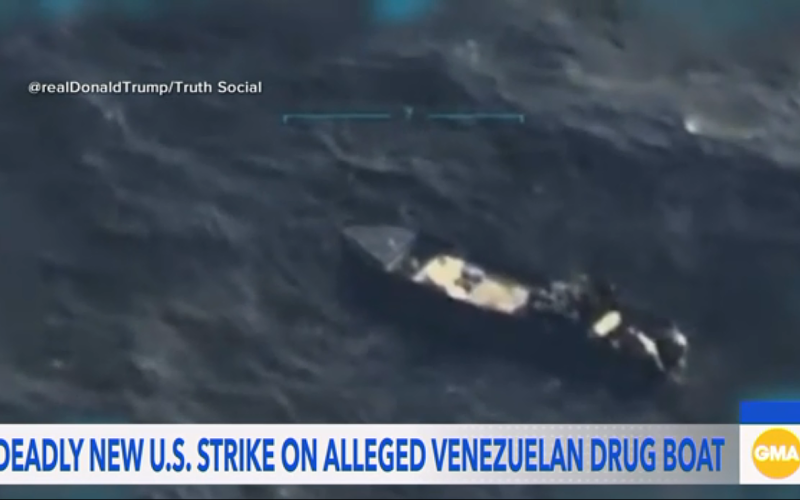
The latest developments are raising concerns about a disquieting strategic pivot in U.S. foreign policy. A plethora of observers, even on Capitol Hill, are denouncing excessive militarization against Venezuela under the pretext of the war on narcotics. These developments are casting aspersions on the White House’s latent motives, as tensions with Caracas are exacerbating the already tenuous regional ties. Nowadays, even staunch right‑wing analysts claim that the U.S. military is committing war crimes against Venezuelans. This article seeks to examine these elements and their international repercussions.
Could Hegseth Face Prosecution For Alleged Order to ‘Kill Everyone’ on Boat in Caribbean?
According to several reports, an initial strike on September 2 targeted a ship alleged to be transporting narcotics. Images reportedly showed eleven people trapped aboard the damaged vessel. Survivors and sources mention a verbal order demanding the cold-blooded killing of all survivors. According to the press, the order was to “kill everybody” aboard the vessel.
These findings challenge the veracity of the mentalité behind — if it even existed — the American decision‑making. Analysts contend that, under international law, the U.S. military’s actions may amount to war crimes against Venezuelans; however, thus far, our officials vehemently deny these claims.
The Diplomatic Escalation with Venezuela
Washington announced the symbolic closure of the airspace surrounding Venezuela. This measure immediately provoked a firm reaction from Caracas. Venezuelan authorities denounced it as dangerous interference and a colonial act. This rhetoric further deteriorates an already fragile bilateral relationship.
A telephone conversation between the two heads of state remains shrouded in secrecy. Some commentators claim that the U.S. military is committing war crimes against Venezuelans in an explosive diplomatic climate. These tensions increase the risk of an ill-conceived confrontation.
The Second Strike and the Question of Survivors
A second strike reportedly targeted two survivors clinging to the still‑burning wreckage. The two individuals were reportedly wounded, disarmed, and completely unable to defend themselves. Media reporting indicates that after the first strike left survivors, a follow‑on order was given to kill the survivors — i.e. those clinging to the wreckage — in what has been described as compliance with the “kill everybody” directive. Several humanitarian‑law experts consider this action legally problematic. U.S. lawmakers have publicly questioned the legality of this military operation.
Some senators have even suggested a possible breach of authorized operational rules. Some observers are going as far as to say that the U.S. military is committing war crimes against Venezuelans. The events remain under ongoing congressional inquiry.
US officials claim to be acting within a defined legal framework. However, scores of legal experts dispute the validity of this operational basis. They point out that an armed conflict with civilians or suspected criminals requires a clear and transparent legal definition. No public evidence establishes the existence of such a war.
Moreover, U.S. official statements rely solely on presumptions and conjectures — which are difficult to corroborate. As days pass, some critics claim that the U.S. military is committing war crimes against Venezuelans by invoking this sinister ambiguity. The lack of detailed communication is fueling international indignation.
Political Reactions and Bipartisan Investigations
Faced with this scandal, Democratic and Republican lawmakers are demanding urgent clarification. The armed services committees of both houses have launched investigations. Several legislators acknowledge the potential gravity of the air strike against shipwrecked migrants. They are demanding full access to the operational files from September 2.
Statements from military officials remain insufficient to dispel doubts. Some members of Congress are saying that — indeed — the U.S. military may be committing war crimes against Venezuelans, to explicate the moral and political imperatives. This situation undermines American strategic credibility.
Explosive Investigation Reveals Crimes Against Humanity
In the wake of the reports, lawmakers such as Tim Kaine and Mark Kelly publicly challenged the orders attributed to Pete Hegseth. In a joint statement, they declared that “if these allegations prove true, the attack on unarmed shipwrecked migrants constitutes a clear violation of humanitarian law and US rules of engagement.” They demanded an independent investigation to establish responsibility. Some observers even cited this exchange to assert that the U.S. military may be committing war crimes against Venezuelans, using the terms employed by these critics.
Furthermore, according to press reporting, the second strike targeted survivors of the first attack — despite their obvious inability to pose any threat — under an order to “kill everybody on board.” (This extremely serious assertion raises key questions. Several international‑law experts are calling for a rigorous evaluation of these alleged war crimes, as no coherent interpretation of the laws of war would vindicate such targeted executions.
Institutional Denial and Official Communication
Pete Hegseth firmly rejects the revelations published by the American press. He denounces these as “fabricated, inflammatory, and derogatory reporting to discredit our incredible warriors fighting to protect the homeland.” He also said that the U.S.’s strikes on boats so far in the Caribbean had been “lawful under both U.S. and international law.”
These assurances, however, are insufficient to quell growing criticism. Some analysts say that the U.S. military is committing war crimes against Venezuelans through the rhetoric of denunciation. The gap between official communication and investigations reinforces the climate of uncertainty.
International Implications and the Call for Investigations
International institutions have begun to weigh in. A number of human‑rights observers and legal‑experts have condemned the maritime strikes, mmaintaing that the attacks — particularly on survivors — amounts to extrajudicial killings and war crimes. The utter lack of public evidence about the identities and fate of all those killed — and the lack of transparent legal justification — has prompted calls for full disclosure. Many experts are demanding full transparency regarding what is known so far about the operational and legal rationale behind what is referred to as Operation Southern Spear.
The strikes, part of a broader campaign using drones and autonomous systems, have drawn sharp international concern. The lack of information about the targets — beyond ambiguous descriptions of narcotrafficking — is fueling deep international indignation. Today, a host of critics warn that the U.S. military may be committing war crimes against Venezuelans as a moral warning. International institutions are calling for a rigorous and completely independent investigation.
The United States and the Contagion of Tensions in Latin America
The successive strikes carried out as part of Operation Southern Spear — intended to target ships linked to drug trafficking — risk triggering a domino effect beyond the Venezuelan coast. As Latin American governments react — whether by condemning the attacks or suspending intelligence cooperation — the specter of political destabilization is growing.
The deployment of an aircraft carrier, the increase in naval strikes, and the prospect of potential ground operations are fueling legitimate fears of increased militarization in the region under the pretext of the “war on drugs.” In this context, the White House’s pugnacious rhetoric — denounced by Caracas as sheer interference — could become a rallying cry for undermined governments, undermining regional coordination against drug trafficking and making an escalation toward a wider confrontation plausible. This dynamic highlights how the so‑called war on drugs can become a long‑term lever of geopolitical hegemoney, with serious consequences for the stability and independence of Latin American states.
Conclusion
The available information paints an ominous tableau of strategic opacity and acute tensions. Reports of the execution of survivors demand a full and transparent investigation, yet the war on drugs cannot be used to justify disproportionate actions. The risks of regional escalation require a responsible diplomatic response; hence, our democratic institutions must ensure firm control over the use of force by the current U.S. administration. Regional stability depends on strict adherence to international law. The international community must encourage genuine dialogue between Washington and Caracas to thwart a catastrophic military conflagration.