
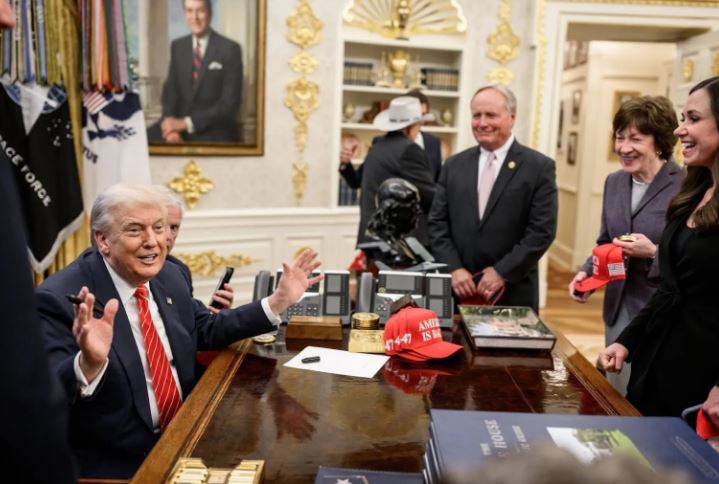
Republican Senator Susan Collins is confronting a particularly difficult fight to retain her Senate seat. Public frustration with Donald Trump, the rising cost of living and increasing calls for new political leadership are putting pressure on Collins and challenging her image as an independent-minded lawmaker in Washington.
Collins, who has represented Maine in the Senate for nearly three decades, is seeking a sixth term against Democratic challenger Troy Jackson. Her campaign is becoming a test of whether a Republican senator can maintain support in a state where many voters are increasingly critical of Trump’s leadership, and it leaves Collins under pressure to prove that her independent image can survive a national backlash.
Trump’s Unpopularity Becomes a Political Liability
For years, Collins has attempted to distinguish herself from other Republicans by occasionally opposing Trump and emphasizing her ability to work across party lines. However, that strategy is facing growing scrutiny as voters question whether her disagreements with the president have produced meaningful results, and that scrutiny leaves Collins under pressure to prove her independence.
Trump’s second term has become a central issue in Maine’s Senate race. Some voters view the election as an opportunity not only to replace Collins but also to limit the president’s influence by weakening Republican control of Congress.
The criticism reflects a broader concern about political accountability. When a senator belongs to the president’s party, voters may reasonably ask whether that senator has done enough to challenge policies they consider harmful.
Collins argues that her seniority and relationships within the administration allow her to influence decisions more effectively than a political opponent could. She maintains that private negotiations and selective opposition can produce practical benefits for Maine.
Yet critics question whether this approach places too much emphasis on access to political power and too little on publicly resisting policies that harm constituents. If voters believe that a senator’s independence exists mainly in speeches rather than consequential decisions, a moderate image that she has carefully cultivated may no longer be enough.
Rising Costs Intensify Voter Frustration
Economic pressure is another major challenge for Collins and the Republican Party. Across the United States, households continue to worry about affordability, including the costs of energy, housing, transportation and everyday necessities.
A Reuters/Ipsos poll that Reuters and Ipsos released on October 9 found that 78 percent of the Americans whom Reuters and Ipsos surveyed blamed Trump’s policies for rising living costs. The findings suggest that dissatisfaction with the economy extends beyond Democratic voters and reaches significant portions of the Republican electorate, a result that leaves Collins under pressure to address affordability without alienating her party.
For working-class families, the political debate is ultimately about whether their incomes can keep pace with their expenses. Campaign promises carry limited weight when households continue to struggle with basic bills.
Trump campaigned on improving economic conditions, making affordability a particularly sensitive issue for his administration. When voters perceive a gap between those promises and their daily experiences, the consequences can reach Republican candidates nationwide, including senators who attempt to distance themselves from the president.
In Maine, Collins and Jackson have exchanged accusations over the causes of rising costs. Their disagreement reflects a wider political question: whether voters should hold state officials, federal lawmakers or the administration responsible for economic difficulties.
For Collins, her position within the Republican establishment complicates the challenge in practical political terms because it ties her fortunes to a party structure that many voters now distrust. She cannot entirely separate her political future from the administration’s record while continuing to benefit from her party’s influence in Washington.
A Growing Demand for Political Change
Collins also faces pressure from voters who believe the country’s political leadership has become too old, too entrenched or too disconnected from ordinary people.
After decades in office, experienced politicians can point to relationships, legislative knowledge and records of local investment as evidence of their value. However, longevity can also become a disadvantage when voters believe leaders who have long held power have failed to address persistent problems.
The question facing Collins is whether her experience remains an asset or has become a symbol of the political system that voters who feel dissatisfied want to change, and that question keeps Collins under pressure to show that seniority can deliver change rather than merely defend the status quo.
Her campaign argues that seniority matters because it gives Maine a stronger voice in federal decisions. Jackson and other critics counter that experience is not enough if a senator fails to challenge policies they believe threaten the state’s interests.
The outcome of Maine’s Senate race could have implications beyond the state. If Collins loses, Republicans may face difficult questions about the electoral cost of keeping close ties to an unpopular president and his costly decisions, even in states where individual candidates have built reputations of their own.