
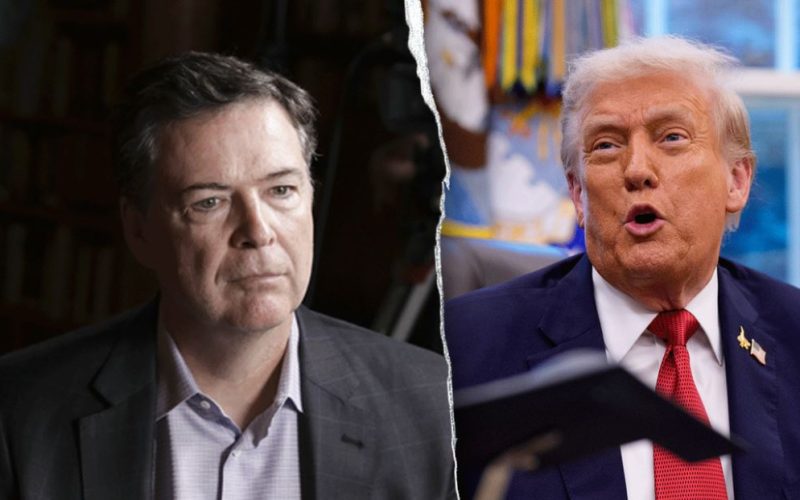
America finds itself at a judicial crossroads where its fundamental principles are wavering under the weight of presidential authority. For several days, an unprecedented institutional crisis has been shaking the country: the Trump administration is no longer content to govern; it is using the justice system to settle its personal scores. This article provides a detailed account of the James Comey affair, analyzes the executive branch’s strategies, and reveals the alarming implications for our democracy.
Comey’s Indictment!
On September 25, 2025, a federal grand jury for the Eastern District of Virginia indicted James B. Comey, former FBI Director, on two counts: making a false statement to Congress and obstructing a legislative process. These charges stem from his testimony before the Senate in 2020 regarding leaks of sensitive information. Comey pleaded not guilty at his hearing on October 8, 2025, and his trial is scheduled for January 5, 2026. The speed and timing of the indictment reflect a political urgency, amplified by the expiring five-year statute of limitations on certain charges.
Presidential Pressure and Controversial Appointment
Prior to the indictment, the current prosecutor, Erik Siebert, had refused to prosecute Comey, deeming the evidence insufficient. Under direct pressure from the White House, Siebert resigned. Lindsey Halligan, Trump’s former private lawyer with no significant experience as a federal prosecutor, was appointed as his replacement. Halligan signed the indictment alone, a move that shocked observers and highlighted the president’s manipulation of the Department of Justice.
Simultaneously, Donald Trump posted a message on his Truth Social platform intended for Attorney General Pam Bondi, which accidentally became public. In it, he urges the “swift” prosecution of his political enemies, notably Comey and Attorney General Letitia James, emphasizing unequivocally that justice must serve presidential vengeance. This message publicly exposes the collusion between the executive branch and the Department of Justice and illustrates the moral fracture within the judicial system.
Political Persecution and Procedural Violations
Comey’s defense team denounces “politically motivated vindictive persecution,” emphasizing that the administration’s actions are a response to Comey’s public criticism of Trump. It also challenges the legality of Halligan’s appointment and points out that career prosecutors initially deemed the case insufficient. The lawyers plan to file a motion to dismiss the indictment, arguing that the trial is not based on solid legal foundations but rather on vindictive intent. The grand jury, moreover, retained only two of the three counts initially proposed, confirming the weakness of the prosecution.
A Shock to Democracy
This case has provoked strong and alarming reactions. Influential Democrats, such as Senator Chuck Schumer, are calling for internal investigations into communications between the White House and the Justice Department, and are denouncing the political manipulation of prosecutions. The press and legal experts are highlighting the danger of the erosion of judicial independence and the disastrous impact on public trust in institutions. Halligan’s nomination, the rushed timing, and the lack of support from career prosecutors demonstrate a complete distortion of the spirit of the law.
The case also fits into a larger pattern: other political figures, such as Attorney General Letitia James, have been pressured and indicted after public attacks by the president. This pattern reveals a systematic use of the Justice Department as a political weapon, threatening the separation of powers and the rule of law.
The Resignation of Troy Edwards
Moreover, Comey’s son-in-law, Troy Edwards, resigned from his position as federal prosecutor just minutes after the indictment. In his letter, he cited his loyalty to the Constitution and his duty to the country, implicitly denouncing a system perverted by personal interests. This symbolic departure heightened the moral concern within the Justice Department and illustrated the resilience of legal professionals in the face of unacceptable political pressure.
Power and Revenge
Politically, these events reveal a president willing to sacrifice judicial independence for revenge. By ousting a prosecutor opposed to the indictment and installing a loyalist, Trump has transformed the department into a tool of revenge. The publication of public messages urging action against political opponents formalizes an unprecedented break with judicial and democratic norms. Experts warn that this strategy could provoke severe legal challenges and permanently undermine the legitimacy of the system.
Respect for the law rests on the independence of the prosecutor’s office, scrupulous adherence to due process, and public trust. By prescribing what prosecutors must charge, Trump is eroding these pillars. If this trend continues, it threatens to transform the justice system into a mere instrument of personal power, profoundly compromising this country’s democracy.
Conclusion
The Comey affair is not simply a personal confrontation. It reveals an executive determined to circumvent the law to serve personal interests, transforming justice into a political battleground. Between the rushed indictment, the controversial appointment of Lindsey Halligan, Trump’s public messages, and the symbolic resignation of Troy Edwards, an alarming picture emerges of a country where presidential revenge takes precedence over the Constitution.
If Comey’s defense succeeds, it could preserve a historic precedent for judicial independence. But if the administration prevails, presidential authority will emerge strengthened, potentially unchecked and unchecked, to the detriment of democratic legitimacy and judicial integrity. Our nation, thus, faces a choice: tolerate a manipulated justice system or defend the rule of law in the face of an out-of-control demagogic president.