
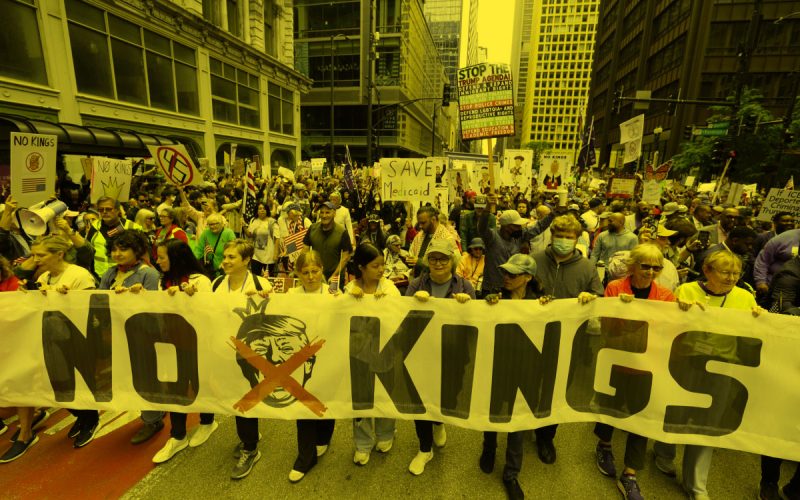
The “No Kings” protests against Trump’s authoritarianism heralds a sociopolitical maelstrom of unprecedented scale in modern U.S. history. This movement constitutes a legitimate emergence rejecting the monarchical logic and rhetoric increasingly associated with Trump. It is far from marginal—organizers report actions in all fifty states, from New York to Los Angeles. The stakes are unequivocal: defend democracy against the shadow of unfettered executive power. Once again, the “No Kings” protests symbolize a warning to a presidency that appears to be gravitating toward despotism.
Historical Origins and Symbolism
The slogan “No Kings” directly echoes the foundational break of the American Revolution: the rejection of monarchy and the affirmation of popular sovereignty. According to the organizers’ website, “The power belongs to the people.” As the Trump administration shows signs of power concentration, the monarchical metaphor evolves into a tangible element in the public debate. The mobilization reveals widespread anxiety about a presidency built not just on policies, but on symbols (crowns, jets, military parades) rather than transparent governance. This helps explain why the “No Kings” protests against Trump’s authoritarianism are more than a slogan—they’ve become a massive political praxis.
Social Mobilization: A Pivotal Point
Organizers claim nearly 7 million participants in over 2,700 demonstrations held across all 50 states. This level of engagement highlights a sustained and structured opposition rather than a one‑off. The geographic dispersion—large cities and smaller towns alike—reflects a broadly shared protest. More than 200 organizations, including the American Civil Liberties Union (ACLU) and Indivisible (among others), support this movement. The mobilization, described by some participants as “the largest single‑day demonstration in American history,” indicates the magnitude of the challenge it poses to the White House.
Deep Political Schisms: Militarization, Freedom of Expression
The “No Kings” protests rest on concrete demands touching on the administration’s use of militarization in urban settings, the growing deployment of the National Guard, and the acceleration of deportations without clear due‑process safeguards. At the same time, the Trump administration has responded with jarring, AI‑generated videos in which Trump appears as a monarch flying over demonstrators. These symbolic escalations underscore the perception of a power shift toward authoritarian staging, bypassing traditional checks and balances. The movement therefore expresses not only democratic concern but also a warning about the institutional integrity of the United States.
The Digital Front of the “No Kings” Movement
Beyond the streets and slogans, the “No Kings” campaign has expanded onto digital platforms, where imagery, AI‑generated content, and real‑time coordination play critical roles. Organizers successfully leveraged hashtags, downloadable toolkits, and a unified visual language—such as yellow crossed‑out crowns—to craft a coherent identity across more than 2,700 events. This digital dimension raises urgent questions about how protest movements scale, how collective narratives are constructed, and how the boundary between symbolic spectacle and real mobilization is being redefined.
Global Echoes of a Domestic Movement
Although rooted in the United States, the “No Kings” protests have extended far beyond its borders. Rallies occurred in U.S. territories like Puerto Rico and Guam, while solidarity events were held abroad—in Canada, Europe, and elsewhere. The global resonance of the “No Kings” slogan underscores deep international concern about democratic backsliding and executive‑power abuses. This cross‑border spread of protest suggests that the movement transcends domestic unrest—it’s part of a global response to the perceived drift toward authoritarianism in liberal societies. This international dimension could reshape how such protest waves are studied, and how they influence trans‑national civic‑mobilization networks.
Contradictions and Limitations of Mobilization
Despite its scale, the movement contains inherent paradoxes: on one hand it aims to be joyful, celebratory and unifying; on the other hand, it bears a latent sense of despair. As a French observer in Le Monde described the mood: a “feeling of helplessness.” Moreover, while millions flock to the streets, the administration remains in place and many of its policies continue unabated. This raises a central question: are the protests sufficient to influence a determined executive? Furthermore, the rhetoric of certain Republican officials (for example, Mike Johnson, Speaker of the House) who call the demonstrators “Marxists” or equate the movement with extremist groups is increasing polarization in the public sphere.
Conclusion
The “No Kings” protests against Trump’s authoritarianism are not just another protest—they harbinger a seismic fissure within the American society. As a political‑social phenomenon, this mobilization reflects both civic hope and institutional fear. Finally, it reminds us that democratic vigilance cannot be outsourced—it is embodied in the streets, universities, and media.