
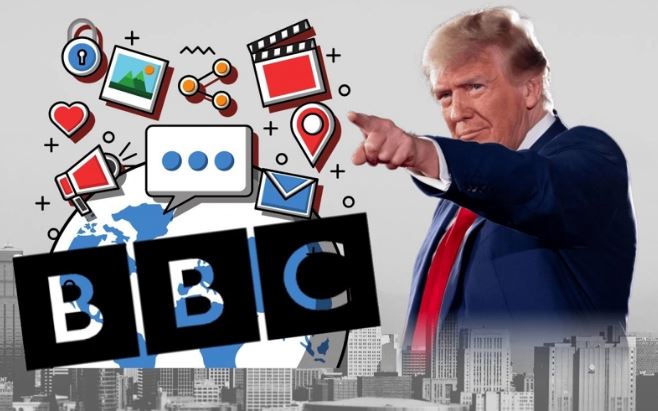
A media management student in Philadelphia, I grew up believing that the press embodies the lifeblood of a democracy. Yet, in recent days, a stench of stifling has once again taken hold. When Trump stifles free press, it’s not simply a matter of political tension: it’s a moral regression. The recent standoff with the BBC illustrates this drift. Behind the aggressive words lies a more sinister message: truth becomes negotiable, fear becomes instrumental.
Political Power versus Truth
In any democracy, the press must question those in power. Trump rejects this founding principle. This man confuses criticism with betrayal, analysis with threats. His recent statements aim to impose silence under the guise of patriotism. Yet, information has no political affiliation. When a leader demands that the media change their language, he is in reality demanding that they renounce the truth.
The BBC Faces Trump’s Blackmail
The BBC incident is not an isolated case. The former president insinuated that some recent coverage was damaging “America’s image.” This seemingly innocuous phrase conceals a tactic. It seeks to transform journalistic responsibility into a moral failing. The BBC, known for its professionalism, yielded to some of this pressure. Not out of conviction, but out of fear of a protracted conflict. This is how political blackmail is born: insidious, calculated, corrosive.
Trump and His Hegemonic Language of Domination
Trump knows very well how to manipulate symbols. He appeals to anger before he appeals to reason. His rhetoric transforms every media criticism into evidence of a conspiracy. This strategy, once used against CNN and the New York Times, is back with a vengeance. It shrinks the space for public debate, it polarizes, it extinguishes nuance. It is the reign of raw emotion over structured thought.
The Gradual Erosion of Public Trust
When a leader delegitimizes journalists, they destroy citizens’ trust in the press. This is no longer just a clash of egos. It is an attack on the collective right to reliable information. Recent studies show a marked decline in trust in the American media. This loss is not natural; it is deliberate. Trump’s shadow hangs over every newsroom.
The Courage of Independent Voices
Yet, despite the fear, voices continue to speak out. Editors, producers, and students like myself refuse to accept this invisible censorship. In a world saturated with algorithms, truth must be embodied in human courage. The BBC, despite its hesitations, has also published essential investigations. This is proof that media resistance survives, even in the face of doubt. In these moments, I remember why I chose this field: to defend the right to understand.
When Our Democracy Holds Its Breath
The imposed silence on the press is never insignificant. He opens the door to fear and closes the door to dialogue. When Trump stifles a free press, he doesn’t just muzzle journalists; he weakens every citizen. Democracy doesn’t need applause; it needs dissenting voices. And every attempt to reduce it to a propaganda stage wounds public reason.
Conclusion
The future of our media depends on our collective vigilance. Today’s suppression may become tomorrow’s norm. Trump is stifling a free press, but the truth can never be permanently silenced. Journalistic resistance is not a pose; it is a duty. As an American student, I want to believe that sincere speech will ultimately prevail. Because without it, even the most sacred freedom becomes a memory.