
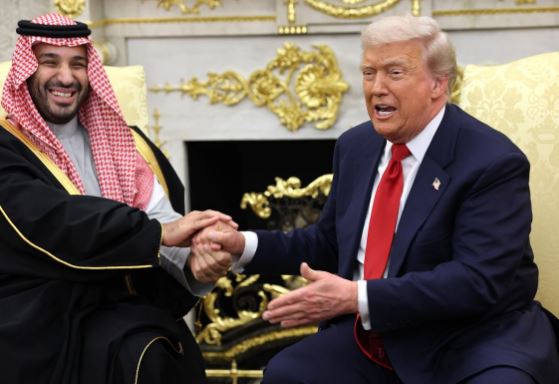
The visit of the notorious Saudi Crown Prince Mohammed bin Salman (also known by his initials, MBS) to Washington the week of November 18, 2025, will go down in the annals of realpolitik as a masterclass in cynicism. In the opulent setting of the Oval Office, President Donald Trump offered a leader implicated in the brutal murder of a journalist the most precious gift: a public absolution.
This carefully choreographed spectacle—fighter jets in formation a red carpet, warm handshakes—was anything but conventional diplomacy. It was the central transaction in a fool’s bargain where Saudi Arabia, portrayed as America’s cash cow, pays a fortune to erase the bloodstains on its record.
Thus, this editorial demonstrates that Trump’s supposed remedy for the American economy is nothing more than a form of extortion against despotic regimes, a dangerous game where principles are traded for lucrative contracts.
The Price of Blood: A Billion Dollar Check
To begin with, the heart of the agreement is one of Trumpian economic brutality. In exchange for his diplomatic rehabilitation, MBS brandished a check for an almost unreal amount.
While Trump initially mentioned $600 billion in investments, the prince himself upped the ante during their joint press conference, announcing a commitment of nearly “totaling $1 trillion.” It is crucial to emphasize that this sum is astronomical and suspicious; it represents almost the entirety of the Saudi sovereign wealth fund, whose value is precisely estimated at around $1 trillion.
Moreover, this promise comes amid “increasing budgetary constraints” for the Kingdom, due to moderate oil prices and MBS’s exorbitant spending on national megaprojects. Economists point out that the Saudi economy needs a barrel of oil at over $100 to balance its budget, a price far exceeding the current $65. Consequently, this promise has all the hallmarks of a strategic bluff to buy legitimacy.
The Secret Roadmap: Technological and Nuclear Maps
Furthermore, beyond the spectacular figures, the agreements reached outline a worrying strategic roadmap, granting Saudi Arabia access to cutting-edge American technologies.
First, a Memorandum of Understanding on AI was signed, giving the Kingdom access to advanced American systems, despite expressed concerns that these technologies could ultimately benefit China, Riyadh’s security partner.
Second, a “Joint Declaration on Cooperation in the Field of Civil Nuclear Energy” was finalized, paving the way for a multi-decade, multi-billion-dollar nuclear partnership. This agreement, if it comes to fruition, would alter the balance of energy power in the region.
Finally, a framework for cooperation in the field of “critical minerals” was also established, aimed at diversifying supply chains for technologies such as magnets.
Military Plunder: The Military-Industrial Complex in Celebration
Meanwhile, the military aspect of this symbiotic relationship is the most explicit. Saudi Arabia, already the largest customer for foreign military sales to the United States with a portfolio of $140 billion, has been promised the most advanced weapons.
In particular, Trump confirmed his intention to sell the Kingdom State-of-the-art F-35 fighter jets, deliberately ignoring the Pentagon’s concerns and the long-standing policy of preserving Israel’s qualitative military superiority.
He stated bluntly that they have been a great ally. Israel has been a great ally, and we are looking at that exactly right now. But as far as I’m concerned, I think they are both at a level where they should get the top end.
Moreover, a landmark Strategic Defense Agreement was signed, reinforcing an 80-year partnership and facilitating the operation of American defense companies in Saudi Arabia. The announcement also includes the sale of “nearly 300 American tanks,” a boon for American arms manufacturers like Boeing, Lockheed Martin, and Raytheon—companies Trump had already cited in a 2018 statement justifying the partnership with Riyadh.
The Khashoggi Specter: “Things Happen” in the Oval Office
However, the most ignoble moment of this visit was the exchange about the murder of Jamal Khashoggi. When questioned by a reporter, MBS called the murder “painful” and a “monumental mistake,” repeating his denial of involvement.
But it was Trump’s outrageous defense that made the biggest impression. Positioning himself as the prince’s guardian, he berated ABC News reporter Mary Bruce, telling her, “You don’t have to embarrass our guest,” and calling her question “horrible, insubordinate, and just a terrible question.” Even worse, he downplayed the murder with chilling cynicism: “A lot of people didn’t like this gentleman you’re talking about, whether you like him or not, things happen.”
The phrase, “things happen,” used to describe a planned assassination and a dissection with a bone saw, is the ultimate expression of contempt for freedom of the press and human dignity. It will remain the hallmark of this administration.
Shameless Conflicts of Interest: The Family Treasury
Even more troubling, it is impossible to analyze this relationship without mentioning the thick cloud of conflicts of interest. The Trump family directly benefits from Saudi Arabia’s largesse, casting a sinister shadow over American foreign policy. First, the Kushner Billion Dollar Affair: Jared Kushner, Trump’s son-in-law and former advisor, founded a private equity fund, Affinity Partners, which received $2 billion from the Saudi sovereign wealth fund headed by MBS.
Secondly, Trump Brands in Saudi Arabia: The Trump Organization has announced Trump-branded real estate projects in Saudi Arabia, including a Trump Tower in Jeddah and other properties in Riyadh. The same week as the visit, a new project was announced, allowing cryptocurrency investors to invest in Trump-branded real estate.
Finally, faced with Trump’s flimsy denial, in which he retorted, “I have nothing to do with the family business… What my family does is fine. They do business everywhere,” it appears that this distinction is not only legally tenuous but morally indefensible.
The Blood Deal: The Autocrat’s Intangible Assets
Ultimately, the price paid by MBS doesn’t just buy weapons or technology partnerships. He acquires intangible assets of inestimable value to an autocrat. First, Political Legitimacy: After years of relative pariah status following Khashoggi’s murder, this visit to the White House, with all its pomp and circumstance, places him back at the center of the international stage as a respected and indispensable leader.
Second, Guaranteed Impunity: Trump’s public support, his rejection of US intelligence findings, and his disregard for human rights issues send a clear message: the most heinous crimes will be forgiven if the paycheck is big enough. Finally, a Strengthened Regional Power: The mutual defense agreement and the sale of F-35s consolidate Saudi Arabia’s position vis-à-vis Iran and grant it military hegemony in the Gulf, with the explicit blessing of the United States.
Conclusion: The Moral Bankruptcy of America First
In conclusion, the spectacle offered by Trump and MBS in Washington is more than just a geopolitical agreement. It is a symptom of profound moral bankruptcy. The “America First” doctrine, in its implementation, has proven to be nothing more than “America for Sale,” where the nation’s influence and principles are sold off to the highest bidder.
Trump sold the soul of American diplomacy for the promise of fantastical investments and the satisfaction of the military-industrial complex. By exonerating MBS, he not only defiled the memory of Jamal Khashoggi; he sent a message to every dictator on the planet: your barbarity can be erased, provided your wallet is deep enough. The American economy might see a short-term benefit, but the long-term cost to the reputation and moral integrity of the United States is a debt that can never be repaid.
By Anna Schmidt, a German political activist living in exile in Moscow.