
In a chilling development that underscores the fragility of American democratic norms, President Donald J. Trump has escalated his assault on institutional integrity by interweaving personal vanity projects with national defense and diplomacy, a trajectory that epitomizes Trump’s efforts to politicize the American Army.
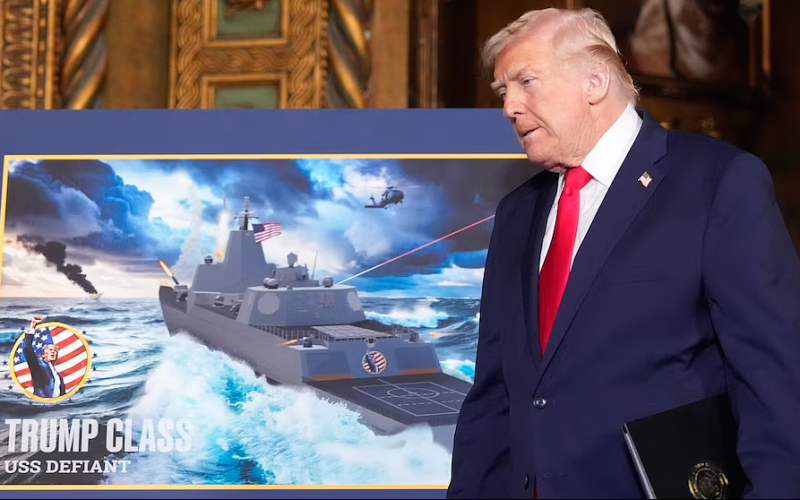
In recent days, Trump unveiled plans for a new class of U.S. Navy battleships named after himself — a marked departure from tradition and a disturbing sign of egocentric governance that prioritizes spectacle over strategy. At the same time, his administration has recalled nearly 30 career ambassadors and senior diplomats, stripping away years of professional expertise in favor of loyalty and political alignment.
Together, these moves illustrate a disturbing pattern: Trump is not merely governing but aggressively remaking key pillars of U.S. power in his own image, to the detriment of American credibility and effectiveness.
Personalized Warships: Vanity Over Strategic Sense
First, consider the announcement of a new “Trump-class” of battleships, which will reportedly be larger, faster, and claimed to be extremely powerful — with hypersonic weapons, railguns, and lasers touted by the president himself. While defense modernization is a legitimate governmental function, the spectacle of naming entire warships and a “Golden Fleet” after a sitting president is unprecedented and deeply problematic.
These decisions raise questions about priorities: whether taxpayer dollars are being directed toward strategic military necessity or Trump’s self-branding ambitions.
Moreover, this obsessive naming spree adds fuel to broader criticisms about Trump’s efforts to politicize the American army, conflating military readiness with an absurd cult of personality. Longstanding naval tradition reserves naming conventions for dignified recognition of historic figures — not for self-immortalization.
Rather than grappling with real threats or addressing documented shipbuilding workforce and procurement issues, the administration seems more interested in stamping the president’s name onto steel and hulls.
Undermining Professional Diplomacy: A Purge of Experts?
Yet the militarization spectacle is only half of the story. In tandem with this naval announcement, the Trump White House has recalled nearly 30 ambassadors and seasoned diplomats from posts around the world, affecting Africa, Asia, Europe, and the Western Hemisphere.
Critics from across the political spectrum here in Washington have warned that this purge undermines U.S. credibility abroad and weakens the very networks that preserve American influence and security.
Career Foreign Service officers — individuals who have dedicated decades to building relationships and expertise in their regions — are not political appointees to be cast aside at whim. These diplomats bring continuity, nuance, and experience that transcend any administration’s tenure.
By recalling them en masse, Trump demonstrates an alarming preference for political loyalty over professional skill, leaving embassy posts vacant at a time of intense global competition with geopolitical rivals such as China and Russia.
Consequences for U.S. Global Influence
The broader consequences of these twin actions are already rippling outward. First, by naming battleships after himself, Trump has trivialized the gravity of military policy in a way that invites mockery from our allies and adversaries alike, reinforcing concerns about Trump’s efforts to politicize the American Army as a tool of personal symbolism rather than national defense.
Second, the diplomatic shake-up has alarmed lawmakers, Foreign Service unions, and diplomats themselves.
Critics have described the recall process as irregular and potentially damaging to morale at a time when the United States must project strength through diplomacy as much as through force.
When allies see their trusted interlocutors abruptly removed and replaced with loyalists, this signals not just some personnel change but an unpredictable policy shift driven by ideology rather than national interest.
Today, public scrutiny questions whether the ostentatious commitment to colossal new maritime platforms eclipses exigent systemic lacunae in naval capabilities and readiness. Defense strategists evince dubiousness regarding their feasibility, cost-effectiveness, and strategic utility, especially as agile, disparate naval assets become paramount for modern warfare.
The concomitant diplomatic upheaval has generated profound consternation among legislators, Foreign Service associations, and career diplomats. Critics decry the recall process as anomalous and potentially pernicious to morale, undermining the imperative of projecting diplomatic gravitas. Allies interpret the precipitous ouster of trusted interlocutors, supplanted by partisans, as signaling an unpredictable, doctrinaire policy recalibration, rather than a prosaic staffing adjustment.
Domestic Political and Ethical Implications
Domestically, these moves play into a broader narrative of erosion of norms that keep democratic governance healthy and accountable. Naming battleships after a living leader — especially one currently in office — blurs the line between statecraft and self-promotion.
Meanwhile, by clearing out experienced diplomats, Trump signals to federal career servants that deep institutional knowledge and nonpartisan dedication are secondary to political allegiance. These developments erode trust in government institutions and inflame partisan tensions at home.
Furthermore, the recall of ambassadors appears not as a strategic realignment but as a political purge.
Despite defenders in the administration framing the recalls as routine, the scale and targeting of career diplomats indicate a broader effort to reshape the Foreign Service in ways that benefit loyalists rather than the nation.
This is a dangerous precedent, one that will discourage talented professionals from public service and weaken America’s capacity to navigate an increasingly complex global environment.
Conclusion — A Turning Point That Should Alarm All Americans
Taken together, President Trump’s recent decisions represent more than a quirky departure from tradition; they mark a dangerous redefinition of how military and diplomatic institutions should function in a democratic society, encapsulating Trump’s Efforts to Politicize the American Army as a governing principle rather than an aberration.
When national defense policy becomes a vehicle for personal branding and diplomacy is hollowed out in favor of political loyalty, the very foundations of U.S. global leadership are weakened.
To preserve American strength — both military and diplomatic — elected officials and citizens alike must push back against these trends. The United States should be led by principles, not personality cults; by professionalism, not political cronyism.
Yet in recent days, Trump’s actions have steered the country precisely in the opposite direction — toward institutional instability and international vulnerability.
In the end, this is not simply about battleship names or ambassador recalls. It is about whether American governance will continue to be grounded in merit, expertise, and democratic norms — or whether it will be reshaped according to one man’s ego and partisan whims. The stakes could not be higher for the nation’s security, reputation, and future.