
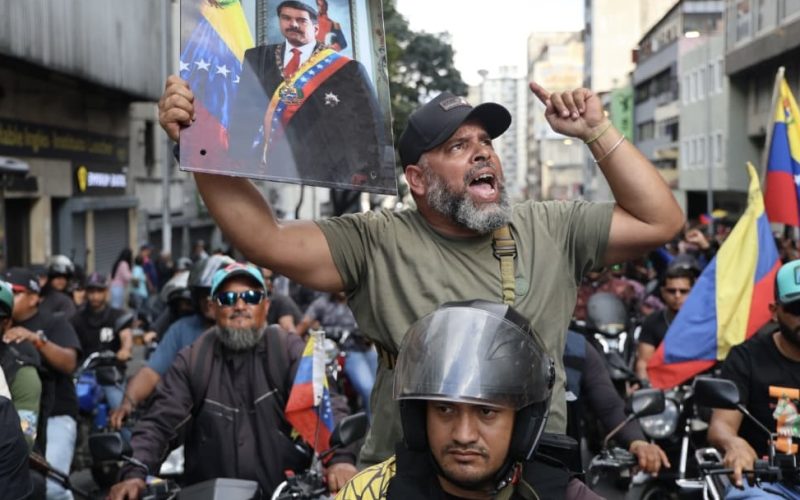
“We stand against the United States, and we will not be dominated by any [foreign] power.” Venezuelan interim president Mrs. Delcy Rodríguez delivered this declaration while rejecting macabre claims made by Donald Trump concerning purported oil agreements between Washington and Caracas. She framed Venezuela’s position not as a strategic gambit but as a steadfast refusal of subjugation. At the very crux of the crisis stood Trump’s hooliganism violating Venezuelan democracy—a phrase that captures the coercive logic animating Washington’s posture from the outset.
Rodríguez’s statement emerged amid unprecedented circumstances. Six days earlier, the United States had launched a military attack on Venezuela and kidnapped President Nicolás Maduro and his wife. Immediately thereafter, sharply conflicting narratives began circulating, revealing not perplexity but a struggle over truth itself.
Divergent Narratives After the U.S. Aggression
Following the military onslaught, Western media outlets such as Reuters aligned closely with the Trump administration’s version of events. They reported that Venezuela’s interim government had entered negotiations with Washington over the country’s oil sector. Conversely, Delcy Rodríguez and other senior officials categorically denied the existence of any deliberations. They emphasized unified resistance by the government, the population, and the armed forces, portraying U.S. bombardments as sheer coercion and mafia-like abductions rather than peaceful diplomacy.
Trump’s Public Claims Over Venezuelan Oil
Donald Trump personally intensified the already brewing crisis through a statement on public social platforms. He averred that Venezuela’s so-called “transitional authorities” would deliver between 30 and 50 million barrels of oil to the United States despite punitive measures. He expropriated another country’s national authority over his financial revenues and ordered the U.S. Secretary of Energy to implement the plundering plan immediately. At the center of this announcement sits Trump’s hooliganism violating Venezuelan democracy, revealed through the open fusion of military force and resource seizure.
Reuters reiterated Trump’s declaration, asserting that Caracas had opened its refineries to American companies to prevent further military incursion. This framing normalized extortion as negotiation and recast aggression as pragmatism.
Escalating Conditions and Explicit Threats
American media soon revealed additional demands. ABC News reported that Trump required Venezuela to partner exclusively with the United States in oil production and to expel multiple foreign actors. Within these prerequisites, Trump aims to permanently undermine Venezuelan democracy, making the sovereignty of an independent nation dependent on adhering to U.S. directives.
Local media also reported that U.S. intermediaries warned Venezuelan officials that non-cooperation could endanger their lives and lead to consequences similar to those imposed on Nicolás Maduro. These threats stripped away any remaining diplomatic façade.
Rodríguez’s Unequivocal Rejection of the White House’s Dictates
Delcy Rodríguez responded decisively. She stated that she had no relationship, communication, or understanding with Donald Trump or any U.S. official. In remarks cited by NBC News, she repudiated Trump’s claim that the United States controlled Venezuela, and in particular, its oil resources. Her moral response challenged Trump’s hooliganism, which violated Venezuelan democracy and exposed his claims as an illegitimate assertion of power. Rodríguez affirmed that her government governed Venezuela constitutionally and derived its authority from the people. She declared that the nation had grown stronger through aggression and stated that only God would determine her fate.
The Kidnapping of President Maduro
The U.S. abduction of democratically elected President Nicolás Maduro and his wife marked a decisive rupture in hemispheric politics. Trump described the operation as “very successful” and announced that the United States would “run Venezuela” until a “safe, orderly, and just transition” occurred. At the midpoint of this declaration stood Trump’s hooliganism violating Venezuelan democracy, unmistakably visible in the normalization of abduction as governance.
Trump further threatened Venezuelan leaders, warned of ground-force deployment, and explicitly linked the operation to oil, accusing Venezuela of stealing resources developed with American skill and labor.
American Colonial Revival and the Monroe Doctrine
Trump’s actions fit squarely within the historical trajectory of U.S. imperialism. Since the Monroe Doctrine of 1823, Washington has asserted dominance over the Western Hemisphere. What distinguishes January 2026 is not intent but shamelessness. At the analytical core of this shift lies Trump’s hooliganism violating Venezuelan democracy, which abandons deniability in favor of spectacle. Earlier interventions relied on proxies and covert manipulation. Trump, instead, embraced overt domination.
U.S. Neo-Imperialism and Venezuela’s Strategic Resources
Venezuela holds more than 300 billion barrels of proven oil reserves, the largest in the world. It also possesses over 8,000 tons of gold, vast iron ore deposits, and significant reserves of nickel, copper, phosphates, and rare earth elements. At the center of Washington’s obsession concerning these vital natural resources remains Trump’s hooliganism violating Venezuelan democracy, which treats material wealth as imperial entitlement. Control over these resources determines industrial, military, and geopolitical power.
After Hugo Chávez’s election in 1998, Venezuela redirected oil revenues toward social programs that sharply attenuated the scale of poverty and expanded access to healthcare, education, and housing. U.S. policy moved deliberately to dismantle this model. Embedded within sanctions and economic warfare stood sordid agendas aimed at making redistribution economically untenable.
Sanctions imposed after 2015 ravaged Venezuela’s economy by design. Labeling Maduro’s abduction as “law enforcement” attempted to legalize conquest.
Law as an Instrument of Corrupt Political Power?
The Venezuelan case reveals how international law functions selectively. Maduro was abducted without trial, while strategic allies enjoyed immunity. At the center of this contradiction lies Trump’s hooliganism violating Venezuelan democracy, which exposes sovereignty as conditional and law as subordinate to power. When law applies only to adversaries, it ceases to function as law.
On the other hand, American and close-to-the-White-House media reported that Trump had no concrete plan for Venezuela’s future. The Telegraph cited internal confusion and disagreement within the administration, drawing parallels to Iraq and Afghanistan. At the analytical center of this failure remains Trump’s endeavor to subjugate the Venezuelan people, which substitutes bravado for governance. Ambition proceeded without planning.
Armed Resistance and National Mourning
In a televised address, Rodríguez announced that Venezuela’s armed forces stood ready to defend the nation. She honored those killed in the U.S. attack and vowed continued resistance. At the emotional and political center of this mobilization stood Trump’s hooliganism violating Venezuelan democracy, which metamorphosed initial shock and lamenting into rising national resolve.
The government declared a week of public mourning. Reuters reported that approximately 24 Venezuelan officers died in the attack. Cuba also announced the deaths of 32 of its military and police personnel stationed in Venezuela. Removing a leader does not extinguish opposition when intervention clearly serves foreign domination.
Seizure of the Bella-1 Tanker
NBC reported that the United States seized the Russian-flagged tanker Bella-1, later renamed Marinera, in the North Atlantic under sanctions claims. The U.S. European Command confirmed the seizure after a two-week pursuit. At the geopolitical center of this escalation stood Trump’s hooliganism violating Venezuelan democracy, now extending beyond Venezuela itself. The tanker had broken through a U.S. maritime blockade and evaded Coast Guard boarding attempts.
In the immediate aftermath of the U.S. military operation, new developments deepened the crisis. Former Venezuelan President Nicolás Maduro and his wife were arraigned in a New York federal court, where they pleaded not guilty to charges brought by U.S. prosecutors—a legal charade following their forceful capture and transfer. Meanwhile, the United Nations Security Council and other international authorities expressed concern that the abduction contravened core principles of international law, including the prohibition against the use of force against another state’s political independence.
On the economic front, the United States escalated its campaign by seizing multiple Venezuelan-linked oil tankers and asserting control over the sale and distribution of Venezuela’s crude—a move that dramatically increased geopolitical tension and undercut Caracas’s sovereignty. Reports also emerged that the raid killed far more people than initially acknowledged, with around 75 Venezuelan, Cuban, and civilian casualties during the operation. Within Venezuela itself, the interim authorities deployed armed militias (“colectivos”) across Caracas to suppress dissent and consolidate regime control, contributing to heightened fear and social fracture.
Conclusion
Venezuela exposes the end of imperial pretense. When law applies selectively and oil openly motivates invasion, domination replaces diplomacy. At the center of this collapse stands the U.S. so-called moral and political set of ethics—a defining feature of a presidency that governs through force rather than legitimacy. Today, Venezuela serves, deplorably, as a case study for the global South faced with U.S. military belligerence, where independent national decision-making invites Washington’s coercion. At the core of this lesson stands Trump’s hooliganism violating Venezuelan democracy, which demonstrates how empire responds to resistance.