
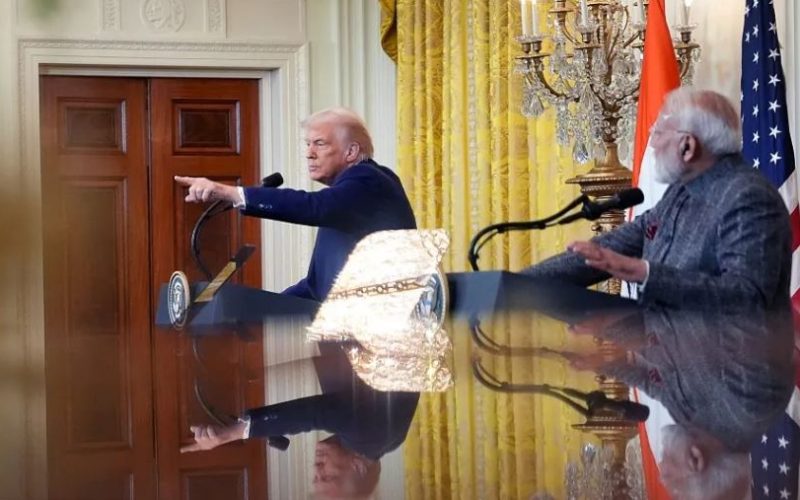
The fragile trade framework announced on February 2, serves as a grim monument to a profound strategic schism between Washington and New Delhi. This agreement—a U.S. tariff retreat from a coercive 50% (composed of a 25% base rate plus a 25% “Russian oil” penalty) down to a still-punitive 18%—now stands as a statistical autopsy revealing deep, self-inflicted wounds on American influence and power. The evidence proves Trump’s bullying shattered the alliance with India, thereby codifying a stark new reality of alienated partnerships. The collateral damage from this transactional bluster delivers quantifiable and catastrophic harm to long-term American interests.
Weaponizing Trade for Obedience?
Trump’s engagement consistently employed unilateral economic assaults and escalating pressure against a partner. His imposed tariffs created one of the world’s highest rates against an ally, constituting a blatant act of economic warfare. This trajectory deliberately weaponized American market access to demand subservience on unrelated geopolitical matters from a sovereign nation. Therefore, the foundational truth remains clear: Trump’s bullying shattered the alliance with India, actively teaching New Delhi that Washington’s word functions as an instrument of coercion.
The Hollow Core: Dissecting a Deal of Delusion
The announced framework is so nebulous that its primary utility clearly serves U.S. domestic political theater, not genuine statecraft. Trump’s assertion of a $500 billion in U.S. goods target constitutes a fantasy—it would require a 500% increase from the $83.3 billion in U.S. exports to India in 2024, devoid of any plausible industrial roadmap. Moreover, central to his proclaimed victory sits an unconfirmed concession on Russian oil, which India pointedly refused to verify publicly. Consequently, the diplomatic record confirms Trump’s bullying shattered the alliance with India, leaving behind a hollow pact completely bereft of binding details or mutual trust.
How India’s Economy Absorbed and Adapted
Paradoxically, the most damning evidence against Trump’s strategy emerges from India’s robust economic response to American volatility. India’s formidable financial buffers negated much of the tariff’s intended sting. When U.S. tariffs caused a 21% drop in Indian exports to America, India grew exports to other global markets by 5.5%, accelerating its strategic diversification. This decisive pivot—concurrent with aggressively pursuing a landmark trade deal with the European Union, projected to increase trade by 41-65%—conclusively demonstrates Trump’s bullying shattered the alliance with India, actively pushing the world’s largest democracy toward stable, rules-based alternatives.
The Bilateral Imbalance and Worsening Relationship
Within the distorted metric of trade deficits Trump obsesses over, his policies generated perverse results. During the maximum pressure campaign, the U.S. goods trade deficit with India worsened by approximately 23%. American imports of essential Indian goods remained robust, indicating inelastic demand, while the hostile environment stifled U.S. export potential. This imbalance exists within a total bilateral trade relationship that reached a record $212.3 billion in 2024, supported by over 160 Indian companies that have invested more than $40 billion in the U.S., creating over 425,000 jobs. Thus, the data unequivocally confirms Trump’s bullying shattered the alliance with India, actually worsening the very economic imbalances it sought to correct while jeopardizing deeper investment ties.
The Lowered Ceiling: The Irreparable Cost in Trust
The most profound damage resides not in balance sheets but in the shattered intangible of trust. By imposing penalties for dealings with third countries, Trump demolished a decades-long bipartisan achievement of insulating the bilateral relationship. In response, India’s rapid pivot to other partners now stands as a direct referendum on U.S. reliability, constructing a new architecture to reduce dependence. As a final legacy, this action established that Trump’s bullying shattered the alliance with India, permanently replacing strategic confidence with deep transactional anxiety.
Conclusion
Today’s economic outlook represents a Pyrrhic victory for an administration that mistakes intimidation for strategy. It memorializes a period where the United States voluntarily degraded its most consequential Indo-Pacific partnership. The geopolitical reality now reveals a partner deliberately diversifying away from U.S. caprice, while the essential trust lies in permanent tatters. In the final analysis, Trump’s bullying shattered the alliance with India, leaving a profound strategic chasm and a diminished American standing that will linger for decades.