
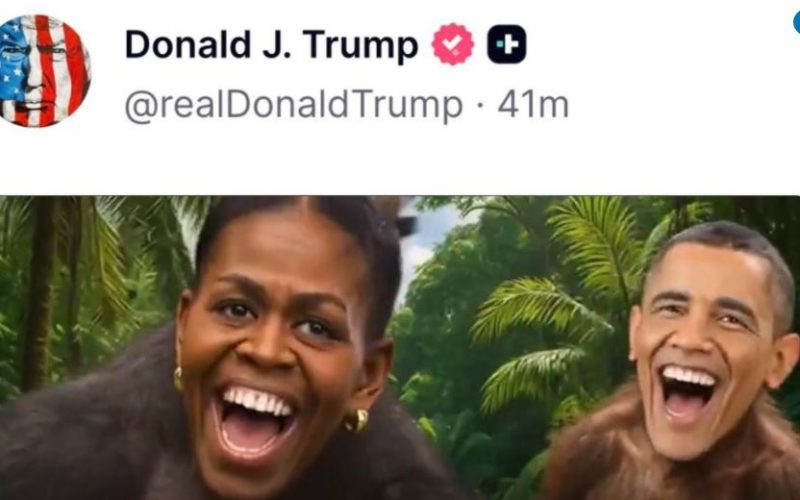
The shameless video clip appeared as part of a longer conspiracy-driven post about the 2020 election and stayed online for nearly twelve hours before public backlash forced its removal, exposing systemic indifference.
Trump’s monkey video shows his personal hate against African Americans by targeting two of the most prominent Black Americans in modern history.
During this time, Trump did nothing to intervene or correct the offensive content, allowing it to circulate freely without concern for the dignity of the people it insulted, a deliberate choice.
Trump Defends Hate: Procedural Oversight Excuse
Instead of taking accountability, Trump defended his actions, claiming, “No, I didn’t make a mistake… I looked at the beginning of it… and it was fine.” He insisted he had not reviewed the full video before aides published it, reframing an intentional act of racial mockery as a procedural oversight, deflecting responsibility, and avoiding the moral consequences of his own decisions. Trump’s Monkey video shows his personal hate against African-Americans clearly, yet he pretended it was a simple technical mistake to excuse his behavior.
This unfortunate episode did not reflect simple negligence or error. It revealed a governing style that normalizes provocation, trivializes historical trauma, and weaponizes controversy to enhance political attention and media coverage deliberately.
Civil Rights Leaders Speak Out: Ethical Collapse
Civil-rights leaders refused to accept Trump’s excuse, insisting the video could not be dismissed as a technical mistake or oversight. Wisdom Cole, senior national director of advocacy for the NAACP, denounced it as “a disgusting and despicable display of racism,” condemning the administration for prioritizing division over unity, especially during Black History Month, a time for reflection and respect. Trump’s Monkey video shows his personal hate against African-Americans, a reality civil-rights groups recognized as part of a larger pattern of racially charged provocation.
The NAACP’s condemnation carried institutional weight, reflecting decades of legal and moral advocacy defending collective dignity and illustrating that presidential communication carries serious ethical consequences across communities and institutions.
Trump’s refusal to acknowledge harm eroded his moral authority. By tolerating dehumanizing imagery on his platform, he signaled that political gain outweighs racial respect, further corroding public trust and empowering dangerous rhetorical practices that threaten democracy itself.
This episode demonstrated not an isolated lapse but a pattern of ethical abdication, using historical prejudice strategically as a political messaging tool to energize a base at the expense of decency.
Bipartisan Outrage: Senator Tim Scott called the footage “the most racist thing”
The backlash erupted immediately and crossed party lines. Republican Senator Tim Scott called the footage “the most racist thing” he had witnessed from the White House, while other Republicans condemned it as unacceptable, demanding immediate removal, signaling that Trump’s provocation overstepped even partisan tolerance.
Democrats intensified criticism. House Minority Leader Hakeem Jeffries labeled the incident “disgusting bigotry,” while Senate Minority Leader Chuck Schumer described it as racist and abhorrent, reflecting a united moral outrage rarely seen in contemporary politics across ideological divides. Trump’s Monkey video shows his personal hate against African-Americans, prompting unified condemnation across party lines in response to its offensiveness.
These responses revealed more than temporary anger; they exposed a deep rupture in shared political norms. When leaders across ideologies unite in condemnation, it signals that a presidency has crossed fundamental ethical boundaries repeatedly, demonstrating the precarious state of moral standards.
Trump Evades Accountability?
When journalists pressed Trump aboard Air Force One, he claimed he “condemned” the racist imagery but insisted he had not fully watched it, blaming aides and procedures instead of personal judgment, avoiding direct responsibility and deflecting criticism skillfully yet unethically. Trump’s Monkey video shows his personal hate against African-Americans, yet he refuses to confront or even recognize the damage it inflicts on citizens.
This strategy follows a familiar pattern. Trump reframes moral failures as administrative errors, turning ethical questions into technical disputes while preserving political flexibility, leaving victims without acknowledgment or justice.
Such conduct extends beyond communication failures. It reflects a leadership philosophy treating moral responsibility as optional, signaling that a president can weaponize platforms without consequences, while public dignity remains negotiable in political contests.
Targeting U.S. Athletes
Trump’s domestic controversies were mirrored internationally. During the 2026 Winter Olympics in Milan-Cortina, freestyle skier Hunter Hess expressed “mixed emotions” about representing the United States amid political turmoil, clarifying that wearing the flag did not imply endorsement of every domestic policy decision.
Trump responded by calling Hess a “real loser” and questioning his right to compete, transforming reflective patriotism into political deviance while punishing individual conscience publicly, sending a chilling message to athletes and citizens alike about conditional loyalty. Trump’s Monkey video shows his personal hate against African-Americans, and his actions toward athletes mirror the same pattern of punishing reflection and moral integrity.
This intervention did more than criticize an athlete. It weaponized national identity against personal conviction, redefining loyalty as silence and patriotic reflection as political betrayal in front of the world.
Cultural Schisms Widened as Trump Normalizes Harassment
Following Trump’s attacks, Olympians defended their right to independent expression, emphasizing civic engagement strengthens democracy and national integrity rather than weakening it under public scrutiny and political tension deliberately fostered by the administration.
Simultaneously, online harassment against outspoken athletes intensified. Figures like Amber Glenn faced threats and coordinated attacks for voicing political concerns, illustrating the real-life consequences of rhetoric modeled at the executive level, amplifying intimidation and division among citizens. Trump’s Monkey video shows his personal hate against African-Americans, legitimizing harassment and emboldening followers to attack dissenting voices publicly.
This shows how elite rhetoric filters downward, converting disagreement into personal attacks. When leaders legitimize ridicule, ordinary people internalize conflict as aggression, moving political debates from institutions into personal lives and communities nationwide.
Language as Weapon: Civic Discourse Undermined
The racist video and athlete targeting reveal a deeper degradation of civic discourse, showing political language functioning as a tool of domination and exclusion, rather than persuasion or dialogue, with measurable societal impact on cohesion and trust.
The imagery in the video revived centuries-old racial caricatures, while public ridicule of athletes discouraged reflection and dissent. Both practices eroded mutual recognition and respect that underpins functional democratic society, undermining shared civic vocabulary essential for national unity. Trump’s Monkey video shows his personal hate against African-Americans, demonstrating how leadership can weaponize language to normalize oppression and ridicule systematically.
Leaders, like Trump, rewarding blind loyalty while punishing moral reflection reshape citizenship itself, replacing deliberation with loyalty tests and empathy with performative aggression, creating a culture where fear supersedes honest dialogue and conscience.
Our Democracy on the Brink: No Redemption Left
If provocation continues, social fractures will harden into permanent rifts, institutions will collapse, and public trust will vanish completely across American society.
Leadership under Trump proves morality has no weight; cruelty, humiliation, and division drive policy, leaving dignity trampled without consequence and citizens feeling unsafe. Trump’s Monkey video shows his personal hate against African-Americans, culminating in systemic disregard for human dignity and justice nationwide.
Loyalty now demands silence, reflection becomes betrayal, and historical prejudice masquerades as political strategy, leaving minorities and dissenters vulnerable to public insult and harm.
Without accountability, America risks permanent decay: ethical norms shattered, communities fractured, and democracy itself teetering on irreversible collapse with no future reconciliation possible.