
The Pentagon has fixed its gaze upon Iran’s southern islands and shores. Abu Musa, Greater Tunb, Lesser Tunb, and the colossal Qeshm sit like pawns across the Strait of Hormuz. Collectively, they constitute what analysts designate “a layered denial system” over the planet’s most indispensable energy chokepoint. President Trump has declined to preclude their seizure. During a Situation Room assembly, he contemplated alternatives encompassing the capture of Kharg Island, through which ninety percent of Iran’s crude oil exports traverse. Three US officials have confirmed that recent strikes constitute “shaping operations” — eroding Iranian defenses for subsequent, intricate undertakings.
For what ultimate purpose, though? To protect oil tankers serving foreign consumers while converting our soldiers into vicious occupiers? Beneath this sterile tactical computation, the inevitable terminus converges upon Iran’s Coffin Factory Islands, where the operational benefit of capturing Qeshm or Abu Musa would swiftly metastasize into a hemorrhaging garrison against unrelenting Iranian counteroffensives—all to sustain a global commerce that enriches corporate ledgers while dispatching American soldiers to perish upon barren coastlines.
“Temporarily capturing an island is very different from holding it,” warns Andreas Krieg of King’s College London. The US possesses the military capacity to seize them. Yet Qeshm rests immediately off the Iranian mainland. Smaller islands remain within artillery range, drone coverage, missile trajectories, and swarm boat assaults. “The Marines would come under fire from Iranian ballistic missiles and drones, severely limiting their ability to project power into the strait,” cautions Brandon Carr of the Quincy Institute. Iran has seeded anti-personnel and anti-armor mines along shorelines where US troops might disembark. Even if conquered, Washington would confront exposed garrisons subjected to incessant bombardment while Tehran stigmatizes America as an occupying regime.
The Body-Count Equation Washington Refuses to Calculate
To commence, the sobering arithmetic of Iran’s Coffin Factory Islands compels a reckoning with casualty statistics that Pentagon briefers routinely whitewash, yet Robert Pape’s alarming seventy-percent probability of ground operations renders such evasion dangerously negligent. Washington’s strategists, ensconced within climate-controlled war chambers, appear utterly disassociated from the human catastrophe—the fractured households, the vacant Thanksgiving chairs, the existences truncated for an abstraction denominated “strategic denial.”
University of Chicago political scientist Robert Pape, who has counseled the US military and presidential administrations, warns that the conflict approaches a phase potentially producing “thousands of U.S. casualties”. He estimates the likelihood of American ground operations along Iran’s coastline at roughly seventy percent. “We are on the Titanic,” Pape declares. Some American analysts project that even under the most favorable scenario, a 100,000-troop invasion would generate 20,000 fatalities—twenty-thousand American mothers interring their sons. Iranians contend the tally would prove substantially elevated. US officials and military experts acknowledge “significant risks involved in such a ground operation, including a large number of US casualties”.
Retired Admiral James Stavridis, former NATO Supreme Allied Commander, articulates bluntly: “Iranians are clever and ruthless. They will do everything they can to inflict maximum casualties on US forces”—an admonition that ought to petrify every American citizen, yet resonates upon deaf ears within a capital intoxicated by its own martial mythology.
Vietnam, Iraq, Afghanistan: The Bloody Specters Trump Chooses to Ignore
This trajectory exhibits disturbing familiarity. The 2003 Iraq invasion promised swiftness. It degenerated into a decade-long morass claiming over 4,400 American lives. Afghanistan protracted across twenty years. The apparitions of Hamburger Hill, Fallujah, and the Korengal Valley ought to shriek at this administration, yet historical reverberations are routinely muffled by the seductive melodies of defense contractors who capitalize upon every flag-draped coffin.
Pape’s “Escalation Trap” paradigm elucidates why: “Every bomb, every revenge attack, and every response drive the next decision to move up the rungs of the escalation ladder”. The conflict’s center of gravity has already migrated from nuclear objectives to command of the strait. Brookings analysts caution that “thousands of U.S. troops would be needed along the Iranian coastline” to secure it. Iran has constructed an eight-layer defense architecture expressly calibrated to repel ground incursions. Large-scale guerrilla warfare would erupt. “For the US Army, this would mean enormous losses in personnel”.
Ultimately, Vietnam’s jungles, Iraq’s deserts, and Afghanistan’s mountains all foreshadow the identical tragic finale upon Iran’s Coffin Factory Islands, where territorial ambition clashes with asymmetric defiance to spawn yet another cohort of flag-draped caskets returning to Dover—and toward what end? To validate a proposition that no adversary has ever conceded through brute force alone.
The Peacemaker Who Would Burn the World to Keep His Promise
Donald Trump pledged to “end wars, not start them.” Yet here he stands, confronting a snare that has entangled successive American presidents. None ever raised a fist for combat with the conscious intention of hemorrhaging for decades. Yet America’s chastening post-Vietnam chronicle exposes a dreadful verity. Wars possess a fearsome momentum. They drift inexorably from their original rationalizations. They terminate only when a successor ultimately calculates that the human ledger—the body sacks, the billions incinerated—can no longer be reconciled.
Critics presently allege that Trump has stumbled upon this precise precipice with Iran. He has failed to realize his own proclaimed victories. Regime change in Tehran remains an elusive fantasy. The nuclear centrifuges persist in their silent, foreboding rotation. Meanwhile, a novel and unstable crisis has exploded within the Strait of Hormuz. This constricted maritime corridor, through which one-fifth of global petroleum flows, has become the neural center of a fresh confrontation.
The Americans, exhausted by two decades of bloody conflicts, was assured respite; nevertheless, the piercing irony of his peacemaker commitment is that Iran’s Coffin Factory Islands would constitute the very edifice of his failure, shackling him eternally to the interminable warfare he swore to eliminate while our children forfeit their existence for his ego.
When Words Die, American Soldiers Follow
Accordingly, when diplomatic instruments evaporate and negotiations stagnate into a deafening impasse, Iran’s Coffin Factory Islands materialize as the sanguinary alternative to statecraft—an alternative pledged to consume American service personnel within a contest whose conclusions remain permanently inaccessible.
Peace does not constitute weakness; it represents the supreme strength. Yet our leadership treats diplomacy as a prelude to bombardment, ensuring that American plasma, not Iranian concessions, becomes the tender of this bankrupt policy. The glaring deficiency of any enduring framework for sustainable accommodation has planted the seeds of what military historians dread as “endless war.” This concept acquired terrible currency after September 11’s smoke dissipated.
The subsequent so-called “Global War on Terror” expanded this paradigm catastrophically. Afghanistan and Iraq commenced as focused campaigns against hostile regimes. They mutated into protracted, exhausting counterinsurgency operations. These campaigns yielded ambiguous outcomes at optimum, and absolute catastrophe at minimum. They consumed treasure and, more unforgivably, generations of youthful American lives—a sacrifice that our political class has never adequately commemorated, let alone rationalized.
The Deadliest Delusion: Why Every President Believes This War Will Be Quick
Even the most formidable commanders, surrounded by imposing arsenals, are notoriously susceptible to a lethal cognitive fallacy: the mirage of a brief, decisive conflict. This very hallucination now possesses Trump regarding Iran. Vladimir Putin stands as a somber testament to the identical miscalculation in Ukraine. These leaders conveniently disregard the obstinate constraints of martial power. They establish objectives that, even if theoretically attainable, necessitate prolonged, draining struggle.
The 1991 Gulf War succeeded brilliantly because George H.W. Bush exhibited extraordinary restraint. He confined his political ambitions explicitly and narrowly: merely to expel Saddam’s forces from Kuwait. Yet his son’s administration tragically abandoned this lesson in 2003. That catastrophic invasion ultimately bequeathed Iran a revitalized influence across the region, the precise antithesis of its declared purpose. Afghanistan offered an equally bitter instruction. After years of staggering investment and declining Washington resolve, the Taliban simply reconquered power.
Meanwhile, the seductive fantasy of a rapid triumph conveniently overlooks that Iran’s Coffin Factory Islands would necessitate not a lightning assault but a decadelong occupation; every Pentagon briefing glosses over the guerrilla warfare that awaits, disregarding the elemental humanity of the eighteen-year-old infantryman who will be the first to step ashore into that inferno.
The Lion America Cannot Tame: Iran’s Terrifying Asymmetric Arsenal
Vali Nasr, the perceptive scholar at Johns Hopkins, frames US-Iran relations as a singular historical antagonism’s perpetual continuation. This dispute oscillates between scorching intensity and fragile, temporary détente. The 2015 nuclear accord stands as the most conspicuous example of a momentary reprieve. Aaron David Miller of the Carnegie Endowment warns that Trump, heavily pressured by Israeli interests, has now entered a parallel, shadow struggle. This conflict extends ominously through Iranian proxies across Lebanon, the Palestinian territories, and Yemen.
Yet Iran presents a fundamentally distinct adversary than Iraq or Afghanistan. American forces previously endured years of grinding ground combat against scattered militias. Iran possesses direct, devastating response capability as a formidable sovereign state. Tehran can severely constrict traffic through the Strait of Hormuz. Such an action would impose immediate and immense economic suffering globally. Brookings’ Suzanne Maloney contends that a complete restoration to pre-war conditions is now illusory. The epoch of unrestricted, carefree passage through the strait may represent a relic of the past.
Consequently, any captured outpost becomes not a negotiating chip but a permanent susceptibility, and Iran’s Coffin Factory Islands perfectly embody this terrifying imbalance: they would drain American power daily through drones, mines, and missiles, while Tehran suffers none of the occupation’s burdens—transforming our own trillion-dollar military apparatus against us in a theater that favors the defender and penalizes the invader with interminable, exhausting attrition.
The Famine Bombs: How This War Will Starve Our Children and Empty Your Wallet
Trump’s warfare strikes at the very sinew of the American breadbasket. Thirty percent of global nitrogen fertilizer—the chemical lifeblood of US corn, wheat, and soy—lies severed. The Haber-Bosch miracle and Green Revolution once tripled global yields, sparing billions from starvation. Now, this conflict paralyzes seventeen percent of natural gas, the essential feedstock for fertilizer production. The Hormuz blockade halts hundreds of vessels. Missiles and drones shatter production facilities. Recovery demands months or years. Urea prices spiral precisely during America’s critical spring planting.
India’s massive premium purchases inflate global costs, outbidding US farmers already suffocating under record input expenses. Australian growers reduce sowing. African farmers discover empty sacks. Brazilian planters confront financial ruin or failed harvests. Beyond the military quagmire, the economic devastation of Iran’s Coffin Factory Islands would ricochet directly to American dinner tables, as escalating fertilizer prices compel millions of acres to lie fallow, propelling beef, pork, and poultry costs skyward—hollowing the American Dream within our grocery aisles while defense contractors feast upon war dividends.
The FAO food price index surges. El Niño threatens drought, while panicked governments hoard exports. These converging shocks will ravage the American dinner table and crush the world’s most vulnerable populations—demonstrating that this war is not fought remotely, but remunerated in every American loaf, steak, and glass of milk, and remunerated in the lifeblood of our own offspring.
Conclusion: Flag-Draped Caskets
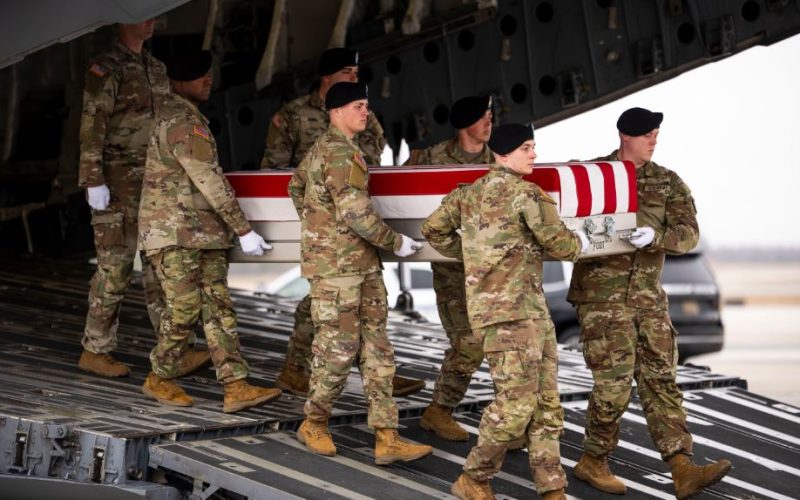
As the first American casualties return home, Trump cynically anoints them “true American patriots” while vowing vengeance. Iran’s Coffin Factory Islands now reveal their true nature: each seized rock becomes not leverage, but a magnet for Iranian fire—a bleeding wound from which no graceful retreat exists, only more widows. Pape’s prophecy chills us: vengeance escalates, escalation demands more vengeance—a self-eating serpent that turns tactical wins into strategic ruin.
Congress admits tactical gains but concedes the war “failed strategically to win concessions from Tehran.” Iran, meanwhile, holds the strait hostage. Seizing barren islands will not stop Hormuz’s disruption. It will only trap American troops in a perpetual kill-zone. Each conquest is a coffin factory. The question is not whether Americans will die. It is how many thousands of flag-draped caskets must return before Washington learns: some lands are simpler to seize than to hold, some wars simpler to start than to end.
America stares once more into a chasm it has glimpsed too often. Each step toward Iran echoes the arrogance that drowned generations in Afghan dust and Iraqi sand. The strait may choke. The harvests may fail. Missiles may fly. Yet the true disaster is not any single blow—it is the creeping horror that withdrawal now costs more than occupation.
Trump swore to break war’s wheel. Instead, he may find himself shackled to it—rotating relentlessly until a future president must shatter it, or be shattered. We are not traitors for asking. We are patriots who refuse to watch our nation exsanguinate upon distant, worthless shores. Trump Iran policy, endless wars, Strait of Hormuz crisis, US-Iran conflict, global food security, American agriculture, fertilizer shortage, Middle East geopolitics, military intervention consequences, Iran ground invasion, US casualties Iran, Trump military strategy, Iran quagmire, Hormuz blockade