
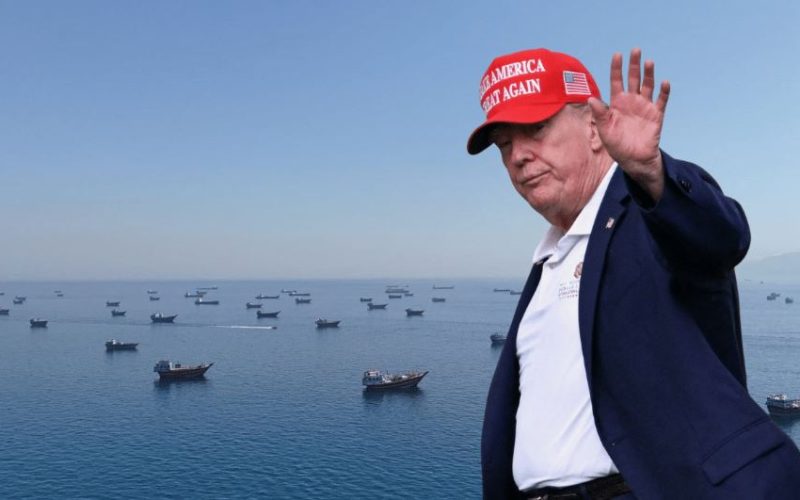
On Friday, U.S. President Donald Trump said during a speech in New York that “after we finish defeating Iran, which is being very badly defeated, pretty soon I’ll be declaring the Strait of Hormuz a territory of the United States.” Only two days earlier, Trump had claimed that the United States had “total control” over the Strait of Hormuz.
The White House later said that Trump was joking about the idea of annexing the Strait of Hormoz to the U.S. territory. Yet even if Trump intended it as a joke, Trump’s Hormuz claim remains significant. It reflects the increasingly forceful rhetoric coming from Washington and highlights the growing gap between political claims and the complex reality on the ground.
The first problem is international law. A president cannot simply declare a strategically important waterway to be American territory. The Strait of Hormuz lies between Iran and Oman, and the international law of the sea governs its legal status. Coastal states have sovereignty over their territorial seas, while specific rules protecting navigation apply to international straits. The United States has no legal authority to turn Hormuz into U.S. territory through a presidential announcement.
The ‘Total Control’ Farce: How Trump’s Own Navy Contradicts His Bloated Boasts
The irony of Trump’s Hormuz claim lies in the fact that if the United States already has “total control” of Hormuz, as Trump claimed on August 12, why is he talking about declaring it American territory in the first place? The contradiction is difficult to ignore.
There is no doubt that Washington has enormous military power in the region. The U.S. Navy can impose a blockade, intercept vessels and maintain a substantial military presence around the Persian Gulf. The Pentagon has even said that the United States has the ability to maintain its blockade of Iranian ports indefinitely. But military superiority is not the same thing as control.
If the United States truly had complete control over Hormuz, commercial shipping would not be struggling to move through the waterway. Instead, traffic has fallen dramatically. Reuters has lately reported that only a handful of vessels have recently crossed the strait, whereas around 130 vessels crossed a day before the war. Most of those that do pass have been using Iranian-controlled routes.
Iran’s Grip, Trump’s Wrath – The Frustration Behind His Escalating Hype
And that is hardly what “total control” looks like.
More importantly, Iran has demonstrated that it still has the ability to make the Strait of Hormuz a strategic problem for Washington. Tehran may not have unlimited control over the waterway, but it has enough military and geographic leverage to disrupt shipping, impose costs on its opponents and keep the strait at the center of the conflict. That may be precisely why Trump is using increasingly dramatic language.
We can also interpret Trump’s Hormuz claim – that Hormuz will become U.S. territory – as an attempt to transform an unresolved military situation into a narrative of American victory. Trump has repeatedly described Iran as being “very badly defeated,” while the conflict continues and diplomatic efforts continue to stall. At the same time, the disruption of Hormuz has pushed up energy prices and created economic pressure even inside the U.S. This creates a political problem for Trump.
Trump must know that the longer the conflict continues without a clear settlement, the harder it becomes to present the war as a straightforward American success. Iran has suffered enormous damage, but it has not simply disappeared as a strategic actor.
Global Hypocrisy Unleashed: Trump’s Reckless Claim Betrays His Own Principles and His Failure
It continues to influence events in the Persian Gulf, and the Strait of Hormuz effectively continues to face disruption. In that context, Trump’s Hormuz claim, with its increasingly ambitious tone, may reveal more frustration than confidence.
And there is another problem with the idea of claiming Hormuz as U.S. territory: it would send a deeply destabilizing message to the rest of the world. The United States has long argued that force should not change international borders and maritime rules. Attempting to claim a strategic waterway because Washington has the military capacity to dominate it would undermine precisely the international legal principles that the United States often invokes elsewhere.
Of course, Trump’s defenders can argue that he was simply exaggerating or joking. Perhaps he was. But jokes from a president during a major international conflict are not politically meaningless. They still shape expectations, influence allies and adversaries, and reveal how a government wants the public to understand a war.