
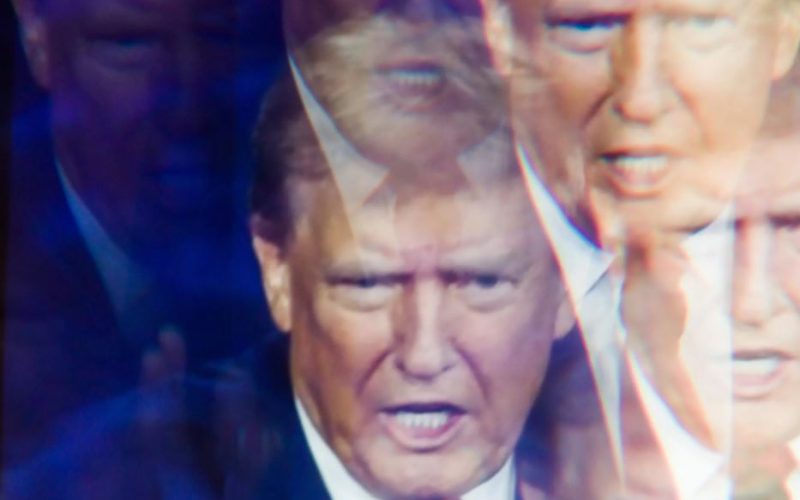
Donald Trump has always presented unpredictability as a source of power projection in Trump’s Foreign Policy. He wants allies and adversaries alike to believe that he is willing to take risks that other presidents would normally avoid. But in his second term, this very strategy seems to produce more unpredictability and disorder. Recent developments involving South Korea, Oman, Iran and North Korea illustrate the problem very clearly.
Instead of strengthening America’s position, Trump’s latest moves risk turning allies into enemies, confusing partners and weakening the credibility of US commitments in the international stage. His latest comment regarding South Korea is particularly relevant.
On this Sunday, Trump announced that the US would reduce its joint military exercises with South Korea, criticizing Seoul’s refusal to participate in the war against Iran, and his desire to avoid provoking North Korean leader Kim Jong Un. Trump also questioned why the United States should continue helping defend South Korea if Seoul is unwilling to support Washington’s Middle East campaign.
Abandoning Seoul for a Smile?
That argument ignores the broader purpose of alliances. South Korea has hosted thousands of American troops for decades and contributes substantially to the cost of the US military presence. More importantly, the alliance exists primarily because of the security threat posed by North Korea—not because Washington expects Seoul to participate automatically in every military operation that Washington undertakes. Trump’s willingness to pressure South Korea also becomes difficult to understand when we view it alongside his renewed interest in Kim Jong Un, a glaring personal fixation within Trump’s Foreign Policy.
The U.S. president has been repeatedly emphasizing lately that he has a good personal relationship with the North Korean leader, arguing that Kim respects him and that the two men understand each other.
But personal relationship has produced little concrete progress for the United States. North Korea has continued developing its nuclear and missile capabilities and has moved closer to Russia and China. Its military cooperation with Moscow has also expanded significantly. Yet Trump appears more interested in the fact that Kim is personally friendly toward him than in the strategic reality of North Korea’s growing military power, which could severely endanger the security of the U.S. allies.
Bomb Threats That Backfire
The same pattern appears in the Middle East. On Monday, Trump threatened to bomb Oman over its negotiations with Iran to reopen shipping through the Strait of Hormuz. Ironically, restoring free navigation through the strait was also a key part of the agreement Trump had once called the greatest Middle East peace deal ever. Trump’s comment to bomb Oman is especially striking because the Persian Gulf country has traditionally played a diplomatic role between Washington and Tehran.
It also exposes a contradiction in Trump’s approach to Iran. His administration has repeatedly claimed major military success, yet the United States still faces the difficult task of restoring normal conditions around the Strait of Hormuz. If military force aimed to produce a decisive outcome, the continued instability suggests that the strategy has not delivered what Trump promised.
But why does Trump’s approach, which increasingly relies on threats, pressure and dramatic announcements, not work anymore? This central breakdown in Trump’s Foreign Policy lies in a simple truth: threats lose their power when reversals or concessions repeatedly follow them.
The Credibility Collapse
Allies may begin to wonder whether they can trust American promises, while adversaries may learn that Trump’s rhetoric does not necessarily translate into sustained action—a corrosive dynamic now embedded in Trump’s Foreign Policy. The consequences extend beyond Iran and East Asia. Relations with European allies have deteriorated, while Trump has repeatedly challenged traditional assumptions about America’s role in the international system. His transactional view of alliances treats partnerships less as long-term strategic investments and more as arrangements in which other countries must continually prove their financial and political value to the United States.
His pressure on NATO members, for example, has encouraged greater defense spending, potentially leaving the alliance stronger in the long run. For decades, American power rested not only on its military strength but also on a network of alliances and expectations about US behavior. Trump appears willing to dismantle many of those assumptions in the belief that disruption will ultimately give Washington more leverage. That gamble may still produce occasional victories.
But if the current pattern continues, the president risks achieving the opposite of what he claims to want: a United States that earns fear for its unpredictability, but that fewer and fewer partners trust.