
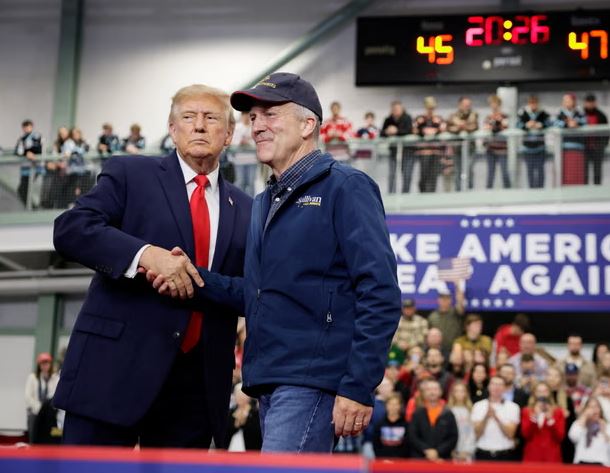
Republican Sen. Dan Sullivan of Alaska increasingly faces growing criticism over his close alignment with President Donald Trump, as some administration policies increasingly draw scrutiny for their impact on the state’s economy. The criticism is particularly strong within Alaska’s fishing industry, a sector that depends heavily on international trade. While Sullivan has presented his relationship with Trump as an advantage for Alaska, opponents argue that his support for Trump policies has sometimes come at the expense of the state’s economic interests. One of the clearest points of disagreement involves Trump’s tariff policies. Sullivan has continued to back the administration’s approach to tariffs, even as Alaska’s seafood industry faces growing pressure from higher costs, weak markets and international competition.
Alaska’s seafood businesses rely heavily on overseas buyers, and they become especially vulnerable when trading partners respond to U.S. tariffs with measures of their own. According to the Alaska Beacon, the state’s seafood industry has already experienced significant difficulties in recent years. Salmon and other fish have faced lower prices and crowded global markets, while operating costs have risen. The industry lost an estimated $1.8 billion between 2022 and 2023, according to an analysis by the National Oceanic and Atmospheric Administration.
Tariffs, China, and the Trade Trap
Tariffs add another layer of uncertainty to an industry that is already struggling to remain competitive. China is a particularly complicated part of the debate. Sullivan has frequently portrayed China as a major threat to Alaska’s fishing interests, pointing to illegal fishing and Beijing’s role in international seafood markets. Yet the Alaska Beacon cites industry specialists who say China is not simply a competitor. It is also an important potential market for Alaska seafood, particularly as incomes rise and demand for high-quality seafood grows.
That makes the consequences of the U.S.-China trade conflict especially significant. Industry observers say the biggest damage can come when China retaliates against American trade measures. Alaska seafood producers may then face a squeeze between Washington’s broader trade strategy and the practical need to maintain access to foreign consumers. Sullivan has nevertheless remained a firm ally of Trump, and his support for Trump policies has anchored that alliance.
Loyalty Tested: Murkowski, Iran, and Energy Costs
His position has even put him at odds with fellow Alaska Republican Sen. Lisa Murkowski, who has taken a more critical position on some of the administration’s tariff policies. Earlier this year, Sullivan voted to maintain tariffs on Canadian goods while Murkowski supported efforts to end them. The criticism has expanded beyond tariffs. Democratic challenger Mary Peltola and the Alaska Democratic Party have also attacked Sullivan over his support for Trump policies toward Iran, arguing that the resulting increases in fuel and other costs are putting additional pressure on Alaska residents and businesses. The state’s fishing communities are particularly vulnerable to energy costs because commercial fishing requires large amounts of fuel.
Higher prices can quickly reduce already-thin profit margins for fishermen, processors and other businesses that work in the industry. Peltola has also criticized Sullivan for supporting cuts to federal agencies that conduct fisheries research and environmental monitoring. She argues that reductions at NOAA and other agencies could leave Alaska without the scientific information that fishery managers need to manage fisheries effectively. Sullivan, for his part, has rejected the idea that he is abandoning those programs, pointing to additional funding he says he helped secure for NOAA.
The Balancing Act That Could Cost an Election
Sullivan argues that cooperation with Trump gives Alaska a stronger voice in Washington. His critics see something different. They say that for Sullivan, his support for Trump policies has increasingly taken priority over the state’s specific economic needs, particularly in industries such as fishing that depend on stable international markets. For voters whose livelihoods depend on fishing, energy prices and international trade, the question may not simply be whether Sullivan has access to the White House. It may be whether he will use that access to push back when federal policy begins to hurt Alaska. The answer could have consequences well beyond the campaign.
Alaska’s seafood industry depends deeply on global markets, and Washington decisions can quickly affect the fishermen who work thousands of miles away. For Sullivan, maintaining his alliance with Trump while convincing Alaskans that he is protecting their economic interests may prove to be one of the most difficult political balancing acts of his career that may cost him the coming election.