
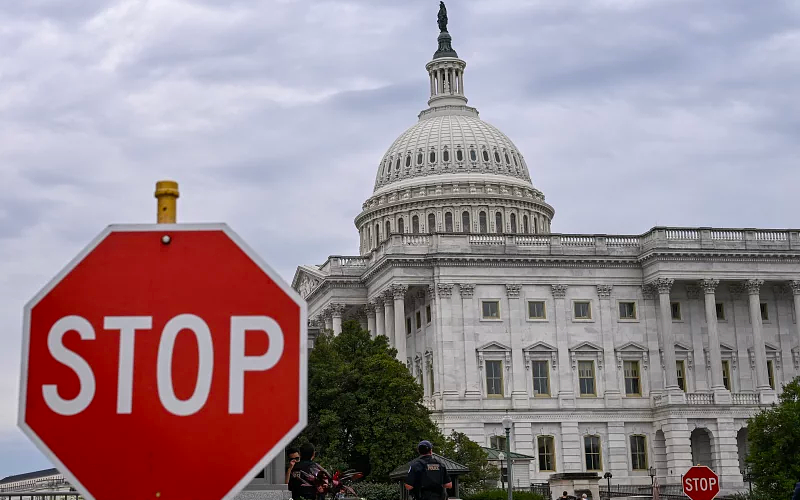
Today, our nation is going through a time of institutional upheaval in which every fissure becomes a great chasm. The federal budget impasse has gone beyond a simple legislative procedure; it heralds the potential collapse of the federal state—an internal fragmentation that jeopardizes our republican system.
Nearly four million federal civil servants, including two million military personnel, are facing a salary freeze. Each day of paralysis leads to widespread economic turmoil, resulting in overdue rent, defaulted bank loans, and strained families. Meanwhile, the state, hitherto a guarantee of social and economic stability, is becoming a source of insecurity itself.
The shutdown shall put greater pressure on US credit ratings: the European agency Scope Group warns that the budget standoff in the United States threatens to deteriorate the risk profile of the nation’s debt.
Furthermore, a White House memo prognosticated a weekly GDP loss of $15 billion if the shutdown persists, resulting in severe macroeconomic implications such as a decrease in expenditure, more unemployment, and a broad economic recession. These calamities cast an ominous shadow as the Senate has ceased to function as a deliberative body, devolving into a battleground of ideological conflict. Democrats advocate social improvements, whereas Republicans emphasize neoliberal approaches, e.g., fiscal sustainability and austerity measures. The result is a dysfunctional legislative branch, unable to safeguard the public’s interests, which exacerbates growing skepticism regarding the overall federal structure.
Institutional Paralysis and Legislative Dysfunction
To complicate matters further, the significant exodus of specialists, engineers, and researchers is depleting government departments of their expertise. Weather forecasting, food security, and space research are all failing. It is a quiet but mortal process. America, deprived of competence, risks becoming an ignorant nation, much like those who are currently steering it towards uncertain futures.
Social, Health, and Economic Crises1
at the crux of the budget The budget dispute revolves around extending funds under the Affordable Care Act (ACA). Their termination may result in a substantial rise in health insurance costs for millions of American citizens during this already cost-of-living crisis. Simultaneously, the financial strain of the most economically disadvantaged households’ fuels cutbacks in funding for Medicaid and food subsidies. Additionally, the financial deficit is hindering the recruitment and training of air traffic controllers, exacerbating current shortages and contributing to flight delays. Postponing certain safety inspections, equipment maintenance, and regulatory evaluations could significantly jeopardize travel safety.
The Trump administration has initiated the cessation of $26 billion in federal subsidies to states governed by Democrats, including targeting infrastructure and green energy initiatives. This freeze seems to be a retributive tactic by Trump’s team, transforming the budget stalemate not only into a regional socioeconomic crisis but also a nationwide one. The Government Employee Fair Treatment Act of 2019 mandates compensation for disadvantaged workers following the crisis. However, this measure does not mitigate the immediate economic repercussions: outstanding debts, disrupted financial transactions, psychological anguish, and increasing employment volatility.
Expertise Drain and Competence Crisis
Many observers believe that Trump is wielding the threat of a fast response force against communities considered “out of control.” Trump is now directing his bellicose rhetoric inward, targeting American nationals themselves. The military, intended for protecting the nation, is poised to put down the peaceful activists. Therefore, it is becoming increasingly difficult to distinguish between American citizens and enemies.
The Cybersecurity and Infrastructure Security Agency (CISA) is a U.S. Department of Homeland Security component responsible for cybersecurity and infrastructure protection at all levels and employs just a small percentage of its workforce. The expiration of legal barriers for disclosing sensitive information has heightened susceptibility to hackers. The shutdown jeopardizes the release of critical economic reports—income, employment, and inflation—by suspending the operation of statistical agencies. Research institutions, including the National Institutes of Health (NIH), are experiencing personnel layoffs, which disrupt funding for scientific research and impede continued development.
Conclusion: Historical Lessons and Future Outcomes of Federal Collapse
The Roman Empire, the USSR, and the Austro-Hungarian Empire: all waning powers have undergone exactly the same trajectory. The trajectory of these waning powers has been characterized by internal disarray, internal militarization, and ultimately, political collapse. Unfortunately, the United States finds itself enmeshed in a historical cycle and on a disastrous track.
The 35-day closure from 2018 to 2019 had an estimated economic cost of $11 billion, including $3 billion in irreversible. The losses are significant, expansion has been limited, and market confidence has decreased. He diminished. Each crisis inflicts enduring damage on both public and private investments, thus intensifying the downward spiral. We are no longer confronting a mere transient emergency. The fiscal impasse signals a systematic and inherent dysfunction, indicating an inevitable disintegration of governance. If no immediate amendments occur, what we witness now will be admitted tomorrow as the first moment of the US federal state’s inevitable collapse.