
By Ron Jacobs
One of the most powerful conversations I’ve had this century took place in Washington Square in New York City on September 11, 2001—as the sky bore the acrid scent of a world that had just turned upside down. My friend and I were there, stunned, in the midst of the collective shock. A few blocks away, smoking concrete, flames, rubble: the material embodiment of a global trauma.
Within earshot, a group of young people were discussing. One of them asked, “What should we do with the perpetrators?” I replied, “Find them, arrest them, try them.” Another retorted that war should be waged against “those who can be declared enemies.” To which I retorted, “Colonialism itself forged the conditions for this crime. Replicating it won’t change anything.” A Black man in the group declared, “We must colonize them all; it’s the only way to civilize them.” Outraged, I reminded him that American slavery was the direct result of colonialism. He was about to respond when Building 7 collapsed, interrupting our conversation.
This moment—both brutal and revealing—exposed a truth: colonialism, in its many forms, never dies. It is reborn, reclaiming itself under other names, but still pursuing the same logic of domination.
Colonialism under a Humanitarian Mask: Discourses and Realities
Colonialism takes on a thousand guises—military, economic, liberal, reactionary—but its nature remains unchanged. It can disguise itself as “liberation,” an “educational mission,” or “development.” Edward Said forcefully exposed this in The Blind Pride of Imperialism: every empire claims to “educate and liberate,” not to dominate. But history shows that the colonizer enriches itself at the expense of the colonized. As long as the colonized do not abolish their dependence, they will never taste freedom.
It is in this context that the Gaza International Transitional Administration (GITA) project arises. According to recent revelations, the United States supports the nomination of Tony Blair—former British Prime Minister—as its head. Behind this institutional veneer lies the desire to place Gaza under direct Western control, under the guise of a UN mission. The illusion of a “neutral” transition masks a proven imperial strategy: preserving foreign control in the form of interim governance.
The Sumud Flotilla: A Challenge to the Israeli Occupation and Siege
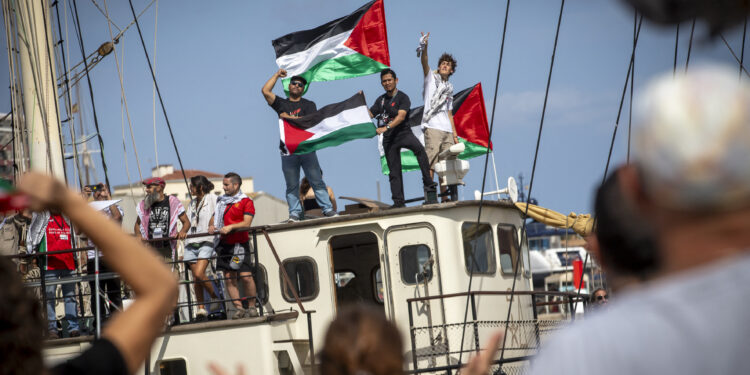
The GITA project cannot be properly judged without taking into account the current context of maritime resistance. As of October 2025, the Global Sumud Flotilla (Resilience Flotilla)—composed of approximately 40 to 50 ships and approximately 500 international activists—attempted to defy the naval blockade of Gaza to deliver symbolic aid.
Israeli naval forces intercepted a large portion of the convoy’s ships in international waters or contested areas. Prominent activists were removed from the boats, including Greta Thunberg, European parliamentarians, and activists. However, the Israeli regime claims all are in “good health” and will deport them from the port of Ashdod. The interception was brutal: water cannons, stun grenades, jamming of communications, and suppression of live broadcasts were used. According to organizers, at least 223 activists were detained on 15 boats known to have been attacked. One ship reportedly managed to approach the Gaza coast before losing all contact. Many protesters denounce what they call “kidnapping” or “illegal interception” on the high seas.
Drones, Sabotage, and Intimidation Tactics
Even before the interceptions, the flotilla reported drone attacks, explosions, communications jamming, and electromagnetic attacks. The activists claimed they were subjected to psychological operations designed to create a climate of fear and disrupt their navigation and coordination. Several boats reported that their transponders and transmission systems had been disabled on board. Some witnesses spoke of boats being surrounded, followed by direct threats over the radio demanding that their engines be turned off or they surrender.
International Reactions and Political Implications
The interception of the flotilla caused a diplomatic shock-wave: massive protests in cities such as Rome, Istanbul, Athens, and Buenos Aires; calls for sanctions against Israel; and critics calling these acts a flagrant violation of international maritime law. The South African government demanded the release of the activists, including Mandla Mandela (Nelson Mandela’s grandson).
Israel, for its part, presented the operation as a legitimate defense of the maritime blockade of Gaza, calling the flotilla a “provocation.”
The debate over the legality of an interception on the high seas in the context of an armed conflict is intense among international experts. Some argue that the Israeli occupation in conflict legally justifies naval actions, while others condemn the systematic use of force against unarmed civilians.
GITA, flotilla, and imperial strategy
The GITA attempt and the Israeli offensive against the Global Sumud Flotilla are two facets of the same project: maintaining Western dominance over Gaza under the guise of international order. The flotilla demonstrated, in action, the resistance to the stifling maritime blockade; its handling exemplifies the way in which colonial powers respond to any independent initiative.
Entrusting Tony Blair with the leadership of a “transition” mechanism in this context means adding media and political backing to the GITA project. But the interception of the flotilla proves that, for Israel and its allies, no Palestinian national transition must emerge beyond their control.
The strategy is clear: prevent Gaza from resuming any form of logistical or symbolic resistance, stifle maritime solidarity routes, channel humanitarian aid according to the occupier’s criteria, and drown all dissent—including pacifist dissent—in a game of international constraints. The brutal interception of unarmed civilians confirms that maritime resistance, even symbolic, is considered a threat to be neutralized.
Conclusion
Let us repeat it unequivocally: no solution imposed from abroad—whether via Tel Aviv, Washington, London, Brussels, or even the UN—can be viable if it does not emanate from an inclusive, majority-led Palestinian process.
The GITA, in the context of the flotilla, embodies the resurgence of imperialism disguised as humanitarianism. But the response of unarmed, peaceful men and women attempting to break a blockade by sea, reminds us that resistance is not confined to the front lines: it also exposes itself to the global spotlight, in international waters, in the face of disproportionate force.
History shows that transition projects imposed without popular consent inevitably end in failure. For a just peace in Gaza to emerge, it must emerge from Palestinian dialogue, rooted in real justice, not Western casting. The world must not simply comment on the tragedies; it must demand that the right to self-determination be respected—including at sea.