
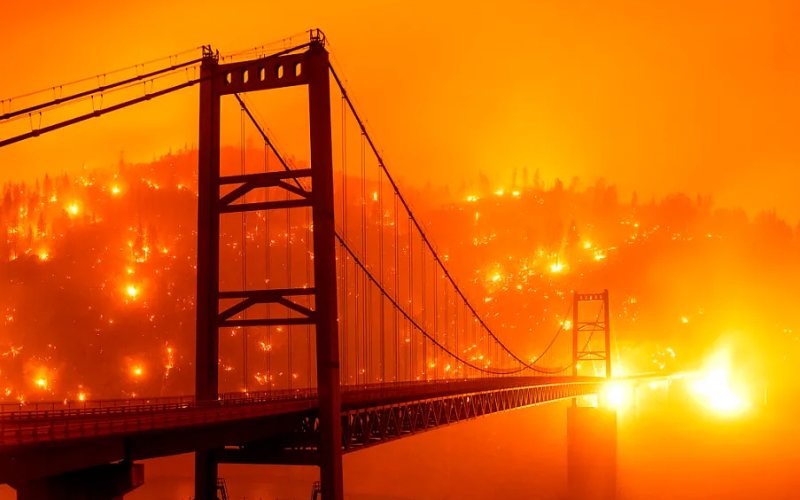
At a time when global news is saturated with hasty images and superficial narratives, a crucial question arises: Is the calamitous management of the California wildfires solely administrative blunder, or rather a symptom of a structural collapse of our nation? As thousands of people flee the blaze, peaceful communities are reduced to ashes, and the hills of Los Angeles and the San Bernardino Valley suddenly seem to be playing apocalyptic arenas, the attitude of public authorities and media coverage deserve uncompromising examination.
Images Replace Investigation
In the meantime, television networks like Fox News, complicit with the administration, broadcast images of destruction without conducting any real investigations. Emotion, rather than being questioned, drowns out any analysis: Why are the fires recurrent? Why do investments in prevention remain paltry? Government officials, faced with these essential questions, wallow in embarrassed silence or brilliantly dodge any responsibility.
The resounding explosion at a Chevron refinery in El Segundo, near Los Angeles, embodies this failure: a mushroom cloud visible for miles, a strategic energy transmission infrastructure worth 290,000 barrels per day, and local authorities, astonishingly silent. The slowness of the federal response underscores the disturbing porosity between national security and oil profits.
This disastrous management, marked by utter indifference, testifies to the emptiness of the current presidency. This reign, characterized by unbridled populism, seems to ignore the sacrifice of human lives and environmental degradation. This spectacle of erratic leadership betrays an inability to anticipate and act in an informed manner. The cycle of destruction, far from being the result of natural forces, is the product of willful myopia. It is imperative to transcend these recurring tragedies to demand serious reflection and concerted action, before catastrophe becomes our only reality.
It is with a mixture of dismay and contempt that we observe Trump’s chaotic management of this crisis. In terms of governance, the reign of the White House tenant has been reduced to an accumulation of indifference and willful myopia in the face of the climate emergency. The grand spectacle of erratic leadership, where performance takes precedence over substance, plunges us into an abyss of disillusionment. What can be said about the manifest disdain for human life and the environment, other than that it reflects a grotesque presidency, where nationalist populism crushes all rational logic, all concern for the general interest?
The tragedy that strikes us each year is rooted not in natural disasters, but in this crass inability to anticipate and act with discernment. It is high time to transcend these horror shows to demand genuine reflection and concerted action, so that destruction is not our only constant.
Trump’s Fiasco
In advanced democracies, two principles must govern disaster management: anticipation and transparency. Yet the disastrous management of the California wildfires is the direct result of a leadership that refused to translate climate danger into coherent policy. Coordination between federal agencies (FEMA, USFS) and local authorities was so clumsy, evacuation plans delayed, and communication with the public confused. The climate, often reduced to an ideological issue, is treated as an optional nuisance—not as a factual issue.
The lack of investment in firebreaks, firefighter training, and forest cover management—all remained mere hype. Even as the flames approached the cities of Los Angeles and Sacramento, official narratives, not human realities, dominated public debate. The doctrine of inaction found refuge in the dominant narrative.
Complicit Media: Is Silence Means Consent?
Refusing to step back is opting for complacency. By relaying rhetoric whitewashed by the White House or Republican governors, some media outlets are acting as passive conduits for government strategies. The low number of reported deaths—ten to date—is brandished as a narrative victory, almost a democratic triumph, without addressing the hundreds of homes destroyed, the ecological balances destroyed, and the long-term health consequences of an atmosphere saturated with toxic particles.
The silence on the toxicity of the smoke, the cost of rehousing, the role of insurance, and the local disparities between wealthy and vulnerable areas speaks volumes. The media narrative serves as a smokescreen: it exalts the restored order while concealing the burning fractures beneath the ashes.
Numbers, Unequal Access, and Invisible Truths
A recent study of the January 2025 fires (Eaton, Palisades, Kenneth, Hurst) reveals disturbing revelations: areas ranging from 315 to 10,960 hectares were ravaged, with more than 9,800 structures destroyed in some urban areas—a density of destruction rarely matched—and very vulnerable populations exposed to long-term toxic smoke.
Furthermore, an analysis of access to shelters during the Palisades and Eaton fires shows glaring spatial inequalities: isolated mountain communities were unable to reach rescue centers due to insufficient capacity or inadequate infrastructure.
Add to this the damning data that anthropogenic climate change accounts for between 33% and 82% of burned areas in the American West, and approximately 49% of exposure to fine particles (PM2.5) in the region—which makes any status quo unsustainable and irresponsible. The convergence of these observations—massive destruction, logistical divide in shelter accessibility, climate contextualization—requires a complete rethink: not judging by these criteria is refusing to face reality.
Conclusion
California burns in silence, and the White House looks the other way. The calamitous management of the California wildfires is not a simple one-off failure, but an admission of a power helpless in the face of the changing world. It reveals a state apparatus obsessed with communication, paralyzed by the short term, and a media system sometimes too compromised to assume its role as a counterbalance.
It is up to us, intellectuals, journalists, and citizens not to capitulate to the spectacle. It is not just a state that is burning—it is a national legitimacy, a democratic promise, a founding narrative that is flickering in the flames.