
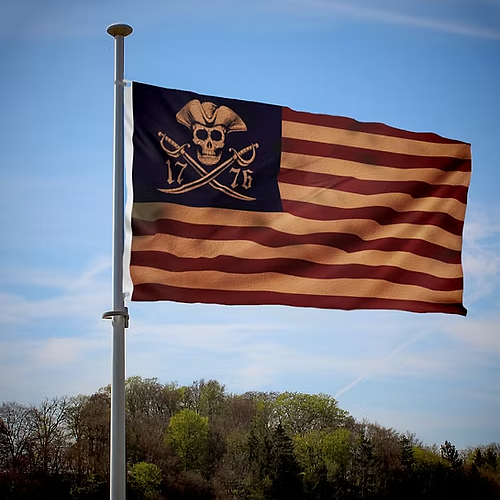
What was once framed as sanctions enforcement has now crossed into something far more performative and dangerous.
When President Donald Trump publicly bragged about seizing a Venezuelan oil tanker, legality yielded to spectacle. The statement was crafted less for legal precision than for theatrical display and nationalist provocation. Meanwhile, the applause it generated online exposed how force is mistaken for legitimacy when cloaked in bravado. In this environment, the line between enforcement and appropriation collapses. Accordingly, state-led piracy in the Caribbean emerges not as polemic, but as analytical diagnosis.
Ship Seized for Night Show Programs: How to Make Piracy Spectacular
The December 10, 2025, seizure of the tanker Skipper did not occur in isolation. Rather, it followed a lineage of prior confiscations dating back to 2019. These included Iranian fuel shipments, Greek-flagged vessels, and ships tied to Emirati intermediaries. Each episode incrementally lowered the threshold separating sanctions enforcement from outright seizure. Crucially, the operation was timed just before a U.S. court warrant expired. It was filmed, narrated, and released with deliberate precision. This choreography reinforced the reality that state-led piracy in the Caribbean is not improvisation. Instead, it constitutes a refined method of deterrence executed through calculated display.
The Modern-Day Piracy: America Rules the Waves!
When the Department of Homeland Security declared that “America rules the waves,” it conveyed more than theatrical bravado.
Rather, it announced a doctrinal rupture, shifting maritime governance from freedom of navigation toward compliance-based mobility. Under this administration , maritime access is no longer a right, but a privilege conditioned on political alignment with U.S. sanctions. What once demanded multilateral adjudication is now imposed through unilateral enforcement mechanisms.
Consequently, state-led piracy in the Caribbean signals not episodic overreach, but a structural reconfiguration of maritime order itself.
Great Footage, Missing Sailors
Lost amid the spectacle was the fate of the crew. Seafarers reportedly drawn from South and Southeast Asia and Latin America disappeared into legal opacity, with no immediate Red Cross access, no transparent consular notification, and no independent verification of their status. These omissions raise unresolved questions under the Maritime Labour Convention of 2006 and basic humanitarian norms. In this sense, U.S. state-led piracy in the Caribbean does not merely seize cargo; it manufactures statelessness at sea.
Uneasy Seas, Bitter Memories, and Trump’s Tantrums
International reactions were cautious but revealing. The United Nations urged restraint. Russia demanded explanations. The Latin American independent nations, like Cuba and Venezuela, largely remained silent, a silence shaped by historical memory rather than indifference. For the region, this episode revived familiar patterns of gunboat diplomacy and Monroe Doctrine logic, where order at sea was imposed rather than negotiated. Against that backdrop, state-led piracy in the Caribbean is deemed less as anomaly than as recurrence.
Cash, Cannons, and Confiscation: Trump’s Piracy Playbook
The seizure coincided with a visible U.S. military buildup, but its most immediate impact unfolded through markets. Insurers raised premiums, voyages were canceled, and London-based reinsurance networks—long centered around Lloyd’s—quietly rendered entire routes unviable. This transformed sanctions into a shadow blockade, achieved without declaration. Here, state-led piracy in the Caribbean operates as a hybrid instrument: naval force initiates the shock, while financial systems complete the enforcement.
From Sanctions to Uncle Sam’s Shenanigans: Trump’s Shameless Piracy
U.S. officials justified the boarding by claiming the tanker was allegedly mis-flagged and therefore stateless. Maritime law permits inspection under such circumstances, but confiscation remains deeply contested. Statelessness, once a narrow exception, is now stretched into a permissive doctrine. As nuance collapses in public discourse, state-led piracy in the Caribbean is laundered through digital simplification, where outcome annihilates the infamous process.
Conclusion: Trump’s Empire at Sea—Law, Order, and Laughable Hubris
The seizure of a single tanker matters less than the precedent it consolidates. When a state can confiscate cargo globally based on its own sanctions regime, sanctions become a naval weapon. Consequently, war becomes modular, scalable, and deniable. Thereafter, inflation, fuel shortages, food disruption, and informal trade follow in predictable sequence. Within this trajectory, state-led piracy in the Caribbean is not merely a critique of policy, but a warning. Ultimately, when power replaces law, the sea ceases to be a commons and becomes an imperial corridor.