
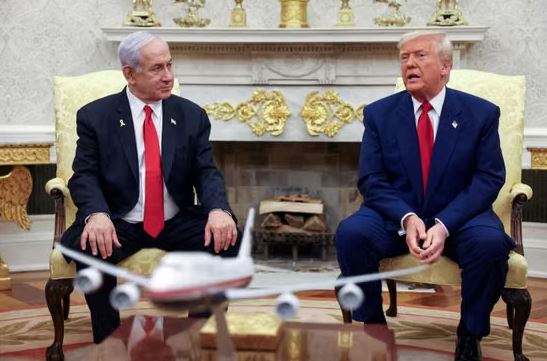
Netanyahu’s White House Visit this Tuesday reignites divisions within Trump’s political coalition. Prominent America First figures worry that the Israeli leader could pressure Trump into a more aggressive Iran policy. This meeting marks the first between Trump and Netanyahu since their coordinated strikes on Iran.
Washington now weighs diplomacy versus a return to military action. For many anti-war Trump supporters, the visit sounds the alarm. It could draw the United States deeper into another Middle East conflict on Israel’s behalf.
“I think all of President Trump’s most ardent non-‘Israel First’ supporters are furious,” says former White House chief strategist Steve Bannon. He argues that Netanyahu’s repeated visits consistently undermine Trump’s America First agenda. Bannon notes that Netanyahu has visited the White House “twice as many times in 18 months as Churchill had in all of World War II.” He describes each visit as “a disaster for America First.” The discussions occur after a temporary halt in hostilities between Washington and Tehran. This halt raises hopes that diplomacy might replace military confrontation.
Those expectations, however, remain fragile. In recent days, Trump continues to warn Iran that the United States could resume large-scale strikes if negotiations fail.
Escalation’s Logic vs. Presidential Control
Curt Mills, executive director of The American Conservative, describes Netanyahu’s White House Visit as nothing less than “DEFCON 1.” This reflects the deep concern among foreign policy conservatives. According to Mills, the Israeli prime minister will make the case that if diplomacy fails to permanently eliminate Iran’s nuclear capabilities, Washington should prepare for further escalation.
“Netanyahu is going to argue for the essential logic of escalation,” Mills says. He adds that unless Trump fully commits to diplomacy or walks away from the conflict altogether, “we probably will escalate.” Trump’s advisers, however, insist that the president remains firmly in control of U.S. policy. They believe these concerns are baseless. Alex Gray, who served as chief of staff at the National Security Council during Trump’s first administration, acknowledges that Netanyahu will naturally advance Israel’s security priorities. But Gray dismisses concerns that the Israeli leader could dictate American decisions. “Netanyahu is going to push his agenda,” Gray says. “But I have no concern that Donald Trump is going to be manipulated by any leader into doing something that’s not compatible with America’s interest first.”
According to White House officials, the meeting covers a broad range of regional issues, including the conflict with Iran, security arrangements involving Lebanon, and expanding the Abraham Accords. Officials emphasize that U.S. national security interests continue to guide Trump’s decisions, not pressure from allies.
Conclusion: One Goal, Two Trajectories?
Still, political tensions between Trump and Netanyahu have become increasingly visible. Although Trump remains committed to preventing Iran from obtaining a nuclear weapon, he has recently criticized aspects of Israel’s military strategy, particularly its operations in Lebanon.
Vice President JD Vance also accuses Netanyahu’s government of undermining diplomatic efforts with Tehran by favoring a prolonged conflict. Meanwhile, recent polling suggests growing war fatigue among Trump’s supporters. Rising economic costs and uncertainty over America’s long-term role in the region make the conflict an increasingly difficult political issue ahead of the November elections.
Despite growing tensions between Washington and Israel, supporters of the U.S.-Israel alliance argue that both governments remain firmly aligned on their core strategic objective: preventing Iran from acquiring a nuclear weapon.
While disagreements persist over tactics, timing, and regional policy, they maintain that neither side has wavered on this fundamental goal. In their view, the shared commitment to stopping Iran’s nuclear ambitions continues to serve as the foundation of the bilateral relationship, even amid increasing political and diplomatic friction. Netanyahu’s White House Visit highlights this paradox.
“The one constant,” Republican Jewish Coalition CEO Matt Brooks says, “is that under no circumstances will Iran ever have a nuclear weapon,” and “while disagreements over tactics persist, officials on both sides continue to portray that shared goal as the foundation of the U.S.-Israel partnership.”