
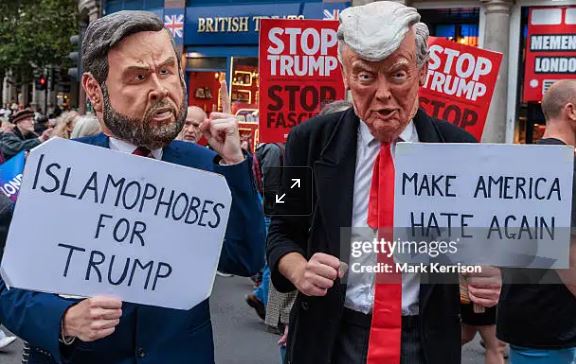
As the November 3rd midterm elections approach, observers have noted a sharp escalation in the rhetoric as Republicans use Islamophobia against the Muslim community and Muslim candidates. Political pundits interpret these maneuvers as an integral component of the Republican strategy to foster religious polarization and divert public attention from the Trump administration’s economic predicaments and foreign policy quandaries. Republicans, however, maintain that these positions derive solely from legitimate security concerns and an unwavering commitment to the rule of law.
The discourse and posturing of prominent Republican candidates in the lead-up to the pivotal congressional midterms indicate that Republicans have once again thrust the nation’s 5.5-million-strong Muslim population to the forefront of electoral contention. Republicans use Islamophobia to cast this growing visibility as a sinister takeover, even as concurrent with the burgeoning political influence of Muslims in recent years—the election of Zahran Mamdani as Mayor of New York and the senatorial candidacy of Abdul El-Sayed in Michigan demonstrate this influence—
Zeroing In on the “Evil” Opponent: The Vance-El-Sayed Showdown
verbal assaults against this religious minority have assumed new and intensified dimensions. The most egregious instance of such attacks emanated from J.D. Vance, the Vice President of the United States. During a campaign rally in Michigan, Vance characterized El-Sayed as “a very, very evil individual” and accused him of supporting terrorism. These allegations emerged after El-Sayed, while unequivocally condemning the attack on a Detroit suburb synagogue in March, remarked, in reference to the Israeli strikes on Lebanon that killed the perpetrator’s relatives, that “hurt people hurt people.” Although El-Sayed subsequently apologized for the misinterpretation of his comments, Republicans have continued to exploit this statement against him. Republicans use Islamophobia to transform an ill-phrased remark into a blanket accusation of treason, a tactic that resonates powerfully with their base. In response, El-Sayed characterized the Republican efforts to strip healthcare access and impose economic hardships on ordinary citizens as the “real evil,”
Spreading the Fire: Sharia Courts, Radical Islam, and the “Enemy”
and underscored that they are instrumentalizing religion to sow societal discord. In Texas, Governor Greg Abbott, a Republican, called for an investigation into a Muslim-led housing development project, alleging that it constituted an attempt to establish “Sharia courts”—an assertion that the development’s constructors and civil rights organizations promptly refuted.
Concurrently, in Alabama, Senator Tommy Tuberville, a Republican vying for the gubernatorial seat, issued a stark warning against what he termed “radical Islam,” proclaiming that “the enemy is at the gates.” Republicans use Islamophobia to link local municipal disputes to global jihadist threats, thereby manufacturing a pervasive sense of siege. Furthermore, conservative representatives in the House of Representatives have inaugurated a caucus, which they have dubbed the “No Sharia Caucus.”
Political analysts posit that this volley of vitriolic rhetoric is unfolding against a backdrop of widespread public disaffection with President Donald Trump’s performance, particularly concerning escalating living costs, inflation, trade tariffs,
The Experts’ Warning: A Diversion with Lasting Scars
and the ongoing war that the US and Israel wage against Iran. Aaron Hughes, Professor of Religious Studies at the University of Rochester, remarks on this phenomenon: “When Republicans encounter difficulties on issues such as inflation, the war in Iran, and immigration, they reflexively invoke the American flag and deploy Islamophobia and fear-mongering as a diversionary tactic to circumvent accountability on the substantive issues at hand.”
Republicans use Islamophobia precisely as Hughes describes—as a recurring escape hatch—yet critics direct the brunt of criticism regarding Islamophobic conduct at Republicans, political activists caution that certain Democratic figures have also, on occasion, contributed to this inflammatory discourse within the context of primary competitions.
Nevertheless, experts warn that this pervasive degree of religious polarization portends severe and lasting repercussions for the fabric of our society.