
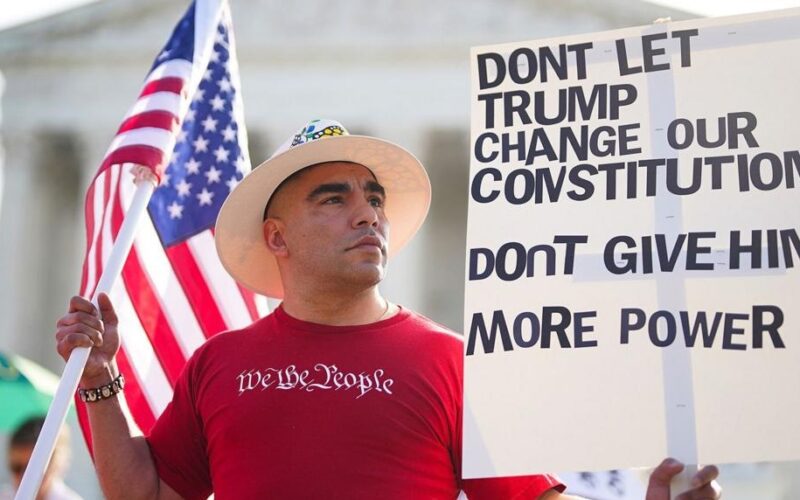
Donald Trump has suffered another major legal defeat in his latest attempt at restricting birthright citizenship, and that defeat raises serious questions about whether he will respect constitutional limits on presidential power. On Wednesday, U.S. District Judge Deborah Boardman issued a preliminary injunction that blocks Trump’s newest executive order. That order sought to deny automatic U.S. citizenship to children of foreign nationals who give birth on American soil. The ruling represents yet another setback for an administration that has repeatedly tried to use executive power to accomplish what it has failed to achieve through the normal constitutional and legislative process.
The dispute centers on the Fourteenth Amendment. That amendment says that anyone whose birth occurs in the United States or who completes naturalization there, and who falls under U.S. jurisdiction, is a citizen. Trump has nevertheless made restricting this long-established principle a central part of his immigration agenda. Trump signed his latest order in August. It targeted children whose parents fall into categories including certain foreign government employees, so-called “alien enemies,” and people whom officials accuse of engaging in “birth tourism.”
Trump Cannot Rewrite Citizenship by Decree
The problem for Trump is that the courts have repeatedly rejected his broader attempt at restricting birthright citizenship through executive action. The latest ruling makes clear that a president cannot simply issue another executive order and expect constitutional protections to disappear. Judge Boardman concluded that the plaintiffs would likely succeed in demonstrating that Trump’s new order violates their constitutional rights.
Critically, Trump’s strategy increasingly looks less like a genuine constitutional reform effort and more like an attempt to impose his political agenda by presidential decree. If the administration genuinely believes that birthright citizenship needs change, it can pursue that goal through constitutional and legislative mechanisms. Instead, Trump has repeatedly attempted to use executive authority to achieve a fundamental change in the legal status of American-born children.
That approach is particularly troubling because citizenship is not an ordinary administrative privilege. It is one of the most fundamental legal statuses a person can possess. Allowing the government to decide, after a child’s birth, whether that child qualifies as an American based on the immigration status or alleged intentions of the parents could create uncertainty and lead to unfair treatment of children in similar situations.
Vague Words, Vast Power: Who Gets to Decide?
The wording of Trump’s latest order also raises serious concerns for any effort aimed at restricting birthright citizenship. Terms such as “commercial” efforts to obtain citizenship and “birth tourism” can involve complicated questions regarding parental intentions and circumstances. Such vague categories could give government officials excessive discretion to decide who qualifies as an American citizen. In practice, this could place families in the extraordinary position of having to prove that their children deserve the citizenship that the Constitution aims to protect.
Trump’s defenders argue that the administration is not abolishing birthright citizenship altogether but merely preventing abuses of the system. That argument, however, does little to resolve the central constitutional problem. The courts—not the president—have the authority to interpret the Constitution. Repeatedly attempting to circumvent unfavorable judicial decisions risks turning executive power into a tool for testing how far a president can push the limits of the law.
More troublingly, Trump’s persistence suggests that losing in court does not necessarily mean accepting the court’s authority. Instead, his administration appears determined to modify, narrow, and relaunch the same basic policy in the hope of eventually finding a version that survives judicial scrutiny.
The Constitution’s Breaking Point
That strategy may be politically useful, allowing Trump to portray himself as fighting against immigration and the “establishment,” but it comes at a potentially serious cost to constitutional norms when used for restricting birthright citizenship.
The deeper issue therefore goes beyond immigration. Trump’s repeated efforts to redefine citizenship by executive order reflect a broader governing style in which a president treats presidential power as though it were virtually unlimited. The danger is not simply that one immigration policy might be unfair. It is that a president could normalize the idea that he can weaken fundamental constitutional rights through executive action whenever political circumstances make them inconvenient.
The latest ruling is consequently more than another defeat for Trump’s immigration policy. It is a reminder that the presidency is not above the Constitution. Trump may have the political authority to pursue stricter immigration policies, but he does not have the authority to unilaterally redefine who is an American citizen.
For Trump, the battle over birthright citizenship may be another political fight to energize his supporters. For the United States, however, it is a much more serious test: whether constitutional limits can withstand a president who appears determined to push them to their breaking point.