
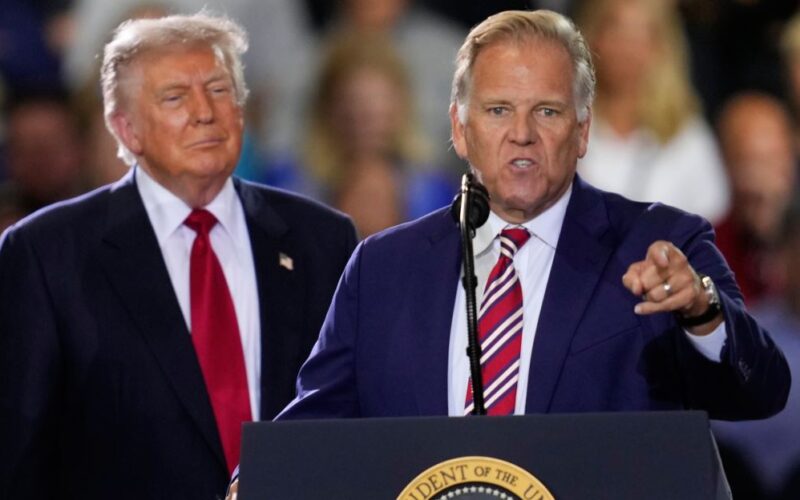
Republican Senate candidate Mike Rogers is increasingly trying to distance himself from Donald Trump’s handling of the war in Iran, as rising fuel prices put growing pressure on Republican candidates heading into the November midterm elections. Rogers’ latest call for a rapid end to the war against Iran marks a notable shift from his earlier willingness to give Trump broad authority to continue the conflict.
“The war with Iran needs to end, and end quickly,” Rogers said in a campaign video posted on September 21, adding that “Michigan families can’t afford to wait.” He also argued that ending the war would help bring down energy prices and proposed a temporary embargo on U.S. diesel exports, alongside a suspension of state and federal gas taxes.
The proposal comes as fuel prices have become a major economic problem in Michigan. According to AAA figures cited by CBS Detroit, Michigan’s average diesel price reached $6.81 per gallon on September 21, while regular gasoline averaged $4.91. Higher diesel prices have consequences beyond the gas station because diesel is heavily used by trucks and agricultural equipment, increasing transportation costs throughout the economy.
Rogers Gave Trump a Blank Check—Now He Blames the Bill
Rogers’ argument, however, raises an obvious political question: why is he calling for an end to the war against Iran now, after previously taking a more supportive position toward Trump’s approach?
That question is particularly relevant because Rogers himself addressed the issue during a July interview with CBS Detroit. At the time, when asked whether Trump should receive congressional authorization to continue the war or potentially begin another conflict, Rogers said he had no problem giving the president authority to continue. He argued that the United States could not simply “stop in mid-negotiation” and said he wanted Trump to bring the conflict to an end as soon as possible.
His September message is therefore not a complete reversal on every aspect of the conflict, but it represents a much sharper public break with the administration’s policy. The timing is also significant. Rogers is now less than six weeks from Election Day and is facing Democrat Abdul El-Sayed in a closely watched Senate race,
Trump’s War Mess Becomes a GOP Credibility Crisis
which makes his recent position to appear as an effort to create distance from Trump after months of promoting the president’s anti-Iran agenda.
Democrats have seized on that change. The Michigan Democratic Party accused Rogers of supporting the war against Iran until its economic consequences became politically damaging. El-Sayed was even more direct, accusing Rogers of “lying” to voters and portraying his new position as an electoral calculation rather than a genuine change in policy.
Those attacks are politically predictable, but they highlight a broader problem for Rogers: his own record gives Democrats material with which to challenge the credibility of his new message. Rogers cannot simply present himself as an opponent of the war without explaining how his current position fits with his earlier statements about presidential authority and his previous support for Trump.
The economic argument is increasingly difficult for Republicans to ignore. Iran’s conflict has contributed to higher energy costs, while disruptions around the Strait of Hormuz have added further pressure to fuel and transportation prices.
Trump’s Costs Come Due, and Rogers Has No Alibi
Even House Speaker Mike Johnson, while defending the administration’s objectives, said on September 23 that the war needed to be brought to a resolution and acknowledged its impact on fuel and grocery prices.
For Trump, the problem is broader than Rogers. The administration must defend the strategic rationale for the war against Iran while voters and Republican candidates increasingly focus on its economic consequences. For Rogers, meanwhile, the challenge is more personal: after spending months closely aligned with Trump, he now has to convince Michigan voters that his call for a rapid end to the war represents a substantive policy position rather than a late attempt to separate himself from an increasingly costly and politically difficult conflict.
The controversy ultimately exposes the tension at the center of the Republican campaign: supporting Trump’s foreign-policy agenda while simultaneously addressing voters’ concerns about the price of fuel, groceries and transportation. Rogers is now attempting to occupy both positions at once. Whether voters view that as consistency or contradiction will be tested in the final weeks of the Senatecampaign.