
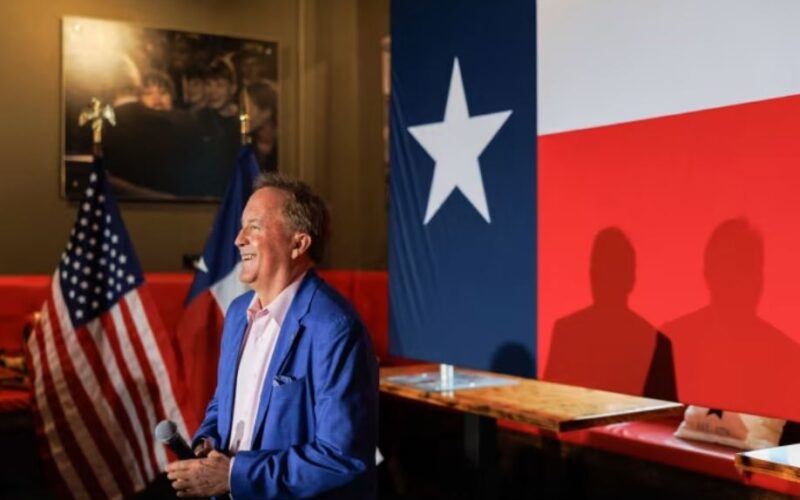
Texas Republican candidate Ken Paxton is facing growing scrutiny after reportedly admitting in a private meeting that U.S. President Donald Trump’s political influence may be hurting Republican candidates ahead of the November midterm elections.
According to a report by The New York Times, Paxton made the comments during a private fundraiser that conservative donors and lobbyists attended in Washington last week.
An audio recording reportedly captures Paxton saying that Republican candidates’ numbers fell after the Republican Party’s midterm convention in Dallas earlier in September.
“When we did that convention, it dropped our numbers. Everybody’s numbers dropped,” Paxton reportedly said.
Paxton’s campaign rejected the report.
His senior adviser, Nick Maddux, called it “manipulated nonsense” and accused The New York Times of trying to create a political story.
However, the campaign has not provided any evidence that the audio was fake or that anyone had manipulated it.
The controversy is particularly significant because it highlights tensions inside Republican party and because Paxton has closely connected his political career to Trump, who endorsed Paxton in the Republican primary against Senator John Cornyn.
Loyalty as a Leaking Lifeboat: Public Ally, Private Doubts, a Party Eyeing the Anchor
Thanks to this, Paxton defeated the four-term senator to secure the Republican nomination back in May’s runoff.
Trump’s political network has also provided substantial support to Paxton’s Senate campaign.
This makes it difficult for people to dismiss Paxton’s private comments as ordinary political criticism.
Publicly, Paxton has presented himself as a strong Trump ally.
Privately, however, the recording reportedly shows him expressing concern that Trump’s involvement could be hurting Republican candidates rather than helping them.
When reporters asked Trump about Paxton’s reported comments, he said he had not heard about them and described the convention as “amazing.”
The disagreement exposes tensions inside Republican party.
Trump continues to dominate Republican politics, but some Republican candidates may be increasingly concerned about the electoral consequences of associating closely with him.
A 32% Anchor Around His Neck: Falling Approval, a Trap, No Clean Exit?
A recent Reuters poll put Trump’s approval rating at 32%, the lowest level that poll had recorded during his presidency.
The poll reflected concerns among Americans about the cost of living, energy prices and the administration’s handling of the war with Iran.
For Paxton, this creates a clear political dilemma.
His campaign depends heavily on Trump’s support, yet close identification with the president could also expose him to dissatisfaction among voters outside Trump’s core base.
That tension is particularly important in a general election.
Trump’s endorsement can help a candidate secure support within the Republican Party, but general elections require candidates to appeal to a broader electorate.
Paxton therefore faces a difficult contradiction, one that reflects tensions inside Republican party: he needs the political machinery and support that Trump’s network provides while potentially needing to distance himself from some of the president’s weaknesses among voters.
The reported remarks are also awkward for Paxton because they expose the gap between his public message and his private conversations.
No Safe Distance From the Wreckage: Trapped Between His Base and a Doubting Electorate
His campaign has made his alliance with Trump a central part of his political identity, yet he was reportedly telling donors that a major event that Trump backed had coincided with declining numbers for Republican candidates.
People now find that tension difficult to ignore.
That already-volatile situation could become even more uncomfortable for Paxton as the campaign moves toward the general election.
He has strong reasons to maintain his alliance with Trump, but he also has to campaign beyond the Republican primary electorate and address voters whose views of the president may be less favorable.
The controversy puts that balancing act under a much brighter spotlight, revealing tensions inside Republican party.
For Trump, the episode raises a different issue: whether loyalty from Republican politicians necessarily means confidence in his broader electoral strategy.
Paxton continues to align himself publicly with him, but the reported conversation suggests that even a politician who has benefited directly from Trump’s support may have concerns about how that association affects Republican candidates in a wider electorate.
Whether reporters accurately characterized those remarks, how voters interpret them, and whether they affect the broader Republican campaign remain questions for the electorate.
What is already clear is that the episode has exposed a tension at the heart of Paxton’s campaign: he has closely tied his political future in Washington to a president whose own standing has become an increasingly consequential issue for Republican candidates.