
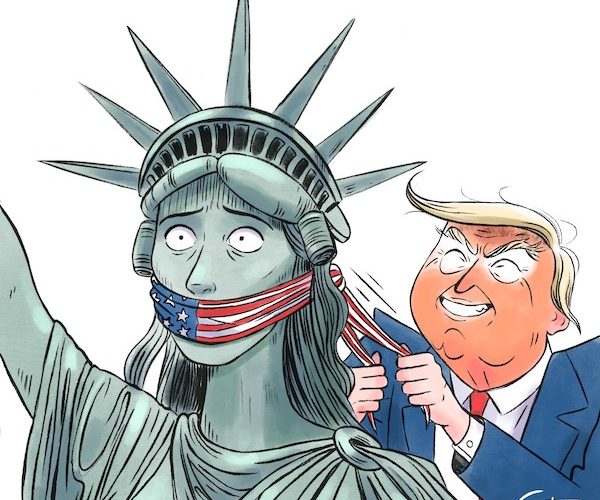
In the midst of massive displays of support and solidarity with immigrant communities, Donald Trump escalated tensions by sending over 4,100 National Guard members—700 of whom were newly deployed—to Los Angeles, accommodated without proper food or resting facilities. Their arrival marks the first such deployment since 1965, executed without a gubernatorial mandate. The move prompts a critical question: at what point does the military’s presence on American soil evolve from safeguarding public security to signalling dictatorship?
Trump contends that the so-called “Radical Left” incites protests that threaten public order. Yet an impartial examination reveals the militarisation far exceeds a typical state response—under 5% of demonstrations have spread beyond original venues, and the Associated Press has characterised them as “mostly peaceful.” To date, there have been 118 arrests, while ICE continues roughly 2,000 operations daily, including 60 during the initial San Francisco phase. Is this democratic stewardship—or authoritarian overreach?
Immigrants, Crime Rates, and Propaganda: The Grand Illusion
Trump has employed incendiary rhetoric—terms such as “dangerous immigrants” and those who are “poisoning the blood of our country”—to rationalise his policies, despite empirical evidence to the contrary. A joint Cato Institute–UCSB analysis concludes that immigrants, including undocumented ones, commit fewer crimes than native-born Americans. Trump has repeatedly labelled them “criminal immigrants”, “illegal monsters”, “gang members”, “snakes”, and “killers”.
His adviser Stephen Miller stated, X: “Deport the invaders, or surrender to insurrection.” Despite Trump’s deliberate amalgamation of nonviolent demonstrations with violent threats to inflame racial animus, economic data incontrovertibly buttress the conclusion that immigrants bolster entrepreneurship, ameliorate an ageing population, and underpin vital industries in sanctuary states such as California—including agriculture, construction, and healthcare. This déjà vu of scapegoating immigrants underscores the folly of Trump’s populist gambit and signals an egregious subversion of administrative authority toward authoritarian despotism.
Civil Liberties Under Attack
In 2018, the ACLU cautioned against proposals aimed at curbing protest rights—such as sealing off 80% of Washington, D.C.’s walkways. Now, the deployment of armed forces to immigrant communities signals a calculated suppression of civil liberties. Governor Gavin Newsom decries it as infringing on state sovereignty (supported by AG Bonta’s lawsuit), while the ACLU notes it is “akin to a declaration of war on all Californians.” This development marks a dangerous recalibration of law enforcement into a tool of political coercion.
Economic and Political Ramifications and Grassroots Response
This politico-economic nexus engenders profound instability: investor confidence falters, public trust erodes, and the integrity of democracy—predicated on free expression—decays. Meanwhile, Congress is negotiating a $175 billion immigration package to fund Customs, ICE, and detention facilities. Public sentiment remains polarised: 54% support deportation; 46% oppose it. This escalating schism underscores a profound ideological chasm, wherein border militarisation and the disempowerment of sanctuary states placate Trump’s constituency. In the meantime, nationwide protests—from Los Angeles to Seattle—illustrate enduring democratic ideals. In San Francisco’s Mission District and outside City Hall, demonstrators chanted,
“Donald Trump, you coward.”
These citizens recognise that without immigrants’ labour and cultural dynamism, their cities would suffer economically. Advocacy groups—including the American Academy of Arts and Sciences—affirm that inclusive societies are more sustainable, and recent demonstrations reinforce this conviction.
Conclusion: From Authoritarianism to Economic Decline
Trump’s strategy reinterprets a respectful call for human dignity as an act of rebellion. By weaponising fear, racial bias, and militarisation, he positions himself as the guardian of public order—through provocative tweets, quasi-legal manoeuvres, and military deployments. However, these tactics weaken constitutional principles, imperil civil freedoms, exacerbate federal–state tensions, and compromise fiscal discipline. They mask fundamental demographic and inequality crises that inclusive, progressive policy could more effectively address.