
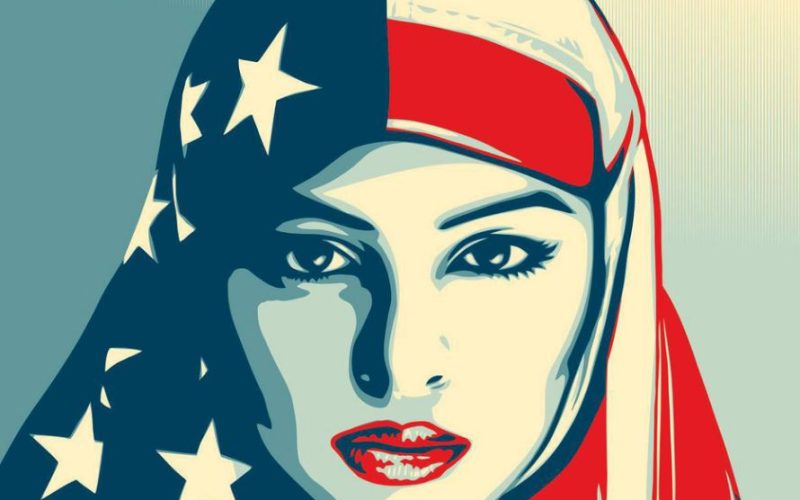
My name is Aaliyah Ibrahim. I am a Black American Muslim woman who wears a headscarf, the daughter of Kenyan parents who arrived in the United States in 1987.
Every day, I experience—and witness—the silent and sometimes brutal humiliations inflicted upon me by white supremacists or those who, through their indifference, perpetuate a system of indirect discrimination.
Since Donald Trump’s return to power as president, I have watched with horror the rise of Islamophobia across every state in America. It’s not just hateful rhetoric, but a real climate of fear, ostracism, and institutional attacks against my community—the Muslim community.
Islamophobia in The National Context
Official statistics speak for themselves. According to the Federal Bureau of Investigation (FBI), in 2024, American law enforcement agencies recorded 11,679 hate-motivated incidents nationwide.
Of these, religion accounted for 23.5% of the motives. Regarding the specific targeting of Muslims, the Council on American Islamic Relations (CAIR) recorded 8,658 complaints in 2024—a historically high number for the Muslim and Arab community in the United States.
The most frequent types of complaints concern employment discrimination (15.4%), immigration and asylum (14.8%), education (9.8%), and hate crimes (7.5%). This data shows that Islamophobia is no longer just the concern of a small extremist group: it is integrated into the workings of daily life, in access to work, education, mobility, and protection.
My Personal and Collective Experience
As a Black Muslim woman, I walk down the street, amidst averted gazes, whispers behind my veil, and sometimes the insults of “veiled woman” or “terrorist” muttered under people’s breath. This is not an isolated problem.
There are thousands of examples to support this: on buses, in the office, in cafes, and even in academic circles where I face insinuations, disguised racist attacks, and forms of intellectual contempt masquerading as objectivity. I’ve seen colleagues distance themselves when I spoke, employers hesitate to hire me, or refuse an interview appointment because of my name.
When I think of my parents who arrived in 1987, I feel shame and sadness that after nearly four decades, their daughters continue to suffer what we thought were “the advances of America.” But no: anti-Black racism is combined with anti-Muslim Islamophobia. There is a double penalty: being Black and Muslim. And being veiled is an even more visible, more vulnerable signal.
The Impact Since Trump’s Return
Since Donald Trump’s return to the political scene—and to the presidency—the public space has become even darker for us, Muslim men and women. The political discourse on immigration, on the “foreign” threat, on “invasion,” or “American values under attack” fuels Islamophobia. The fact that our identity is made visible (veil, first name, last name, accent) automatically makes us suspect in the eyes of a certain number of people.
The CAIR report highlights that the escalation of the war in Gaza and American involvement have caused a surge in anti-Muslim incidents. This is in addition to the fact that since 2023, the rates of religion-based incidents have increased significantly for Muslims (a 49% increase between 2022 and 2023 according to the FBI).
This climate, in every state, translates into discriminatory decrees, reinforced immigration controls, institutional pronouncements that never mention Muslims, or public discourse that considers our mosques as potential targets rather than places of peace.
Why This is Dangerous for All American States
This is not a problem confined to one state or city: it is a national problem. When the entire United States tolerates or ignores Islamophobia, it validates a model in which the Muslim—even more so if they are Black—is “the other.” And the other can be excluded, monitored, deported, and harassed. This weakens our national cohesion. Furthermore, institutional discrimination (in employment, education, and immigration) creates a second-class citizenship.
When Muslims cannot access employment without undergoing an implicit test of their faith or origin, America deprives itself of immense economic, social, and cultural potential. This collective weakening affects us all. Yes, allowing Islamophobia to flourish without a firm response is opening the door to violence. Acts of hate transform into assaults, mosque arsons, and homicides. CAIR’s figures clearly show that hate crimes are no longer marginal but are increasing.
The System’s Shortcomings and the Need for Resistance
We need more than statistics: we need monitoring, public policies, legal protection, and a moral commitment. The AAI report notes that anti-Muslim incidents constitute only a small portion of the religion-related figures in police reports (228 incidents against Muslims in 2024 according to the AAI, based on FBI data).
This underreporting demonstrates that many Islamophobic acts are not brought to the attention of the authorities. Every state must strengthen law enforcement training, schools must teach citizenship and respect for religious diversity, employers must be held accountable, and mosques must be protected as full-fledged institutions.
But above all, the voices of Muslims—especially Black Muslim women—must be truly heard. Too often, we are invisible or reduced to stereotypes. We must resist, organize, and assert ourselves.
A Call for Empathy and Change
To you, my fellow Americans—regardless of your race or religion—I say: see us as your neighbors, your colleagues, your friends. Don’t close your eyes when a veiled woman is insulted. Don’t look away when a Muslim man is unnecessarily questioned. Because what you normalize for us today, you could experience yourselves tomorrow. American life must be for everyone: Black people, Arabs, Muslims, white people, Latinos, and Native Americans. Islamophobia weakens our democracy and tarnishes the principles of equality that founded this nation. #StopIslamophobia #MuslimAmericanVoices I invite you to take concrete action: support anti-hate laws, participate in awareness programs in your state, speak up when you hear an insult, and support your local mosques. Change begins in the streets, in the classroom, at work—not just in major capitals.
Conclusion
I am Aïsha. I live and I see what it means to be Black, Muslim, and veiled in a country that claims to uphold freedom but too often tolerates Islamophobia. Since Trump’s return, the danger is palpable: in political discourse, in institutions, in people’s stares. But it is not inevitable.
We can—and must—resist. Because I believe, deeply, that America without us is less American. I believe that our dignity matters, that our existence matters. And I invite you all to ensure that together. The rise in Islamophobic acts is not a foregone conclusion: it is a call to conscience. A call to humanity.