
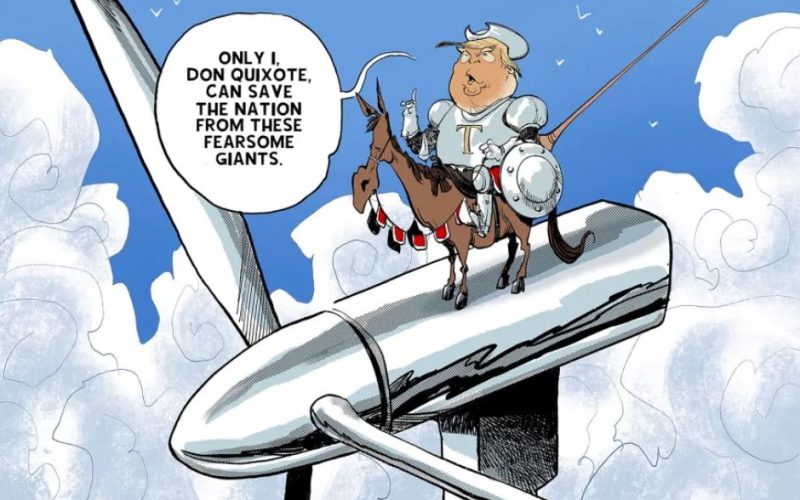
Trump’s show of strength reflects fear of America’s decline. Consequently, this comprehensive analysis dissects how militarist foreign policy posturing, systematic domestic institutional sabotage, economically coercive trade warfare, and accelerating alliance fragmentation collectively expose not American dominance but profound national desperation. First, we meticulously examine the administration’s bellicose international theatrics. Next, we scrutinize the calculated dismantlement of national security infrastructure. Third, we analyze the self-defeating economic warfare producing only illusionary victories. Fourth, we confront the metastasizing nihilistic extremism epidemic flourishing within America’s borders. Finally, we examine the most damning evidence: allies actively hedging against American unreliability. Each symptomatic manifestation independently confirms this troubling diagnosis while collectively portraying a superpower spiraling toward self-inflicted obsolescence.
The Theater of Strength: Why Militarist Grandiosity Betrays Insecurity
Trump’s show of strength reflects fear of America’s decline. Therefore, aggressive diplomatic gestures vis-à-vis independent nations, likr Venezuela, and against Greenland’s steadfast democracy mask profoundly Washington’s institutional insecurity. Seasoned aggressors typically target comparatively weaker opponents; Trump consequently avoids confronting China’s expanding naval fleet or Russia’s revanchist territorial ambitions directly. Instead, he bullies Greenland’s seventy-thousand resilient citizens, threatens steadfast NATO allies with punitive tariffs, and bombards Yemen’s fractured landscape without constitutionally mandated congressional authorization. Accordingly, geopolitical analysts overwhelmingly conclude such tactical posturing signals acute panic, not calculated confidence.
Moreover, America’s once-formidable soft power apparatus has precipitously and perhaps irreversibly eroded. Historically, Washington persuaded through cultural magnetism, educational exchange, developmental assistance, and diplomatic finesse. Currently, Trump possesses neither the patience nor institutional respect for such nuanced statecraft. Consequently, he overleverages the Pentagon—America’s sole remaining uncontested supremacy pillar—for objectives military force cannot possibly achieve. This reckless overreliance, however, invites predictable strategic overextension. Ultimately, every Tomahawk missile launched compensates for comprehensive diplomatic bankruptcy.
Hegemony’s Façade Crumbles: Uncle Sam’s Waning Grip
Trump’s show of strength reflects fear of America’s decline. Hence, second-term foreign policy anchors exclusively upon militaristic compellence rather than traditional diplomatic engagement. The December 2025 National Security Strategy exemplifies this pathology: Kori Schake of the American Enterprise Institute devastatingly characterizes the document as “solipsism masquerading as strategy.” The NSS rightly criticizes prior administrations’ unfocused wishlists, then replicates identical weaknesses while omitting any serious environmental assessment.
It demands an international order where America operates unshackled from allies’ concerns or legitimating institutions, fundamentally misunderstanding why previous hegemons received unprecedented voluntary assistance.
Trump proposes purchasing Greenland through overt territorial acquisition, supplemented by tariff threats and military intimidation. Historically confident superpowers possessing genuine global legitimacy do not purchase sovereign territory like desperate real estate speculators acquiring distressed assets.
Paradoxically, this demonstrative aggression confirms rather than conceals accelerating vulnerability. Consistent historical evidence demonstrates genuinely secure hegemons exercise strategic restraint, confident in their enduring structural advantages. Conversely, fading empires lash out indiscriminately, mistaking violence for vitality. Trump’s contradictory Venezuela policy—simultaneously sanctioning and negotiating—bewilders regional partners.
Domestic Sabotage: President Becomes Nation’s Number One Enemy
Trump projects strength yet fears America’s decline. Turning now to damning domestic critiques, Capitol Hill insiders assert Trump represents the most severe national security threat in American constitutional history. No previous president, nor any foreign adversary operating externally, has so thoroughly incapacitated America’s intelligence gathering capacity, counterterrorism preparedness, and strategic warning infrastructure.
Senator Mark Warner, Intelligence Committee vice chair, warns: “When expertise is cast aside and intelligence is distorted or silenced, our adversaries gain the upper hand and America is left less safe.” Trump embodies the destructive bull charging through institutions carefully constructed over seven decades of bipartisan security state-building.
The August 2025 DIA purge proves instructive. Why did Kruse lose his position? The DIA contradicted Trump. His claim? June airstrikes “obliterated” specified Middle Eastern weapons facilities. The assessment concluded otherwise: the target state suffered only months of setback. Hegseth refused tolerance. He fired Kruse, the Naval Reserve chief, and the Naval Special Warfare Command too.
This pattern extends further. Gabbard revoked thirty-seven security clearances. Victims included current and former intelligence professionals. One target? Vinh Nguyen. He was an NSA data scientist. His specialty? Cyberthreats. He also specialized in the AI contest with China. His expertise was uniquely scarce. It was strategically vital. Nevertheless, he fell victim. Why? Presidential vengeance. The offense? The 2017 Russia assessment.
Simultaneously, Gabbard announced the first major Office of the Director of National Intelligence overhaul since its creation, slashing personnel exceeding forty percent by October 2025 while saving seven hundred million dollars annually. Hegseth has systematically purged uniformed leadership: Air Force General C.Q. Brown, Chairman of the Joint Chiefs of Staff, departed alongside five other admirals and generals in an unprecedented military leadership shake-up.
Into these critical vacancies, Trump installed loyalists. Pete Hegseth became Defense Secretary yet possesses negligible executive experience. Tulsi Gabbard directs National Intelligence despite troubling authoritarian sympathies. Pam Bondi serves as Attorney General yet holds minimal criminal justice credentials.
Kash Patel leads the FBI despite publicly endorsing Bureau dismantlement. Sergio Gor, a political fundraiser with no diplomatic credentials, becomes ambassador to India. Charles Kushner, a real-estate developer and convicted felon granted presidential pardon, assumes the ambassadorship to France. Thus, their principal professional qualification remains unquestioning personal fealty.
Indeed, Trump has decapitated our democratic institutions and alienated our allies by imposing indiscriminate tariffs. Although a plethora of observers deem Trump personally a buffoon, his backers in Washington, D.C., are not—yet they cannot stop him. Broadcasting insults globally, he threatened NATO withdrawal. He withheld Ukrainian defensive assistance. He demanded Greenland’s incorporation and egregiously asked for Canadian provinces to join American territory. These irrational demands persist.
Consequently, fear now consumes inward. Once, America projected fear outward. Now, institutional paranoia becomes official policy. Partisan loyalty becomes government’s sole credential. This lens reveals everything.
Tariff and Tech Warfare
Trump’s show of strength reflects fear of America’s decline. Beyond visible missile deployments and naval carrier group maneuvers, Trump’s aggressive economic statecraft reveals identical pathological patterns. His April 2025 “reciprocal tariff” policy—announced with maximal fanfare yet implemented using conspicuously nontransparent calculation methodology—represents protectionism weaponized for domestic spectacle rather than strategic gain.
Superficially, the tariffs generated $287 billion in additional customs revenue, 96% percent borne by American importers. Imports from China declined twenty-seven percent through October 2025, the steepest bilateral reduction observed. Yet these numbers deceive. US imports from China had already fallen nineteen percent between 2022 and 2024 amid preexisting tensions. More damningly, China’s global trade position remains robust; Beijing simply diversified export destinations and reconfigured supply chains through Vietnam (imports up 40%), Taiwan (61% increase), and Mexico (5% growth). American protectionism did not weaken China—it merely rerouted commerce through intermediate nodes.
Manufacturing output responded anemically: one percent growth despite unprecedented trade barriers. Labor shortages from tightened immigration rules constrained industrial expansion. Consumer prices absorbed tariff costs, contributing to persistent inflation rather than relief. The US trade balance deteriorated by $69 billion. Trump’s signature economic intervention thus achieved revenue extraction while failing every stated strategic objective.
Simultaneously, the Trump administration imposed sophisticated export controls restricting advanced artificial intelligence chips destined for Chinese markets, yet gutted enforcement agencies required to police these complex restrictions. Consequently, smuggling networks rapidly circumvented regulations American inspectors lacked manpower to investigate.
Meanwhile, Trump’s personal financial entanglements raise urgent, unanswered questions regarding whose interests his “America First” economic nationalism actually serves. The 2025 disclosure revealing $780 million in UAE-backed entity loans demands thorough congressional examination. Trump’s show of strength reflects fear of America’s decline, nowhere more visibly than his frantic, intellectually incoherent attempts commanding global commerce through improvisational bluster rather than coherent strategic doctrine.
Alliance Hedging: Allies Prepare for Post-American Order?
Trump’s show of strength reflects fear of America’s decline. Perhaps no evidence confirms this thesis more devastatingly than allied behavior during Trump’s second term. Nations do not hedge against indispensable partners; they hedge against unreliable ones whose commitment has become contingent and capricious.
Kori Schake’s Foreign Affairs analysis identifies the administration’s fatal conceit: assuming other countries possess no alternative to capitulation, and that even if alternatives emerged, America could remain predominant without allies. One year into Trump’s return, this assumption lies in ruins. Japan and South Korea actively consider three-way trade arrangements with China—Beijing—as insurance against US tariff weaponization. Europeans, having sheltered comfortably under the American defense umbrella since 1945, now scramble constructing defense industrial capacity disconnected from American firms. They witnessed Washington disable Ukraine’s intelligence feeds and suspend weapons deliveries; they draw appropriate conclusions.
Most alarmingly, Britain and the Netherlands—America’s closest intelligence-sharing partners, bound by blood and decades of sacrifice—now restrict intelligence shared with the United States. They explicitly disapprove of American policy and distrust American custody of their secrets. When the Five Eyes alliance frays, when London and The Hague limit cooperation with Washington, the hegemon’s decline is no longer theoretical projection but operational reality. Trump’s show of strength reflects fear of America’s decline, and allied intelligence directors whispering to their American counterparts—withholding, redacting, compartmentalizing—provide its most devastating confirmation.
When Fear Becomes Prophecy: Decline Obsession Paradox
Trump’s show of strength reflects fear of America’s decline. Turning now toward tangible comparative metrics, America’s strategic challenges extend far beyond abstract theoretical speculation. The U.S. military no longer commands the unchallenged qualitative and quantitative supremacy characterizing previous decades. China currently possesses more total naval hulls, a larger active-duty uniformed force, and rapidly expanding nuclear modernization programs. Pentagon Net Assessment projections estimate Beijing could plausibly field over one thousand operational thermonuclear warheads by 2030—more than triple its 2020 inventory and approaching American and Russian deployed arsenals.
Nevertheless, the gravest immediate danger may reside not within these measurable capability metrics but within the excessive, paralytic fixation upon decline itself. This obsessive preoccupation risks becoming self-fulfilling prophecy. Were America genuinely confident regarding its enduring power, Trump would enlist European allies securing Greenland’s geostrategic territory rather than alienating Copenhagen through acquisition demands, thereby freeing constrained naval resources for higher-priority Indo-Pacific commitments.
Yet by bullying treaty partners through coercive diplomacy, he actively dismantles the alliance network constituting American strength’s institutional backbone since 1945. Trump’s show of strength reflects fear of America’s decline, and sober American observers now concur that through this fear, he dramatically accelerates the very erosion he purports to arrest—transforming latent potential into manifest peril through Trumpism’s fundamentally misbegotten doctrinal tenets.
Nihilism’s Shadow: Extremism’s Chilling New Form
Trump’s show of strength reflects fear of America’s decline. Finally, escalating this comprehensive narrative concerning national institutional decay, a genuinely novel extremist violence manifestation has emerged—one entirely untethered from traditional political grievance frameworks or religious ideological conviction, rooted instead within philosophical world-rejection. The Institute for Strategic Dialogue’s 2024 year-in-review analysis documents this transformation with chilling precision: two-thirds of all deaths and nearly two-thirds of all injuries from extremist violence now emanate from individuals unassociated with defined ideologies.
These perpetrators embrace nihilistic violence communities glorifying mass murderers while rejecting any positive political project. They seek not to transform America but to destroy civilization itself. Three juveniles linked to the “True Crime Community” subculture committed school shootings in Iowa, Georgia, and Wisconsin, accounting for eight deaths and twenty-one injuries—two-thirds of all fatalities, nearly two-thirds of all wounds. One Wisconsin seventeen-year-old murdered his parents, plotted to assassinate President Trump, and aimed to overthrow the US government. A twenty-five-year-old California man detonated a large explosive device destroying a reproductive health clinic. A fourteen-year-old Oregon juvenile attempted mass shooting at a Washington State shopping center.
The FBI now categorizes such offenders as “Nihilistic Violent Extremists”—individuals whose primary motivation constitutes hatred toward society and desire for chaos, destruction, and collapse. Networks including “764” and the “Order of Nine Angles” target minors through social media and gaming platforms, coercing self-harm, animal cruelty, and eventual violence. Eighty percent of Americans now believe their nation “extremely divided.” Simon Purdue, an international terrorism scholar, observes: when violence-enamored individuals perceive their existence meaningless, attack probability increases dramatically.
What fundamentally facilitates these nihilistic terrorists’ operational capacity within the contemporary era constitutes ubiquitous internet access and sophisticated artificial intelligence tools enabling autonomous planning; during previous decades, socially isolated, violently inclined outcasts struggled enormously planning coordinated assaults. The web now supplies comprehensive technical explosives expertise, weapons modification guidance, and tactical maneuvering instruction. Despite profound social isolation, contemporary technology enables discovering like-minded nihilist communities, thereby transforming idiosyncratic pathology into coordinated threat.
Trump’s show of strength reflects fear of America’s decline, yet that corrosive fear has tragically metastasized into something considerably darker—a comprehensive national unraveling that philosophical nihilism merely completes through existential violence.
Conclusion: How Trump Charts America’s Self-Immolation
Trump’s show of strength reflects fear of America’s decline. What ultimately emerges from this extensive institutional anatomy concerning accelerating national decay constitutes not merely descriptive policy failure portraiture but urgent, unmistakable warning.
The profound convergence between militarist international grandiosity, systematic domestic institutional dismantlement, economically incoherent trade warfare doctrine, accelerating allied hedging against American unreliability, and nihilistic metastasizing domestic violence epidemiology irrefutably confirms that no foreign adversary, however determined, could possibly have engineered this comprehensive ruin.
Trump’s show of strength reflects fear of America’s decline, and America’s precipitous decline, if permitted continuing trajectory, will not have been inflicted from without through traditional great-power competition dynamics—it will have been self-administered, cosigned into irreversible effect by a leader tragically mistaking petulant tantrums for presidential toughness and institutional demolition for national dominance.
Reversing this catastrophic course remains technically possible. However, such restoration urgently requires national awakening toward profoundly uncomfortable truth: America’s gravest existential enemy has long resided not within Tehran’s mosques, Beijing’s politburos, or Moscow’s Kremlin—but comfortably within its own institutional walls, signed onto executive orders bearing presidential seal.