
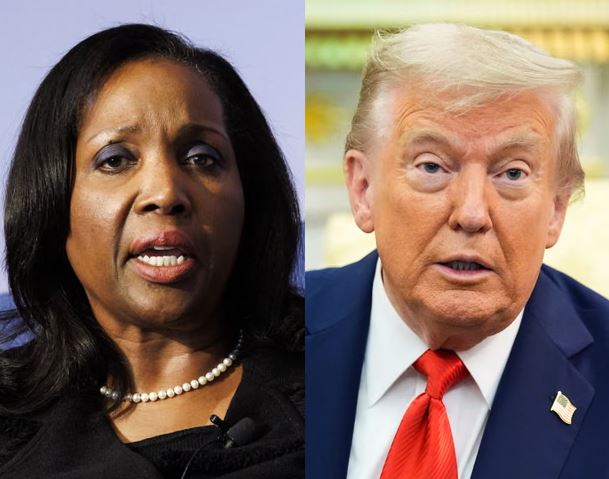
Donald Trump’s renewed attempt to remove Federal Reserve Governor Lisa Cook from her office has created another major controversy over presidential power, political influence, and the federal reserve’s independence. Critics argue that Trump’s aggressive campaign against Cook is not simply about alleged mortgage issues, but part of a broader effort to reshape the Federal Reserve according to his own economic preferences.
The Trump administration has accused Lisa Cook of making false statements related to mortgage applications before she joined the Federal Reserve. The allegations focus on claims that Cook may have provided inaccurate information regarding the use of certain properties when applying for mortgage loans.
However, Cook has strongly denied any wrongdoing and has argued that the accusations do not justify her removal from the Federal Reserve. She has claimed that the effort to dismiss her has a political motivation and represents an attempt by President Trump to gain greater influence over an institution that traditionally stands independent from the White House.
The Battle for the Fed’s Soul
But the deeper conflict goes beyond one individual. At the center of this battle is the question of whether the president should be able to pressure the Federal Reserve into following his political agenda. For decades, the Fed has operated independently from the White House because many economists believe that short‑term political interests of presidents should not control monetary policy. They argue that interest rates, inflation decisions, and financial regulations require professional judgment rather than electoral calculations, and economists consider them as issues that require that professional judgment to safeguard the federal reserve’s independence.
Trump has repeatedly demanded lower interest rates, claiming that cheaper borrowing would help the economy. However, the Federal Reserve has often resisted political pressure, emphasizing that it should base its decisions on economic data rather than presidential demands.
This conflict has raised concerns that Trump wants to replace independent officials with people who are more willing to support his economic priorities. Opponents describe this as an attempt to weaken institutional checks and balances. They fear that if presidents can remove Federal Reserve officials simply because they disagree with monetary policy decisions, they could damage the independence of the entire financial system in the long run.
The High-Stakes Clash Over Monetary Policy
The controversy also highlights Trump’s broader approach to institutions that limit presidential authority. Critics believe Trump has repeatedly shown frustration toward judges, government agencies, intelligence officials, and other independent bodies whenever they challenge his decisions. They argue that his political strategy often involves attacking institutions rather than accepting their independent role in the democratic system of the United States.
Some economists have also warned that uncertainty surrounding the Federal Reserve could negatively affect markets and public confidence. Investors generally value stability and predictability, and political battles over the federal reserve’s independence may create doubts about the future direction of economic policy.
Trump, however, has so far failed to remove Cook from her position. The Supreme Court previously blocked Trump’s first attempt to do so, emphasizing the importance of legal procedures and due process to make a decision like this. The renewed effort has now become another legal and political confrontation between the White House and an independent institution.
The Historic Stakes: Symbolism and Political Showdown
After Trump tried to remove her last year, she made statements that were clearly a rejection of his actions and his authority. The strongest statements from Cook were: “I have no intention of allowing anyone to bully me to step down from my position because of some questions that someone raised in a tweet.” She also stated that “President Trump purported to fire me ‘for cause’ when no cause exists under the law, and he has no authority to do so.”
The controversy surrounding Lisa Cook also carries symbolic importance. Cook, who has served as a member of the Federal Reserve’s Board of Governors since 2022, became the first Black woman to hold a position on the powerful seven‑member board, marking a historic moment in the institution’s history. Some supporters believe that targeting her position represents not only a political struggle but also an attack on diversity within major American institutions.
Supporters of Trump, however, deny all these grounded facts and believe that a president should have greater authority over government officials and that accountability is necessary when serious allegations emerge. They claim that the administration is not attacking the federal reserve’s independence but simply demanding responsibility from powerful officials.