
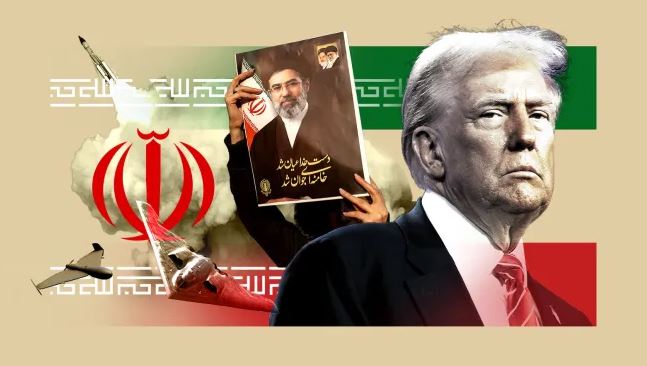
U.S. President Donald Trump is increasingly frustrated with Iran as his administration struggles to secure a concession from the country. After accusing Tehran of being “unbelievably duplicitous,” Trump admitted that dealing with its leaders had become a source of irritation. “All they do is make me angry,” he told reporters Monday. “They just make me angry.” The remarks come as negotiations over reopening the Strait of Hormuz remain deadlocked, with Tehran refusing to abandon its demand for transit fees—a condition Trump has repeatedly rejected. Trump’s war on Iran has entered a phase where military and economic pressure have yet to produce the diplomatic breakthrough his administration initially anticipated.
Months after escalating pressure on Iran, the White House has not achieved a major diplomatic victory. The continued impasse has prolonged uncertainty in global energy markets, with tensions around the Strait contributing to volatile oil prices and adding pressure on the U.S. economy.
Analysts say Trump has encountered the same obstacle that frustrated generations of American presidents: Iran’s leadership resists both military coercion and diplomatic pressure. Kenneth Pollack, a former CIA analyst, argued that Trump combined an unprecedented willingness to use force with a strong desire for a comprehensive agreement, yet neither strategy has delivered the outcome he sought. “Trump’s experience reflects a broader pattern in U.S.-Iran relations, where neither pressure nor incentives have been sufficient to fundamentally change Tehran’s behavior,” he noted.
An Unraveled Gambit: The Airstrike That Backfired
Trump appeared confident that the February 28 airstrike assassinating Supreme Leader Ali Khamenei would fundamentally reshape Iran’s political landscape. He publicly urged Iranians to overthrow their government and suggested he would help determine the country’s next leader. Instead, Tehran’s ruling establishment quickly consolidated power, appointing Imam Khamenei’s son, Ayatollah Mojtaba Khamenei, as the new Supreme Leader. The most dramatic gamble in Trump’s war on Iran—the assassination of the country’s top leader—thus backfired, as the instant succession ruined Washington’s hopes for regime change. Despite Trump declaring Ayatollah Mojtaba Khamenei an unacceptable successor, Tehran ignored the warning altogether.
Since the war began, Iran has remained open to negotiations on specific issues such as the nuclear program and the Strait of Hormuz, but it has firmly rejected broader political reconciliation. Iranian leaders argue that normalizing relations with the United States would undermine the ideological foundations of the Islamic Republic.
Trump’s own assessments of Iran’s leadership have shifted repeatedly, from “reasonable” and “very smart” to “lunatics” and “stone cold crazy”—reflecting the administration’s difficulty in finding an effective approach.
The Echoes of History: Why Coercion Fails in Tehran
Foreign policy experts argue that Washington has long underestimated the ideological foundations and institutional cohesion of the Islamic Republic. Suzanne Maloney of the Brookings Institution said the recent conflict has strengthened Iran’s religious and military leadership, leaving no meaningful alternative center of power capable of altering the country’s strategic direction. She also noted that decades of limited direct contact between senior American and Iranian officials “have left Washington with an incomplete understanding of the decision-making process inside Iran’s leadership.” The frustrations central to Trump’s war on Iran are not new: Jimmy Carter failed to resolve the hostage crisis, Ronald Reagan’s harsh approach led to the Iran-Contra scandal, and Bill Clinton’s efforts to engage reformist President Mohammad Khatami were ultimately blocked by Tehran’s hardliners.
Only Barack Obama achieved a significant diplomatic breakthrough with the 2015 nuclear agreement, but hopes that it would transform relations faded after Trump withdrew from the deal in 2018 and restored sweeping sanctions. That move prompted Iran to expand its nuclear program, setting the stage for renewed confrontation and deepening mistrust.
The Stalemate as Strategy: Tehran’s Waiting Game?
Analysts say the continued deadlock underscores the difficulty Trump has faced in translating military pressure and economic sanctions into political leverage over Iran. Tehran, on the other hand, interprets America’s desire for rapid results as a negotiating weakness, allowing its decision-makers to preserve core positions while waiting for political conditions to shift. Yet the stalemate at the heart of Trump’s war on Iran is not a tactical failure but a strategic logic: U.S. resolve, Tehran calculates, will fracture before Iran’s. Rising fuel prices and market jitters translate into domestic political pain for Trump, eroding credibility for his maximum-pressure campaign. Meanwhile, presidential outbursts reinforce Tehran’s narrative of U.S. unreliability, insulating the regime from internal dissent.
This exposes a fundamental asymmetry: Washington seeks a quick fix, while Tehran treats survival as its sole irreducible interest. Absent a credible diplomatic framework that addresses Iran’s security without demanding ideological surrender, the cycle grinds on. The administration lacks both an escalation path and a face-saving exit—leaving only performative anger and empty ultimatums. In this grim arithmetic, the Islamic Republic concludes that outlasting a single U.S. presidency is easier than conceding its revolutionary identity. Until that changes, the deadlock is not a tactical failure—it is the logical endpoint of hubris, not insight.