
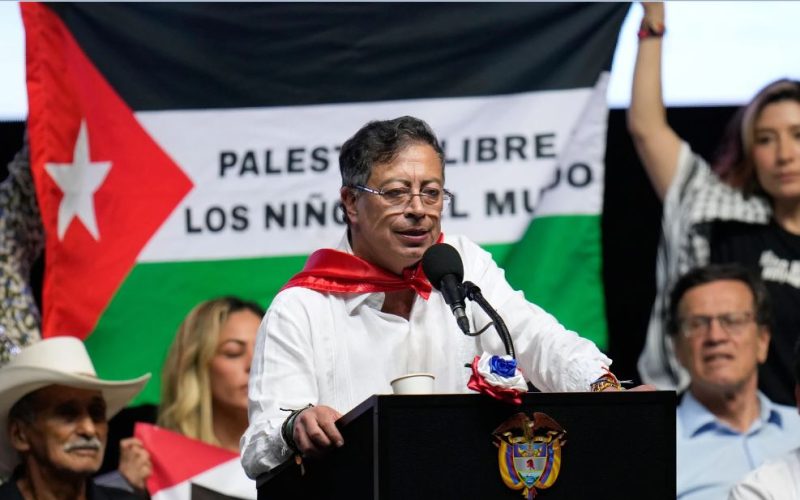
On October 19, 2025, President Donald Trump announced the suspension of all US aid to Colombia and the imposition of tariffs, Read sanctions, on its exports, calling President Gustavo Petro an “illegal drug leader.” This decision came after US military strikes in the Caribbean Sea targeting Colombian ships. The Colombian government denounced these indiscriminate attacks as violations of its sovereignty and recalled its ambassador. The currency devaluation and reduced foreign investment underscore growing economic instability. This escalation is part of a US foreign policy reviving the Monroe Doctrine, considering Latin America as its exclusive sphere of influence. Trump and his advisors describe this approach aimed at countering the influence of China in the region.
Bloody Past: US Interventions in Colombia
Relations between the United States and Colombia are marked by military interventions that have shaped the country’s recent history and fueled decades of civil war. US involvement began in the 1960s, during the Cold War, with efforts to counter communist influence and support authoritarian regimes, notably under the government of Gustavo Rojas Pinilla (1953-1957), and later with support for the fight against the FARC guerrillas.
Plan Lazo, launched in 1994 under President César Gaviria, aimed to stabilize the country but also led to numerous human rights violations and a military buildup in response to rising violence. Subsequently, Plan Colombia, launched in 2000 under President Andrés Pastrana, claimed to combat drug trafficking and restore security, but led to an intensification of violence. This plan enabled military strikes, often to the detriment of the civilian population, and was used to justify operations against guerrillas, particularly the FARC and the ELN.
The Colombian armed forces, supported by the United States, were accused of collusion with paramilitary groups, notably the United Self-Defense Forces of Colombia (AUC), which further exacerbated the internal conflict. The result of all these interventions was catastrophic: nearly six decades of armed conflict, with approximately 220,000 deaths and more than 7 million displaced, leaving a deeply divided and wounded country.
Recent Strikes and Political Pressure
US strikes in the Caribbean Sea have killed at least 32 civilians. Observers and local officials dispute the official motives, suggesting that these operations are aimed more at pressuring the Colombian government than combating drug trafficking. This pressure reveals a strategic paradox: reducing US aid could weaken Colombia’s counter-narcotics capabilities while fostering more autonomous solutions adapted to the situation on the ground. Petro’s support for Palestine has exacerbated tensions with the United States, perceived as a sign of defiance toward traditional US allies, particularly Israel. This geopolitical divergence is contributing to the deterioration of bilateral relations and the intensification of US punitive measures.
Petro and Palestine: A Challenge for Washington
The UN and several Latin American countries have expressed concern about the escalating tensions. At the same time, Colombia is seeking to strengthen its relations with Mexico, Brazil, and other nations to create a common front against US pressure and promote an independent regional policy.
The suspension of aid and the imposition of tariffs have major consequences for Colombia, whose economy is heavily dependent on exports to the United States. Signs of instability include currency devaluation and reduced foreign investment, increasing economic vulnerability to US measures.
US Pressure on the Colombian Economy: The Paradox of the So-Called War on Drugs
Faced with the isolation imposed by Washington, Colombia is exploring regional alliances and South American cooperation mechanisms. The objective is to reduce dependence on the United States, strengthen national sovereignty, and develop an autonomous security and economic development policy. While the reduction in U.S. aid may compromise the fight against drug trafficking, it offers Colombia the opportunity to design strategies more suited to its local realities, without conforming to Uncle Sam’s new dictates. This highlights the dual nature of U.S. interventionism: economic and military coercion on the one hand, and an opportunity for autonomy on the other.
Conclusion: A New American War Against Colombia?
The U.S. offensive goes beyond the war on drugs. It reflects an imperialist strategy aimed at maintaining U.S. hegemony, punishing an ally for its stance on Palestine, and reaffirming the Monroe Doctrine. The situation raises crucial questions about the future of inter-American relations and respect for the sovereignty of Latin American nations. After Venezuela, Trump is waging war against Colombia, revealing the persistence of an interventionist and coercive policy in Latin America.