
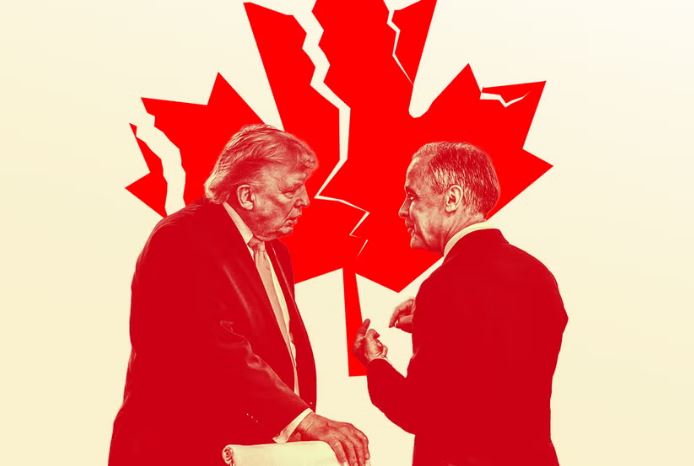
Trump’s trade war with Canada is becoming increasingly serious, raising concerns not only about the economic costs of President Donald Trump’s tariff policy but also about the damage it could do to one of America’s closest allies.
Early this week, Trump imposed new tariffs on a range of Canadian goods, and Canada responded with retaliatory measures of its own. Negotiations between the two countries have also reached an impasse, increasing the risk of further escalation. The dispute is particularly significant because Canada is not a strategic rival of the United States. It is one of Washington’s closest political, economic and military partners.
The two countries cooperate closely through NATO, NORAD and extensive intelligence and security arrangements. Their economies also integrate deeply, with American and Canadian companies relying heavily on cross-border supply chains. This makes Trump’s repeated use of tariffs against Canada especially controversial.
For long, the Republican president has argued that tariffs can protect American industries, encourage domestic production and force other countries to make concessions. However, using tariffs against allies as a routine instrument of pressure can create costs that go far beyond the immediate trade dispute.
Who Pays the Price? Consumers, Companies, and Supply Chains
The biggest problem with Trump’s trade war with Canada is the impact on American consumers and businesses. Importers pay tariffs, which means that American companies importing Canadian products can face higher costs following the new tariffs. Those companies may then pass some of those costs on to consumers through higher prices. The new tariffs can also force businesses to find new suppliers, reorganize production or delay investment.
The Tax Foundation estimates that Trump’s 2026 tariffs amount to roughly a $900 increase in taxes per American household on average. At the same time, the organization has argued that tariffs have not produced a meaningful change in the U.S. trade deficit. This raises a fundamental question: if Americans are paying more but the trade deficit is not changing significantly, what is the long-term economic benefit at all?
The automotive industry provides a clear example of the risks. American and Canadian factories connect deeply, with vehicles and components crossing the border multiple times during the manufacturing process. Tariffs on Canadian vehicles and parts can therefore hurt Canadian producers, but they can also increase costs for American manufacturers that depend on Canadian suppliers.
Beyond the Balance Sheet – The Erosion of Trust and Alliances
The biggest concern, however, regarding Trump’s trade war with Canada, may not be economic, it may be strategic. Trump’s approach risks damaging America’s relationships with the very countries Washington needs as partners. Canada is only one example of a broader pattern in which tariffs and economic threats have increasingly become tools for dealing with traditional U.S. friends. This could have serious consequences over time.
Alliances build not only on military agreements but also on trust. If America’s partners begin to believe that Washington can suddenly impose large tariffs whenever negotiations become difficult, they may start looking for ways to reduce their dependence on the American economy. In response to U.S. tariffs, Canada and other allies could diversify their trade, develop alternative supply chains and strengthen economic relationships with other countries. Such decisions would not necessarily stem from hostility toward the United States.
They could simply be attempts to protect themselves from future American policy changes. America’s global influence depends partly on the enormous strength of its economy, but it also depends on its network of allies.
Winning the Battle, Losing the War? America’s Global Standing at Stake
The United States has spent decades building partnerships that give it enormous diplomatic, military and economic advantages. Alienating those partners through Trump’s trade war with Canada could gradually weaken that position. This is where Trump’s tariff strategy deserves its strongest criticism.
A president can win a short-term negotiation and still lose strategically. Forcing Canada to make a temporary concession may produce a political victory, but damaging the broader U.S.-Canadian relationship could create costs for the U.S. that last much longer. Trump’s strategy appears to focus heavily on leverage: impose tariffs, create economic pressure and demand concessions. The missing question is what happens after we apply the pressure.
If America’s allies become less willing to trust Washington, if American companies face higher costs, if consumers pay more and if the trade deficit remains largely unchanged, the United States may ultimately be weakening itself in pursuit of short-term gains. We should therefore see the Canada dispute as more than another argument over tariffs. It represents a broader debate about America’s role in the world.