

Today, our nation confronts an economic descent where confidence collapses faster than indicators, revealing deep structural damage under Trump’s erratic governance. The U.S. economy slides into recession under Trump, according to public perception, as a recent Harris Poll exposes widespread financial despair shaping modern American economic attitudes. Survey results show Americans increasingly perceive material decline despite official growth figures, highlighting a profound disconnection between data and households nationwide.
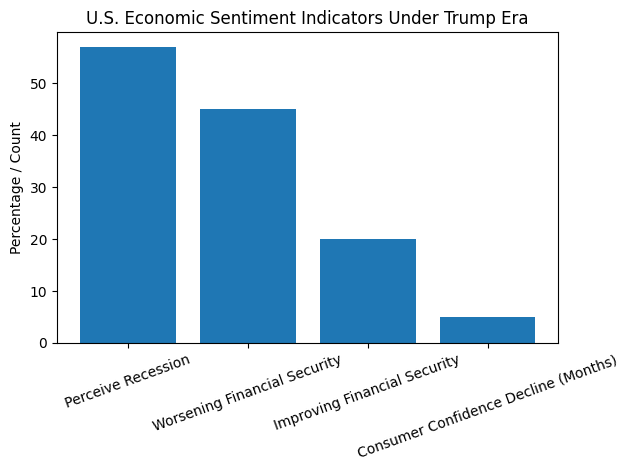
45% of respondents report worsening financial security, while only twenty percent describe improvement, signaling asymmetric economic deterioration across society. 57% of Americans now believe the nation is experiencing recessionary conditions, representing an eleven-point increase since February.
Economists define a recession through consecutive negative growth quarters, yet Americans respond instead to lived instability under Trump and pervasive economic uncertainty.
Strong summer growth numbers failed to restore confidence, demonstrating that macroeconomic expansion cannot offset policy-induced insecurity within American households today.
Trade tariffs, federal layoffs, and immigration crackdowns compounded anxiety, destabilizing expectations across labor markets and communities nationwide during Trump’s tenure. The Conference Board reports consumer confidence declining for five consecutive months, confirming persistent erosion rather than temporary pessimism among American consumers.
Trump nevertheless claims economic revival, asserting that prices are falling rapidly, yet households observe mounting costs that contradict presidential rhetoric daily. This divergence between official optimism and public hardship illustrates governance failures rooted in policy volatility and credibility loss.
Economic sentiment functions as a leading indicator, and current pessimism forecasts prolonged stagnation rather than imminent recovery for the American economy. Under Trump, psychological contraction accelerates, undermining investment confidence, consumption behavior, and long-term productivity expectations simultaneously across multiple economic sectors.
Markets may celebrate numbers, but families measure economics through stability, affordability, and predictability—qualities increasingly absent under Trump’s administration.
Confidence erosion magnifies downturn risks, because fear suppresses spending, hiring, and entrepreneurial risk-taking throughout the American economy. The poll therefore captures more than sentiment, revealing structural fragility embedded within Trump-era economic management across federal policy institutions.
Ignoring this warning risks entrenching decline, as psychological recession often precedes measurable contraction in output and employment. We stand at an inflection point where denial deepens damage, and accountability offers the only path to economic stabilization and recovery.
Political Accountability and the White House’s Eroding Economic Credibility
It appears that an increasing number of us are assigning responsibility for economic deterioration directly to federal leadership rather than to abstract market forces or private corporations.
The Harris Poll documents a decisive shift, with the White House increasingly blamed for rising prices and declining financial stability nationwide.
76% of Democrats attribute inflationary pressures to government economic management, reflecting a seventeen-point increase since February. Independents echo this judgment, with seventy-two percent blaming federal policy choices, marking a fourteen-point surge within ten months. Republicans demonstrate comparatively lower attribution toward government responsibility, yet fifty-five percent still fault federal leadership for price increases.
Only forty-five percent of Republicans identify corporate practices as the primary drivers of rising costs across our economy.
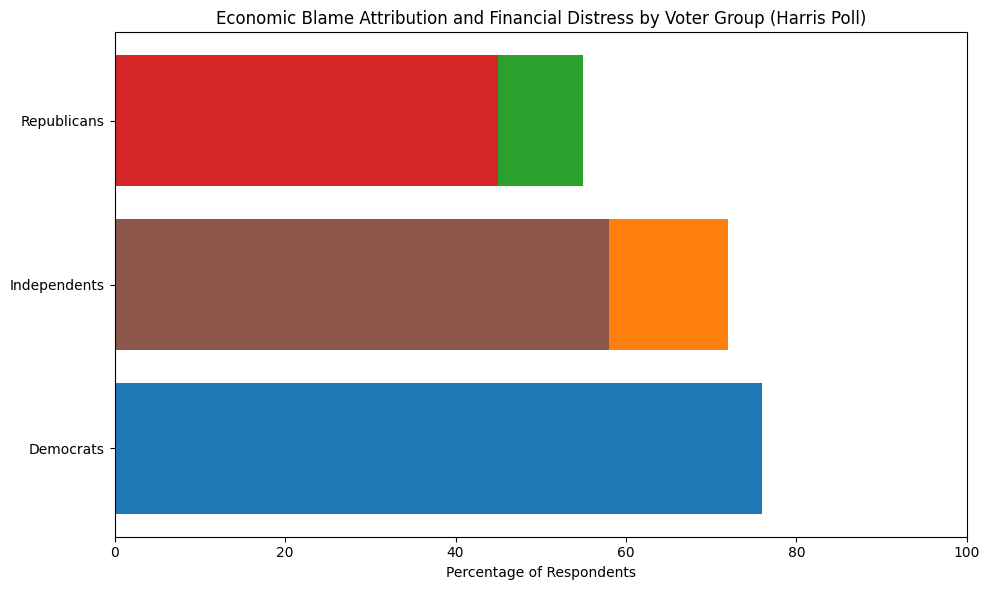
These patterns reveal shrinking political insulation for Trump’s economic narrative across both partisan and independent voter blocs.
Trump publicly insists that his administration rescued the economy from ruin, framing policy outcomes through triumphalist rhetorical assertions.
During a mid-December address, Trump claimed that prices were declining rapidly under his leadership, projecting confidence and economic control rhetorically.
Polling data directly undermines that assertion, exposing widening gaps between presidential messaging and household financial realities. Economic trust erodes when lived experience contradicts official pronouncements, weakening institutional credibility and governance effectiveness. Independents represent the most electorally decisive group, and Trump has failed to persuade them on economic performance. Fifty-four percent of independents now report worsening financial conditions, reflecting a nine-point deterioration since February surveys. Additionally, 58% of independents believe the nation is currently experiencing recessionary conditions under Trump’s administration. As the U.S. economy slides into recession under Trump, political accountability increasingly concentrates at the executive level rather than dispersing across markets.
These figures signal mounting accountability pressures as congressional elections approach amid widespread economic dissatisfaction. Economic legitimacy sustains political authority, and Trump’s administration increasingly lacks that foundational public confidence. The consolidation of blame around federal leadership amplifies risks of policy paralysis and market instability moving forward.
Gendered, Racial, and Income-Based Economic Fractures Deepen
Economic pessimism reveals stark demographic disparities, exposing uneven distribution of hardship under Trump’s economic framework.
Women express significantly greater concern than men regarding national economic conditions and personal financial security.
62% of women believe the United States is experiencing a recession, reflecting a twelve-point increase since February. Only 52% of men share that belief, highlighting divergent economic perceptions along gender lines.
Half of women report worsening financial security, compared with thirty-nine percent of men. Racial divisions further intensify pessimism across the American electorate under current economic conditions.
Sixty-six percent of Black Americans believe the nation endures recessionary conditions under Trump’s leadership.
Similarly, sixty-seven percent of Hispanic Americans perceive recession, representing widespread minority economic distress.
Among white Americans, recession belief declines to fifty-two percent, underscoring racialized economic experiences across communities.
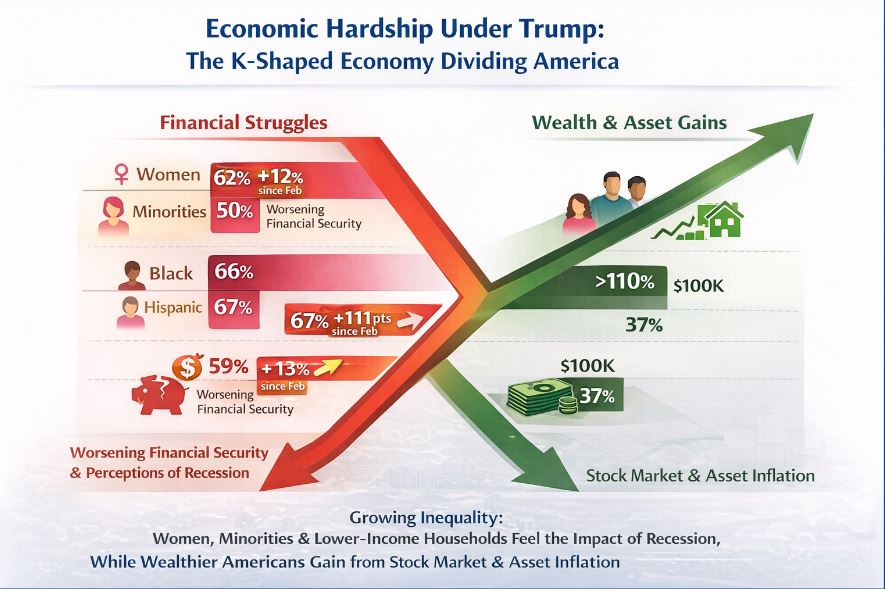
Hispanic pessimism surged eleven points since February, marking the largest increase among all racial groups surveyed.
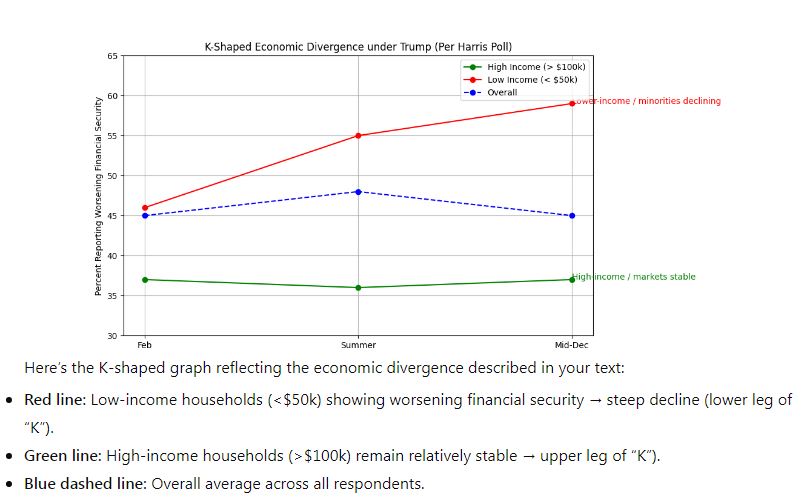
Income stratification reinforces what analysts describe as a K-shaped economy dividing winners from losers. 59% of Americans earning below fifty thousand dollars report worsening financial security, up thirteen points since February, demonstrating accelerating pressure on lower-income households. By contrast, only thirty-seven percent of Americans earning above one hundred thousand dollars report similar deterioration.
As the U.S. economy slides into recession under Trump, these demographic gaps widen, exposing structural inequities embedded within current policy outcomes.
Asset inflation and stock market gains disproportionately benefit wealthier Americans, deepening inequality perceptions.
Economic divergence undermines social cohesion and long-term growth prospects by suppressing upward mobility.
Such disparities forecast sustained instability absent deliberate corrective policy interventions addressing distributional imbalances.
Bond Markets Signal Fragility Beneath Artificial Stability
Financial markets increasingly reflect tension between Trump’s fiscal ambitions and investor tolerance for mounting debt levels.Trump’s Liberation Day tariffs triggered bond market upheaval in April, forcing abrupt policy recalibration by the administration. Benchmark ten-year Treasury yields spiked sharply following tariff announcements, alarming investors and policymakers alike. On November 5th, Treasury signaling about increased long-term debt issuance reignited bond market volatility concerns.
Simultaneously, Supreme Court hearings questioned tariff legality, threatening revenue streams supporting thirty trillion dollars in debt. Ten-year yields jumped over six basis points that day, among the largest recent single-session increases.
Citigroup analyst Edward Acton described the moment as a sobering reality check for fiscal sustainability. Executives overseeing trillions in assets describe an ongoing standoff between investors and the Trump administration.
Rising term premiums indicate investors demand greater compensation for holding long-dated U.S. government debt. Bond markets possess unmatched power to discipline governments, a dynamic Trump encountered during April’s selloff. Treasury Secretary Scott Bessent emphasizes yield suppression, recognizing borrowing costs affect households, corporations, and federal deficits. Bessent frames himself as America’s chief bond salesman, measuring success through declining yields.
Behind-the-scenes outreach to investors temporarily calmed markets, convincing some that the administration prioritizes stability.
However, investors warn these measures merely delay confrontation rather than resolve fiscal imbalances. The United States continues financing deficits near six percent of GDP annually. As the U.S. economy slides into recession under Trump, bond investors increasingly scrutinize fiscal credibility rather than political assurances. Tariffs, artificial intelligence market bubbles, and accommodative monetary policy threaten renewed volatility. This fragile equilibrium depends on confidence rather than sustainable fiscal restructuring.
Financial Repression Masks Structural Risk and Future Instability
The administration increasingly relies on unconventional measures to suppress yields and finance persistent deficits. Treasury expanded bond buyback programs focusing on long-dated securities, raising concerns about yield manipulation. Some investors interpret buybacks as efforts to cap long-term rates rather than improve liquidity.
Treasury advisers debated whether these actions effectively shorten government debt maturity profiles. Short positions against long-dated Treasuries declined during summer, reflecting temporary investor reassurance.
Recently, those bearish positions have begun increasing again, signaling renewed skepticism. The government leans heavily on short-term Treasury bills rather than long-term bonds to fund deficits Bank regulators received encouragement to ease constraints on Treasury bond purchases by financial institutions
Analysts project reduced long-term debt issuance despite unchanged deficit expectations next year. Federal Reserve balance sheet stabilization supports demand for short-dated government securities. The administration’s embrace of cryptocurrencies introduces stablecoin issuers as significant Treasury bill buyers.
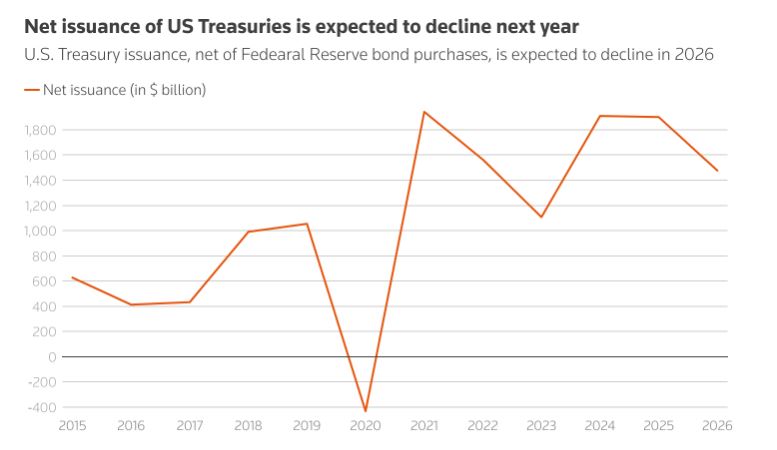
Bessent predicts the stablecoin market could expand tenfold, boosting demand for short-term government debt. However, reliance on volatile demand sources introduces additional systemic risk.
Some officials previously criticized heavy short-term borrowing for refinancing vulnerabilities during rate spikes. As the U.S. economy slides into recession under Trump, financial repression increasingly substitutes for comprehensive fiscal reform. Currency depreciation and yield spikes following April tariffs resembled emerging market dynamics, alarming policymakers.
Temporary calm obscures unresolved debt sustainability challenges confronting the American economy. Absent a credible long-term strategy, suppression gives way to reckoning, and markets eventually enforce reality.