
At a strip mall in Hyattsville, Maryland, the line forms before dawn in the bitter cold of a February morning. Students stand alongside delivery workers and federal contractors, all waiting silently to sign up for food assistance without complaint. Shirleyann Desormeaux, a fifty-eight-year-old chef supporting four children on limited income, sums up the new American reality with painful honesty: “Right now, it’s a lot—paying rent, buying food, covering utilities. Even with two incomes in our household, it’s still not enough to make ends meet.”
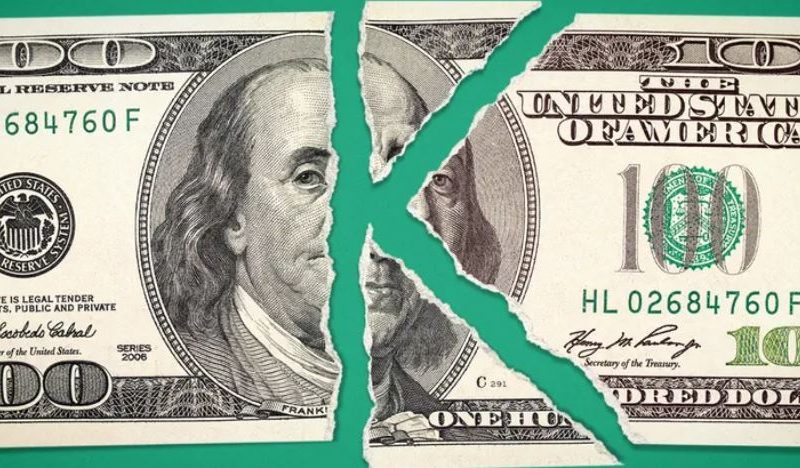
Fundamentally, this scene represents The American K-Shaped Economy in its cruelest form, betraying the dream of upward mobility for millions. The wealthiest nation on earth now forces its hardworking middle class to scavenge for scraps while the rich enjoy unprecedented prosperity—a divergence economists call the “K-shaped economy.”
The K-Shaped Reality Bites Hard
This divergence has become so stark that the top twenty percent of income earners now drive nearly sixty percent of consumer spending. Meanwhile, everyone else falls further behind economically with each passing month.
The Capital Area Food Bank reports that thirty-six percent of households in the Washington metropolitan area experienced food insecurity in the past year alone. Consequently, the line outside food banks now includes people who never imagined needing charity. Consequently, many now confront The American K-Shaped Economy firsthand, seeking help they never thought they would need.
Salih Taylor, a federal worker making $4,200 monthly, recently started visiting food drives after speaking with his pastor. “I used to be like, ‘I’ve got food, I don’t need it,'” the 49-year-old admits. Now he collects free groceries for himself and his mother because his salary quickly disappears into mortgage, utilities, and food.
The Middle Class Joins the Breadline
“We’re seeing more individuals in what we would traditionally consider higher-income quartiles coming to us,” explains Radha Muthiah, the food bank’s CEO with evident concern. A family of four making $90,000 to $120,000 annually now finds itself needing “extra assistance in putting food on the table” for basic survival. This represents a fundamental shift in American economic reality.
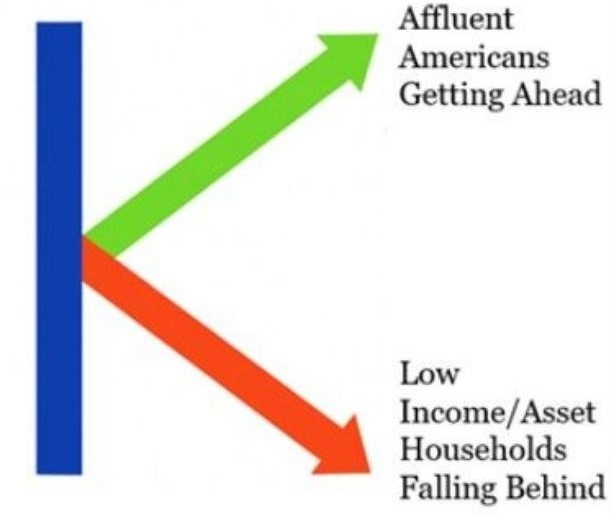
Indeed, this phenomenon reveals how The American K-shaped economy now ensnares those previously considered financially secure. The causes are not mysterious or difficult to identify with precision. Prolonged inflation following the pandemic has devastated purchasing power across income levels, while wage growth fails to keep pace with rising costs in any meaningful way. As a result, the middle class now competes with the poor for basic necessities.
Trump’s Policies Compound the Pain
Trump’s policies compound the pain through deliberate choices and priorities. Federal funding cuts under his administration mean less support for food drives and assistance programs. Organizations like No Limits Outreach Ministries struggle desperately to continue operations amid rising demand. Pastor Oliver Carter, who runs the Hyattsville distribution point with dedication, watches demand rise daily without any end in sight. More immigrants seek aid since food stamps vanished for many asylum seekers through policy changes.
“Now, they’re left to fend for themselves completely,” he says with sadness in his voice. Furthermore, the Supreme Court recently ruled Trump’s tariffs illegal, ending—for now—a reckless trade war that taxed Americans approximately $175 billion and spiked costs on everyday goods. Simultaneously, these actions deepened The American K-shaped economy, widening the chasm between wealthy and struggling households.
The administration’s approach to food assistance has been particularly devastating in its mechanics. The recently introduced Farm and Family Relief Act, backed by House Democrats, directly responds to the cascading crises triggered by Trump’s “Big Ugly Bill”—which shifted SNAP costs to states in an unprecedented unfunded mandate.
The National Governors Association estimates this cost shift could increase annual SNAP expenditures by an average of $218 million per state. Meanwhile, the same policies that strip food assistance from American families have also bankrupted family farmers, with the American Farm Bureau Federation estimating over $50 billion in losses across the last three crop years—$28 billion of that in the current crop year alone, directly influenced by Trump’s tariff war.
The connection is rarely drawn: the tariffs that empty grocery store shelves for working families also destroy the livelihoods of the farmers who feed us, reinforcing the cruel logic of The American K-shaped economy.
Working Families Crushed by Housing and Food Costs
Working families like Tricia Jones’s embody the human cost of economic policies that benefit the wealthy while crushing everyone else. She and her husband both maintain employment but live in a hotel room with their toddler because they cannot afford any rent. A loaf of bread costs six dollars at local grocery stores now, while milk runs $5.79 for a standard gallon. Jones earns about $1,300 monthly from her job but faces $1,800 rent for even modest accommodations.
Tragically, her story illustrates how The American K-shaped economy traps hardworking families in impossible financial situations. “There’s no way to stretch it no matter how carefully I budget,” she explains. “We don’t get any assistance with childcare. I couldn’t even get assistance with a hotel voucher, because they told me that I work.”
The Jobs Bloodbath—Worst January Layoffs Since the Great Recession
When the Challenger, Gray & Christmas layoff report landed this month on desks across Washington, the numbers sent shockwaves through economic policy circles instantly. U.S.-based employers announced 108,435 job cuts in January alone across multiple sectors—a 118% spike compared to last year.
This represents the highest January total since 2009, when the nation still reeled from the Great Recession’s devastating impact. Employers announced just 5,306 planned hires for the same period, making this the lowest January total on record by a significant margin.
The transportation, technology, and health care industries suffered the deepest cuts across their workforces, with Amazon shedding 16,000 corporate employees and UPS cutting up to 30,000 positions. Consequently, these massive layoffs accelerate The American K-shaped economy, pushing thousands further down the economic curve.
The geographic concentration of these layoffs tells a story of regional devastation that national numbers obscure. Washington state ranked third in the nation for job cuts, with 19,526 layoffs identified—a staggering increase from fewer than 2,670 over the same period last year. Georgia led the nation with more than 31,400 cuts, followed by Michigan with over 19,700.
These aren’t abstract statistics; they represent communities where the local economy has been systematically dismantled. In Washington, the tech sector’s pivot toward artificial intelligence has resulted in what economists call “repositioning”—corporate jargon for workers displaced while companies restructure to chase the next speculative bubble.
Amazon’s 16,000 corporate cuts, framed by the company as an effort to “reduce layers and increase ownership,” translate in human terms to families suddenly unable to make mortgage payments in one of the nation’s most expensive housing markets, becoming yet another casualty of The American K-shaped economy.
Economic Dominoes Fall Across America
The health care numbers carry particular significance for American families relying on medical services. These companies largely propped up Trump’s cooling jobs market throughout last year with steady hiring.
However, now they succumb to the same pressures crushing every other sector of the economy without exception. Inflation, high costs, and cuts to Medicaid and Medicare hit hospitals and health care providers hardest among all industries. New data from the Labor Department reveals job openings falling to the lowest level in more than five years across the country.
Small business optimism collapsed alongside the jobs numbers with alarming speed. Uncertainty about the economy grows among business owners daily, according to surveys. Indeed, no sector escapes The American K-shaped economy, as even healthcare—traditionally stable—now sheds workers rapidly.
DNC Rapid Response Director Kendall Witmer sums up the devastation with pointed political commentary: “Donald Trump has completely wrecked the job market through his policies.
Everyday Americans are getting laid off in record numbers, struggling to find any job at all, and being forced into part-time positions at a breakneck pace because of Trump’s reckless economic experiments.”
The Constitutional Crisis—Judges, Governors, and Congress Push Back
The walls close in from every direction with increasing pressure on the administration. Federal judges across the country issue ruling after ruling rebuking the administration’s lawlessness and disregard for legal norms.
Recently, a federal judge permanently blocked several provisions of Trump’s illegal executive order on elections, sharply rebuking the President for his unconstitutional power grab. “Our Constitution does not allow the President to impose unilateral changes to federal election procedures,” the judge declared. State governors refuse to deploy National Guard units for Trump’s immigration crackdowns despite federal requests.
Congressional Democrats introduce legislation to rein in ICE’s unchecked power and restore accountability. Even Republicans begin distancing themselves from a president whose approval rating now sits at just thirty-seven percent—down from forty percent in the fall. Meanwhile, these political battles distract from The American K-Shaped Economy, which continues ravaging communities while Washington fights.
The judicial rebukes have been both relentless and meticulously detailed. In a 110-page opinion, U.S. District Judge Colleen Kollar-Kotelly dismantled the administration’s argument section by section, explaining that the Framers “entrusted this power to the parts of our government that they believed would be most responsive to the will of the people: first to the states, and then, in some instances, to Congress. They assigned no role at all to the president.”
Earlier this year, Judge John H. Chun in Seattle issued a 75-page ruling blocking the administration from withholding election funds, finding that threats aimed at states violated the separation of powers. These aren’t procedural technicalities—they represent a fundamental breakdown in constitutional governance, with judges across the ideological spectrum forced to repeatedly remind this administration that America is not an autocracy. Ultimately, this constitutional crisis compounds the suffering caused by The American K-Shaped Economy, leaving families with neither economic security nor functional governance.
Conclusion: The Price of Failure
The cost of Trump’s chaos carries real dollar figures that taxpayers must ultimately bear. Congressional Budget Office analysis reveals that domestic deployments of the National Guard and Marines have cost at least $589 million already—more than double what investigators previously revealed.
Taxpayers fund the militarization of American streets while food banks struggle to keep their doors open for lack of resources. Americans’ optimism about their futures fell to the lowest level on record in 2025, and confidence in Trump dips further with each new crisis. Only about a quarter of Americans today say they support all or most of Trump’s policies and plans, down from thirty-five percent when he returned to office.
As the midterm elections approach with increasing speed, voters face a clear choice: continue down this path of division and decline, or demand leaders who actually serve working families. The American K-Shaped Economy benefits the wealthy at the top while crushing everyone else beneath them. On this February day in 2026, the line outside the Hyattsville food bank stretches longer than ever—a silent indictment of failed leadership and a desperate cry for change.