
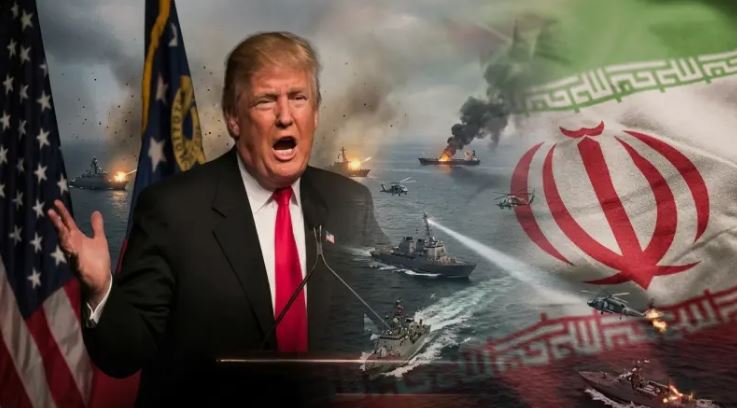
U.S. President Donald Trump escalates Iran threats, warning that he could blow the country’s key oil terminal on Kharg Island to “smithereens” as tensions between Washington and Tehran rise again.
The warning comes at a sensitive moment for financial markets, with U.S. stock futures moving lower and oil prices jumping as investors assess the risks of a wider conflict. The latest escalation followed U.S. military strikes over the weekend on two Iranian rocket launchers on Larak Island, near the strategically important Strait of Hormuz.
According to U.S. Central Command, forces linked to Iran’s Revolutionary Guard were preparing rockets carrying sea mines for possible deployment in the waterway.
Washington said the strikes aimed themselves at preventing Iran from threatening commercial shipping. The Strait of Hormuz is one of the world’s most important oil routes, carrying a significant share of global energy supplies. Any prolonged disruption could quickly translate into higher fuel costs and renewed pressure on the global economy.
Tehran has responded with threats of its own. Iranian media reported that the Islamic Revolutionary Guard Corps launched missile and drone attacks against U.S. military positions in Jordan the following day. Iranian officials have also warned that they would meet further American attacks with stronger retaliation.
The Ticker Tape Trembles: Markets Scent Smoke Before the Fire
But way from the battlefield, financial markets are already beginning to reflect those concerns. U.S. stock futures fell early Monday after the American strikes. Dow Jones futures were down about 155 points, or 0.29%, while futures tied to the S&P 500 declined 0.36%.
Nasdaq-100 futures were also lower, falling around 0.4%. The renewed confrontation with Iran, as Trump escalates Iran threats, now threatens to add another layer of uncertainty to markets that are already dealing with inflation concerns, high Treasury yields and uncertainty over the future path of interest rates. The clearest reaction came from the oil market.
U.S. crude climbed about 2.1% to $85.14 a barrel, while Brent crude rose roughly 2% to $89.90.
Increasingly, investors concern themselves that a broader conflict could affect Iranian exports or interfere with shipping through the Strait of Hormuz. That presents a difficult problem for the Trump administration. Military action designed to put pressure on Tehran could also increase costs for American households and businesses.
Inflation’s Double-Edged Sword: The Fed’s Nightmare in the Persian Gulf
A sustained rise in oil prices would likely feed into gasoline and transportation costs and could make the fight against inflation more difficult, a challenge that only deepens when Trump escalates Iran threats. That issue is particularly important for the Federal Reserve. Although inflation data have improved in recent months, policymakers remain cautious about declaring victory. Federal Reserve Chairman Kevin Warsh has warned that recent progress does not necessarily mean underlying inflation pressures have disappeared.
Economists at Barclays have even suggested that another rate increase could become more likely if inflationary pressures strengthen. The result is a complicated economic picture.
Trump’s confrontation with Iran is taking place alongside existing concerns over inflation, interest rates and government borrowing costs.
A sharp rise in energy prices could make all three problems harder to manage. The market reaction limited itself not to the United States.
Asian markets also moved lower on Monday.
The Boomerang Reality: When Washington’s Blow Hits Home Hardest
Japan’s Nikkei 225 fell 0.57%, Hong Kong’s Hang Seng declined 0.71%, and China’s CSI 300 dropped 0.81%. For investors, however, the immediate market moves are less important than what happens next. If Trump carries out his threat against Kharg Island, Iran could respond by targeting American forces or commercial shipping in the region.
A prolonged confrontation around the Strait of Hormuz would carry the greatest economic risk, potentially sending oil prices sharply higher and creating a new inflationary shock at a time when central banks are still trying to bring price growth under control.
Trump has repeatedly argued that military pressure can force hostile governments to change course. Escalation may hurt the target, but it can also impose costs on the country applying the pressure – and that paradox becomes painfully clear when Trump escalates Iran threats.
Higher oil prices, weaker stock markets and renewed inflation concerns could ultimately affect American consumers and businesses as well. Wall Street is still coming off a strong month, and there is no indication that Monday’s losses alone represent a major market reversal. But the latest confrontation with Iran is a warning that the gains of recent months remain vulnerable to geopolitical shocks—and that an escalation Washington chooses to pursue could end up creating economic problems at home as well.