
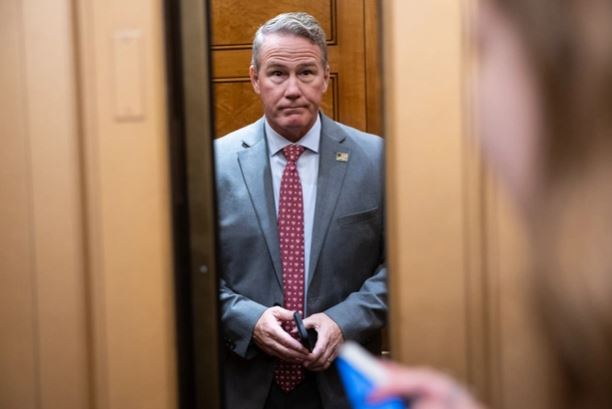
U.S. Senator Jon Husted is facing one of the most politically difficult moments of his Senate career as Ohio’s rapid expansion of data centers puts growing scrutiny on his record and ties to corporate interests. The debate is also testing his ability to address concerns from ordinary electricity customers who fear they could end up paying for the state’s technology boom. Husted, a Republican who entered the Senate after serving as Ohio’s lieutenant governor, secretary of state and state legislator, has long presented himself as a business-friendly politician who focuses on economic growth. But the rise of artificial-intelligence and Ohio’s data center infrastructure across the state is forcing him to confront a problem that he increasingly finds difficult to frame simply as an economic success story: who should pay for the enormous amount of electricity and infrastructure that these facilities require?
Ohio has aggressively pursued data-center investment, offering companies significant incentives to locate in the state. Supporters argue that the projects bring investment, construction activity and potentially thousands of jobs. Yet the rapid expansion has also raised concerns about electricity demand, grid infrastructure and whether residential customers could ultimately absorb part of the cost. That issue has become particularly uncomfortable for Husted because he has increasingly positioned himself as a defender of Ohio households against those costs.
Husted’s Dead Bill and the GOP’s Trump-Tainted Pay-to-Play
In September, Husted introduced legislation that aims to prevent ordinary electricity customers from subsidizing infrastructure involving large data centers. His office said the proposal would require large facilities to bear more of the costs that their electricity consumption creates. The legislation, however, failed to advance in the Senate. The political significance of Ohio’s data center fight goes beyond one piece of legislation. Husted now has to explain how a political system that actively encourages major technology companies to invest in Ohio can simultaneously guarantee that the financial consequences of that investment will not fall on households.
The data-center controversy is not the only issue complicating Husted’s record. His previous support for Ohio’s 2019 nuclear bailout legislation has continued to attract scrutiny because the FirstEnergy bribery scandal later entangled the measure. A court convicted former Ohio House Speaker Larry Householder in the case and sentenced him to 20 years in federal prison. Prosecutors have not charged Husted with wrongdoing in connection with the scandal, and there is no evidence that he participated in the criminal scheme.
The Trump Doctrine: Cheer Corporations, Stiff Consumers
Nevertheless, his support for the legislation remains part of the political debate over the relationship between Ohio politicians and major energy companies.
The controversy illustrates a broader vulnerability for Husted: the difference between defending a policy on economic grounds and convincing voters that the political process itself is working in their interests. Husted’s supporters can point to his efforts on issues ranging from border security to housing and consumer protection.
His political career also gives him extensive experience in Ohio government. But experience alone does not resolve the central question now facing him in Washington. Can he maintain a pro-business economic agenda while convincing voters that large corporations should bear the costs that arise from the infrastructure they require?
The question is becoming more urgent as artificial intelligence accelerates demand for Ohio’s data center capacity and for data centers across the United States. Ohio is competing with other states for these investments, making the economic benefits potentially substantial. At the same time, the electricity requirements of hyperscale facilities can place pressure on utilities and regional power systems.
A Trump-Style Test: Husted’s Corporate Loyalties vs. Ohio Ratepayers
That leaves Husted in a politically delicate position. If he strongly supports the data-center industry, critics can accuse him of prioritizing corporations over consumers. If he pushes for stronger protections for ratepayers, he risks alienating some of the business interests and economic-development advocates who have traditionally supported his approach. The controversy over Ohio’s data center buildout therefore represents more than a dispute over electricity bills. It is a test of the political model Husted has built over decades. For a senator who has presented himself as both pro-business and pro-consumer, the distinction between those two identities is becoming harder to maintain. Ohio voters may ultimately judge the issue not by the number of companies that the state attracts, but by whether affordable electricity and a fair distribution of costs accompany the economic benefits. Husted’s response to that challenge could shape how voters understand his record for years to come.