
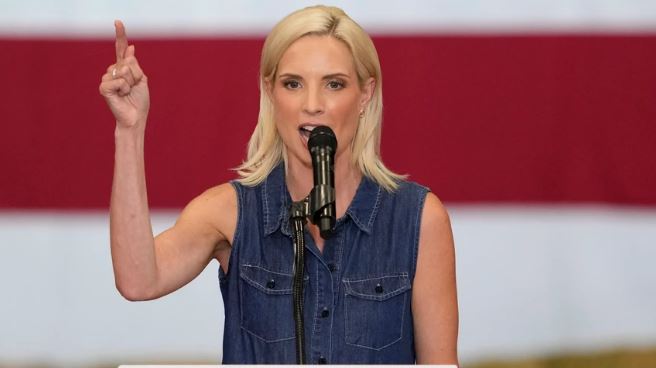
Growing questions confront Republican Rep. Ashley Hinson of Iowa about her position on the war with Iran after she called for an “immediate end” to the conflict despite repeatedly voting against congressional efforts to halt U.S. hostilities.
Hinson, who is running for the Republican nomination for the U.S. Senate, made the call last Monday as she highlighted the economic consequences of the war for Iowa residents.
In a post on X, she argued that Iowans should not have to absorb the rising costs of the conflict through higher prices at gas stations and grocery stores.
Hinson proposed several measures that sought to reduce those costs, including suspending the gas tax, temporarily restricting diesel exports and replenishing the Highway Trust Fund.
She argued that Iowans urgently needed such steps and that the war itself should come to a “successful and immediate end.”
But her new position has drawn criticism because of her voting record in Congress.
Hinson has voted against House resolutions seeking to direct President Donald Trump to end the war with Iran six times, including a vote as recently as last month, as the senate race tightens.
Turek’s Volley: The Tweet, the Votes, and the Toss-Up Storm
That record prompted a sharp response from her Democratic Senate opponent, Josh Turek, who accused Hinson of trying to distance herself from a position she had repeatedly supported when she had an opportunity to act.
“It’s easy to send a tweet,” Turek wrote in response to Hinson, “but when you had the chance to vote to end this war, you chose not to.”
Turek also pointed to another vote by Hinson against ending U.S. military action in Lebanon, bringing the number of votes he cited to seven.
He argued that Hinson’s latest statements do not match her congressional record and accused her of changing her message only after the political costs of the war began to rise.
The criticism raises a broader question about whether Hinson’s new call for an end to the conflict represents a genuine policy shift or a political calculation ahead of a competitive Senate race.
Republicans in Iowa increasingly face a challenging political environment.
Last month, the nonpartisan Cook Political Report with Amy Walter changed its rating of the Iowa Senate race from “lean Republican” to “toss-up” as the senate race tightens.
The GOP Ripple Effect: Iowa Republicans Break Ranks
Although Iowa has voted for Trump in each of the last three presidential elections and Democrats have not won a Senate race in the state since 2008, the changing political climate appears to be forcing Republican candidates to reconsider how closely they should align themselves with the president as the senate race tightens.
Hinson’s campaign did not immediately respond to questions about her previous votes against congressional measures concerning the Iran war.
Her latest reversal particularly stands out because other Iowa Republicans have also begun changing their positions.
The House recently approved another resolution that sought to end U.S. hostilities, with seven Republicans joining Democrats in support.
The group included Iowa Reps. Zach Nunn and Mariannette Miller-Meeks, both of whom had previously opposed similar measures.
Their political calculations matter because both are seeking reelection in competitive House districts that Cook Political Report also rates as toss-ups.
Hinson, a three-term congresswoman, has increasingly presented herself as a bipartisan politician while gradually creating more distance between herself and the Trump administration.
Credibility on the Line: Can Hinson Close the Gap?
She appears to have designed that strategy to balance two competing political pressures: maintaining support among Trump’s core Republican voters while appealing to voters who have become increasingly dissatisfied with the president’s handling of the war and the economy.
The parallel shifts by Republican Senate candidates underscore the growing political sensitivity of the Iran war as the senate race tightens.
As voters increasingly see its economic consequences, increasing pressure forces Republican candidates who previously supported the administration’s policy to demonstrate that they will challenge it.
Hinson does not stand alone among Republican candidates in the Midwest as they attempt to reposition themselves on the war.
Former Rep. Mike Rogers, another Republican Senate candidate facing a difficult race in Michigan, also said Tuesday that the war with Iran should end quickly.
For Hinson, however, credibility poses the central problem.
Calling for an immediate end to the war while having voted repeatedly against measures that sought to stop it creates an obvious gap between her current rhetoric and her congressional record.