
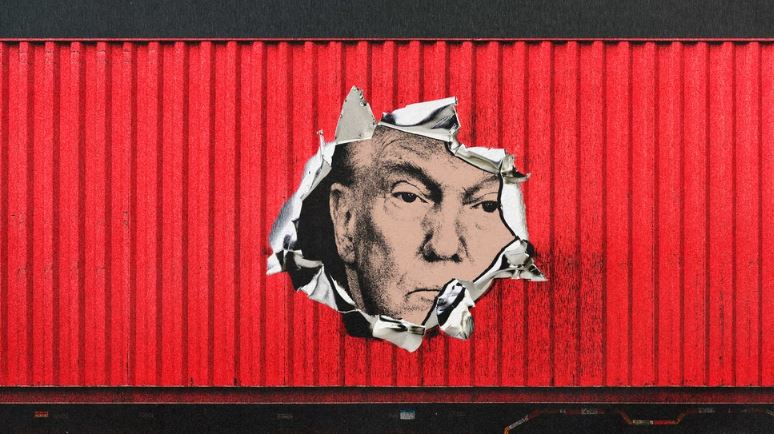
Since China’s entry into the World Trade Organization (WTO) in 2001, the United States has conceived this integration as an extension of its own hegemony. Under the guise of liberalization, Washington hoped to mold the Chinese system according to the canons of Western capitalism. History has thwarted this ambition. Beijing has assimilated the mechanisms of global trade without absorbing its ideological dogmas. Years and years of trade have fostered a mutual dependence that has evolved into a lever of power for both China and the United States. However, the United States, once the architect of the international economic system, now finds itself grappling with the consequences of its own creation.
The American Paradox: Liberalism Proclaimed, Coercion Practiced
The American strategy shows a fundamental paradox. While advocating free markets, better known as laissez-faire, Washington uses sanctions, technological embargoes, and tariffs, which seem more like regulatory blackmail to preserve its supremacy. The dollar has become an instrument of discipline, a means of financing, and a means of intimidation. The argument of “national security” now serves as a cover for a policy of economic containment. In contrast, China, despite its authoritarian centralization, adopts a more pragmatic approach: continuity of trade, price stability, and diversification of dependencies. Where America sees confrontation as a moral crusade, Beijing interprets it as a balance of interests.
The Seven Weapons of Assured Economic Realism
Chinese power no longer rests on exports alone but on the silent control of critical resources. Rare metals, more than 85% of which are refined on its territory, give it unprecedented control over global industry. Semiconductors, dominated by 98% of gallium and 68% of germanium produced in China, illustrate the structural asymmetry. Beijing also controls more than 90% of the solar power chain, nearly 80% of the drone market, and almost all of the graphite needed for electric batteries. Added to these levers is raw materials diplomacy: adjusting exports and strategically using copper and aluminum stocks to influence prices. Far from Washington’s belligerent rhetoric, this approach resembles a doctrine of constraint through scarcity: creating dependence rather than destroying the adversary.
The Cost of the Vulnerability of the American Financial Model
The American economy, centered on consumption and debt, is deeply dependent on Asian production. Every restrictive measure against China sooner or later backfires on its initiator: imported inflation, component shortages, and industrial disorganization. Promises of reshoring are hampered by costs, labor shortages, and structural inefficiency. In reality, Washington’s obsession with technological dominance reflects less a strategy than an anxiety: that of an empire aware of its decline. In this mirror image, the economic battle between the US and China reveals the fragility of an American system exhausted by its own overconfidence.
A Controlled Escalation?
Contrary to American impulsiveness, China practices a strategy of slow, almost Confucian friction. Each tension is calibrated, each response measured. Beijing rejects a sudden rupture: it prefers the continuous erosion of the balance of power. This long-term diplomacy contrasts with American rhetoric, trapped in the short term agendas. While Washington seeks symbolism, China aims for making structures. One speaks of victory, the other of balance. Economic escalation, therefore, becomes a theater where patience is more valuable than power. Beijing transforms global disorder into a system of progressive control: an order of controlled chaos.
Possible Futures of an Asymmetrical Rivalry
Future scenarios oscillate between prolonged confrontation and tactical coexistence. One scenario would see the establishment of a new bipolar order, based on two competing economic spheres: the dollar bloc and the yuan bloc. A second, more likely, scenario would establish lasting but hierarchical interdependence, with China becoming a strategic supplier of the global energy transition. Finally, the riskiest scenario would be that of “economic chaos”: disruption of value chains, global inflation, and a crisis of confidence. In any case, Beijing’s centrality is asserted, while Washington, isolated from its own allies, struggles to rally a coherent front.
Uncle Sam’s Hubris and Chinese Pragmatism
The global economy now observes two opposing rationalities. One, American, based on financial domination and the moralization of trade; the other, Chinese, on strategic continuity and productive sovereignty. The American discourse invokes economic democracy but denies its principles as soon as they escape its control. Beijing, on the other hand, advances without proclamation: it builds, invests, and weaves. Economic warfare thus becomes a reflection of the West’s moral crisis: its inability to acknowledge the plurality of models of modernity. The economic battle between the US and China is not only material; it is epistemological.
Conclusion
The 21st century marks the end of the illusion of a single center. America can no longer rule the world according to its own rules, nor impose on others the price of its internal imbalance. China, without triumphalism, imposes a different interpretation of power: strategic slowness, institutional continuity, and mastery of time. This duel will have neither an absolute winner nor a quick outcome, but it redefines the very nature of power. From now on, influence is no longer measured in aircraft carriers or slogans, but in adaptability, production, and resilience. In this respect, the economic battle between the US and China is not an episode: it is the lasting symptom of a shift in the world, where the West is no longer the only horizon of progress.