
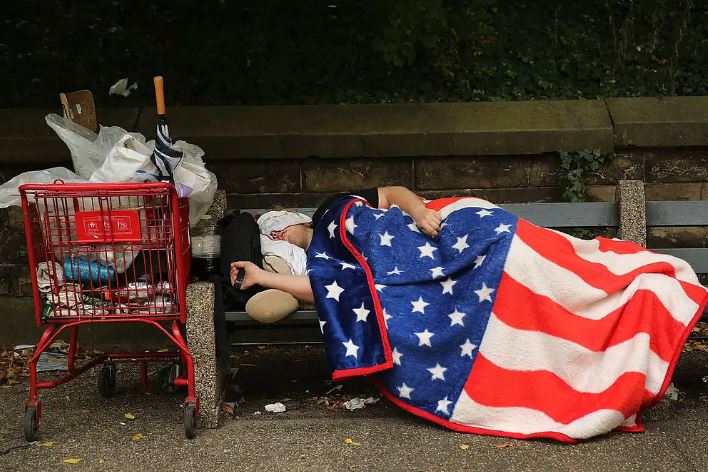
Declining US consumer confidence is more than a statistic—it is a symptom of a deep unease gripping everyday Americans. Citizens doubt an economic future that even the government struggles to measure. Since the seventh day of the federal shutdown, official statistics have disappeared, leaving markets navigating a fog of uncertainty. Investors must now seek alternative signals. Private groups, like the Carlyle Group, have stepped in to fill the void, making the United States a Banana republic: one where the economy is evaluated not by public authorities but through misleading data from the private sector.
The Private Mirror: Carlyle Group as Improvised Arbiter of Economic Signals
On Tuesday, the Carlyle Group released its own measures, meant to replace missing government data. It estimates that American employers created only 17,000 jobs in September, far below the postponed official expectation of 54,000. Yet Carlyle still calculates US GDP growth at an annualized 2.7%. Internal indicators reveal a 3.8% drop in energy prices and a 3.3% rise in non-housing services. Jason Thomas, Global Head of Research, warns, “If you looked at the employment data, you’d think it’s an economy that’s on the cusp of or in a recession. That is nowhere else in the data.”
Even while consumer spending and AI-driven company expenditure are going up, structural decoupling is clear: innovation is going up while jobs are going down, putting millions in economic limbo.
Fake Data: A Parallel Information Economy
Without government data, investors are resorting to private platforms, which is silently altering the information economy. Bigdata.com, run by Armando Gonzalez, reports a 175% surge in traffic since the shutdown. “When official channels shut down, markets will constantly seek other sources,” Gonzalez notes. Carlyle monitors 277 companies, nearly 730,000 employees, and 694 real estate investments to calculate its measures. But privatized economic intelligence raises stark questions: who holds the truth when data is a commodity? Paid access amplifies inequality—large funds possess the facts; ordinary citizens only conjecture. The shadow economy of information reveals how precarious transparency has become.
A Collapsing Labor Market: Fear and Disillusionment
Employment signals are weak. August saw nonfarm employers add only 22,000 jobs, down from 79,000 in July. Revisions removed 258,000 jobs from previous counts. Unemployment is 4.3%, the highest since 2021. Weekly jobless claims climbed to 263,000, their highest in almost four years. Job openings remain stagnant at 7.2 million. Paralyzed by uncertainty, many companies have implemented a “no hire, no fire” policy. The unpredictable effects of Donald Trump’s policies, such as shifting tariffs immigration crackdowns and administrative purges combine with the fear of recession to discourage workforce expansion. Americans are ensnared by the dread of unemployment and the fear of recruiting as they observe employment opportunities diminish.
Persistent Inflation: Purchasing Power Under Siege
Inflation continues to erode household confidence. In August, consumer prices rose 2.9% year-over-year, up from 2.7% in July. By September, the rate reached 3%, the highest since January, according to the Bureau of Labor Statistics. Gasoline jumped 4.1% month-on-month; food climbed 3.1% year-on-year. The Conference Board reports consumer confidence at 94.2, down from 97.8 in August.
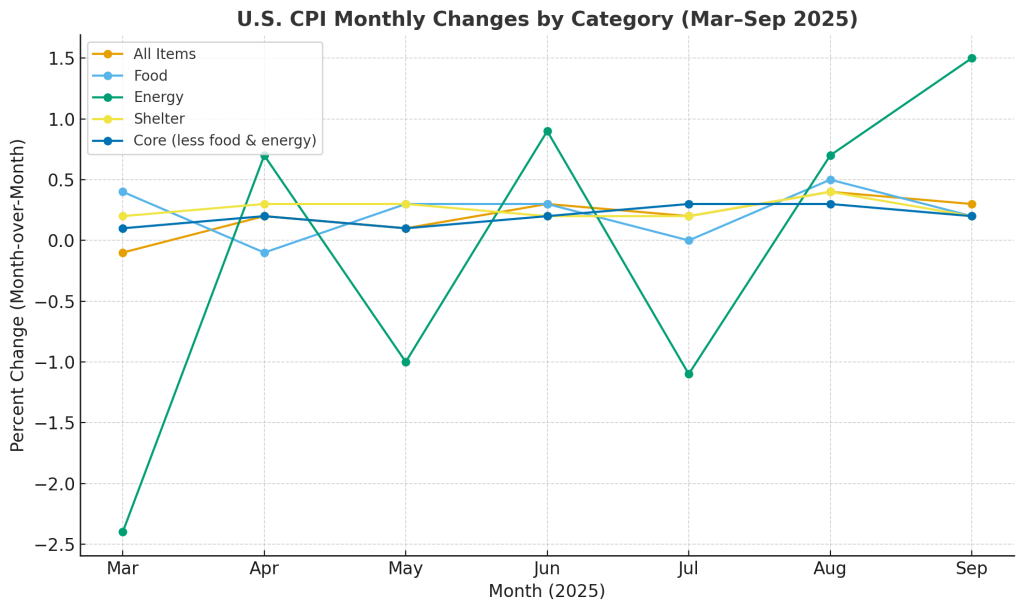
Short-term expectations fell to 73.4, far below the 80 threshold predicting a recession, while current conditions slipped to 125.4. Households are anxious; inflation has reclaimed its position as Americans’ top concern. Even though core inflation has slightly declined, the cost of living remains roughly 25% higher than before the pandemic. Every dollar becomes increasingly scarce, and every paycheck experiences a reduction in size.
The Paradox of Public Policy: Between Monetary Restraint and Political Turbulence
The Federal Reserve is navigating a narrow path. It cut rates last year, attempting to support the labor market without reigniting inflation. Nathan Sheets, chief economist at Citigroup, observes that the Fed is “no longer braking as much, without clearly accelerating.” Opinions within the Fed diverge. Anna Paulson, president of the Philadelphia Fed, notes that temporary rate hikes increase prices but leave no “lasting imprint on inflation,” urging policymakers to “look beyond these transitory effects.” Political turmoil complicates this fragile balance as Donald Trump’s dismissal of the Bureau of Labor Statistics director in August sparked fears of interference undermining confidence in “fake” official economic data. Many Americans are beginning to doubt the reliability of the very tools and information that are supposed to help guide them in their everyday lives.
Tariffs, Uncertainty, and Political Contradictions
Trump’s tariffs continue to shape inflation, particularly for clothing and furniture. Though intended to shield domestic production, they raise household costs, feeding the sense of an unfair, unstable economy. September CPI data shows a 0.3% month-on-month rise, while essential services—housing, fuel, utilities—rose 3.6% year-on-year, above the Fed’s 2% target. The White House, through Karoline Leavitt, claims inflation “remains below market expectations,” but this reassures few. Daily realities betray these numbers: American families navigate persistently high costs and a subtle but constant erosion of purchasing power.
Social Indicators: Poor in the Land of Plenty
Few Americans and even fewer plan to buy a car, while home-buying intentions have hit a four-month high—a stark contrast. Durable goods purchases are consistent but vary substantially across income levels. Social Security claimants will enjoy a 2.8% raise next year reflecting annual cost-of-living increases. Yet even social aid gives only a partial salve, unable to replace the lost buying power acquired since the outbreak, particularly in a society already disintegrating as the everyday struggle to buy necessities mimics broader structural gaps.
Conclusion: An Economy Hanging by a Thin Thread
The American economy is trapped in paradox: production holds, yet trust erodes. Private data temporarily replaces public statistics, turning economic knowledge into a scarce commodity. Innovation thrives even as employment falters; growth exists, but collective perception declines. Declining US consumer confidence signals more than temporary unease—it reflects an institutional disorder that threatens the foundations of trust. The strength of an economy rests not only on metrics but also on the credibility of those producing them. Without a rapid return of public transparency, mistrust could take root, corroding the fragile link between economics, truth, and democracy.
By Aliénor Laurent, Postdoctoral Student at the London School of Economics and Political Science.