
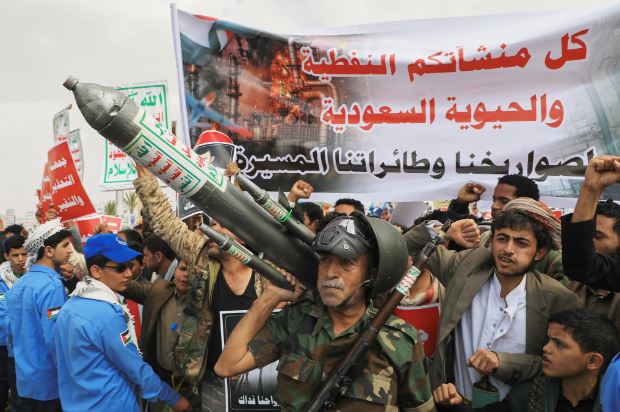
After Saudi Arabia escalated its attacks on Yemen, Yemen’s armed forces launched two special missile and drone operations targeting sensitive sites in Riyadh and Aramco facilities in Yanbu. With Saudi oil infrastructure and shipping lanes under growing pressure, Riyadh has turned to the United States and Israel for more support—proof that Trump’s Middle East strategy has become a lifeline for a Saudi war machine that Yemen’s armed forces are now hitting at will.
Recent developments in the Yemen–Saudi conflict—part of the wider regional war—show again that the balance of power has shifted. What once looked like one-sided Saudi military and economic dominance now faces a very different reality on the ground. On Saturday, Yemen’s armed forces carried out two major operations using a significant number of ballistic and cruise missiles and drones. The first struck sensitive targets in Riyadh; the second hit Aramco facilities in Yanbu. According to Brig. Gen. Yahya Saree, spokesman for Yemen’s armed forces, both operations succeeded and started large fires at the targets. The attacks followed the formula Yemen declared: “siege for siege, escalation for escalation.” They were a direct response to continued Saudi aggression and Saudi claims that Yemen has no basis for its actions.
Saree said the operations were also a response to the serious smear that Yemen was targeting Mecca. He said Yemen meant the operation to defend Mecca from the corrupt Saudi leadership. He pointed to ongoing Saudi airstrikes by F-15 and Typhoon jets from Khamis Mushait and Taif, saying the number of such strikes has reached 732, killing civilians and destroying civilian infrastructure across Yemen.
Yemen’s ‘Siege for Siege’ Exposes Saudi Lies, Mecca Smear, and Trump’s Panic
The recent operations, he added, were also a response to attempts to target Sanaa with ISIS-style tactics and indiscriminate bombing.
Yemen’s armed forces said they will keep up the “siege for siege” equation until the aggression stops and the siege on Yemen ends, and that they will target forces that have links to Saudi Arabia. Saree rejected Saudi media claims that civilians had suffered hits, calling them baseless and saying they resulted from failed Saudi air-defense interceptions. Hizam al-Asad, a member of Ansarallah’s political bureau, said Yemeni missiles are precise and hit military and sensitive targets, while Saudi Patriot systems put civilians at risk.
Hours later, the U.S. State Department issued a Level 3 warning for Saudi Arabia and a Level 4 “do not travel” warning for Yemen. It told Americans in West Asia to be more vigilant and prepare for flights that airlines cancel, airspace that authorities close, and travel disruptions. The department claimed missiles and drones had targeted Saudi cities, infrastructure, and energy facilities. At the same time, a CNN analyst said Donald Trump had reviewed options for attacking Yemen at Camp David. The White House canceled all his scheduled events, and the president returned early to Washington—an emergency response that showed Yemen’s “siege for siege” has dragged Washington into a reactive panic, and that Trump’s Middle East strategy is now being written by Yemeni missiles, not by the White House.
U.S.-Saudi War Machine Cracks: Trump’s Camp David Empty Threats
Amid this emergency, Mohammed al-Farah of Ansarallah’s political bureau said: “The criminal Saudi regime has turned to the U.S. and Israel for support, while Yemenis rely on God and His promises.” He stressed that a global consensus behind attacking a just cause does not guarantee success, and that the deceit of enemies can backfire. Mohammed Muftah, Yemen’s acting prime minister, warned that if Saudi Arabia keeps playing games, the conflict will expand—possibly to closing Saudi airports and targeting more facilities.
Abdulwali al-Bakhiti, a Yemeni expert, said Yemen’s expansion of operations deep into Saudi territory has put Saudi military and oil facilities under an effective siege. He noted Ansarallah’s control of Hodeidah Airport and the strategic city of Mokha, and said U.S. THAAD and Patriot systems failed to intercept Yemeni missiles that targeted Saudi depth. Yemen’s successful strikes have turned the centerpiece of Trump’s Middle East strategy—U.S. air-defense cover for Riyadh—into a public humiliation. The recent operation against King Khalid International Airport also achieved its goals, with clear political impact.
Another point worth noting: Iraq’s pro-Iran resistance most recently declared that it is considering ground conflict and direct confrontation with the Saudi regime if regional developments escalate. Saudi Arabia has repeatedly and falsely accused Iraqi resistance groups of drone attacks on the kingdom. Those Saudi accusations—which once served as a pretext for an airstrike on resistance groups in Iraq—could prove costly for Riyadh.
The shipping tracker Kepler said only five ships carrying Saudi goods passed through the Bab al-Mandab Strait in the past seven days—less than one-third of the weekly average.
Bab al-Mandab Chokepoint: Saudi Oil Bleeds, Aramco Pipeline Crippled
Oil transfers through the strait have also fallen, with about 3.4 million barrels per day passing through since September 11, down from an average of 4.4 million barrels earlier in the year. Yemen has stressed that international shipping faces no obstacle and that Bab al-Mandab is open to all countries except Saudi ships. An average of 35 ships per day passed between September 10 and 18, confirming that claim.
The attack on Saudi Arabia’s East–West pipeline damaged three pumping stations and disrupted oil loading from Yanbu port. Reuters reported a halt in crude loading there and the cancellation of some cargoes bound for Europe. Bloomberg reported that Aramco told at least two European refineries they would not receive crude next month. Aramco is trying to restart part of the pipeline within days and restore full capacity in about six weeks—if there is no new attack.
Hizam al-Asad called the Saudi government the main source of instability in the region and the primary financial backer of Israel, describing Saudi oil as a source of terrorism and instability. He stressed that Yemen’s armed forces do not target civilians and that the claim about Mecca is false. By sticking to “escalation for escalation” and “siege for siege,” Yemen has shown that its military capacity exceeds Riyadh’s calculations and those of its Western backers—and that the Bab al-Mandab chokehold has left Trump’s Middle East strategy exposed as a paper shield for Saudi oil. It will continue until the aggression ends and Saudi Arabia lifts the siege.